Review: Nancy Drew: Secrets Can Kill
|
Nancy Drew: Secrets Can Kill Developer: Her Interactive By Audrey Wells 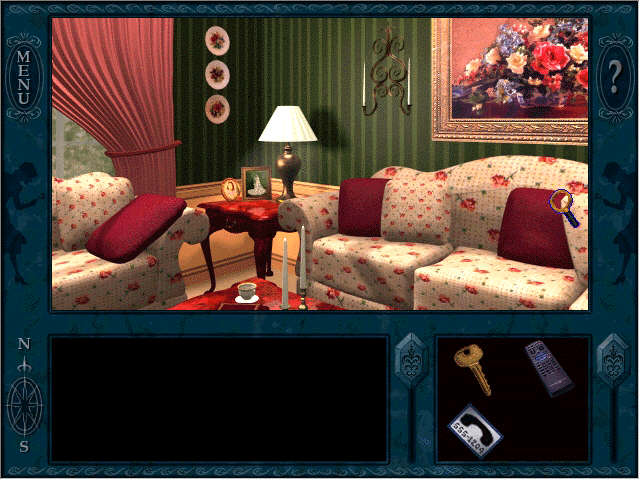 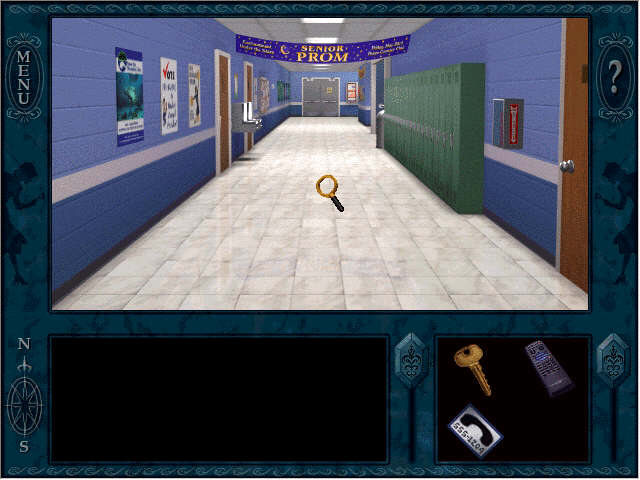 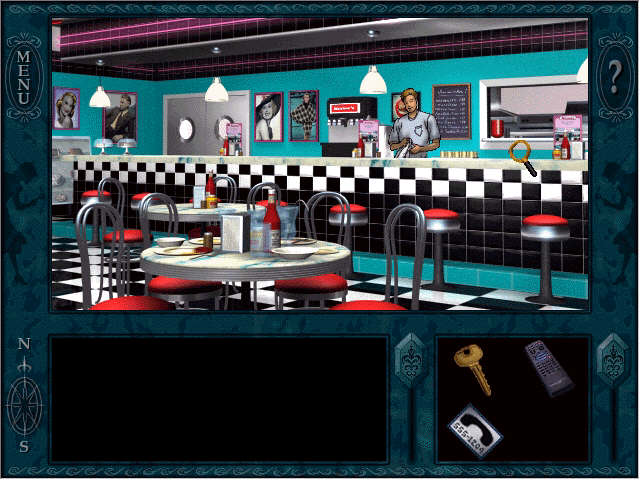 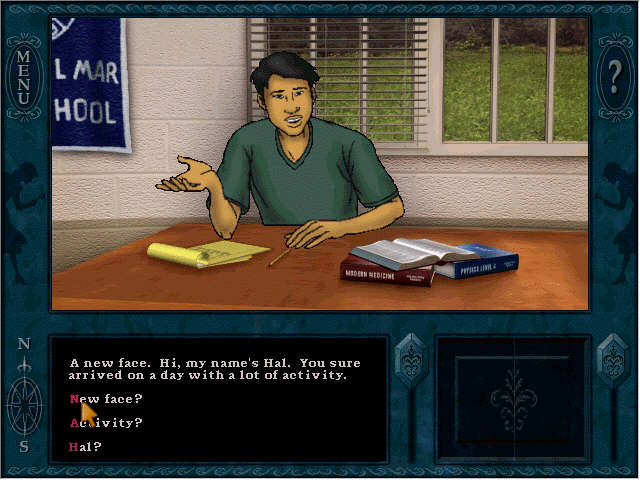 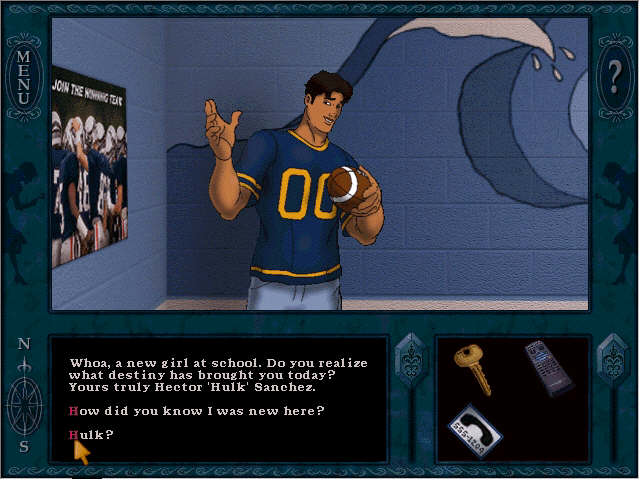 |
The first game in the Nancy Drew series by Her Interactive, Secrets Can Kill, is designed especially for “adventurous girls” over the age of ten. Quite honestly, Her Interactive has pulled it off nicely. This is clearly not a painful Barbie dress-up or makeup game, but a pure adventure mystery intended to make young players use their wits and draw conclusions about the mystery that Nancy Drew has set out to get to the bottom of. Of course, you need not be a young girl to play this game–I would encourage young boys and adults of both genders to try it out as well.
Secrets Can Kill commences when Nancy visits her Aunt Eloise, the local high school librarian, in Florida. As expected, a new case manifests itself–a student named Jake Rogers was mysteriously murdered the night before at the Paseo Del Mar High School. And all four of the students loitering around seem to be awfully tight-lipped when Nancy pries too far into their knowledge of Jake Rogers, perhaps even keeping secrets that can kill! Though the plot is not especially gripping, it is unquestionably interesting, especially for the younger players.
The graphics of Secrets Can Kill are a nice blend of 2D cartoon characters against 3D environments. Even a couple of years after the game’s original release, I found the graphics pleasing to look at and relatively high-caliber. To some extent, the 2D cartoon characters are a lot more expressive and natural looking than 3D characters could be at the time. (3D characters typically end up looking like stiff puppets, though the technology is undoubtedly getting better by the minute!) You guide Nancy around the detailed 3D-rendered world with her patented magnifying glass. Clicking and holding when it is highlighted blue will allow you to pan 360 degrees around the environments, while the red-highlighted magnifying glass will allow you to interact with the environment. The panning is a bit jerky, even on my powerful computer, but the graphics are crisp and clear.
The music is nice and often full of atmosphere and dripping with intrigue. When there is something dangerous in a room (such as a impending explosion), the music reflects it and makes everything feel more ominous. The voice acting overall is well-done, though Nancy’s voice is a bit annoying and sluggish.
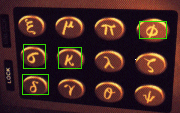
The puzzles in this game are pretty easy, even when playing at the “Master” or “Senior” difficulty levels. This is essentially a good thing, however, since you have to remember that this is a game designed for children–that manages to appeal to adults as well. The hardest puzzle is a slider puzzle, and even if you hate sliders, a bit of perseverance will reward you. (On a side note, I also tried the “Junior” level and found few differences, except that the slider puzzle has fewer pieces). A lot of the “puzzles” consist of coded messages scattered about the game, which I will discuss (or complain about, rather) in a moment. The rest are the usual inventory ones, to just use objects in the right places, and a handful of combination locks that Nancy has to crack. The game is easy overall, but just right for a light gaming experience for an adult and a nice challenge for younger, less-experienced gamers.
One of the few complaints I have, as I mentioned a moment ago, involves the way the majority of the clues were placed into the game. I lost count of the number of times the designers created a “secret” phrase or sentence by highlighting specific letters of say, a menu in Maxine’s Diner, a book in the school library, or a poster on one of the school’s bulletin boards. These phrases spelled out things like “DON’T RUN NANCY” and other absurdities. Other tactics included random memos of jumbled letters that had to be deciphered to some extent. Some of these clues were relevant and gave away more specific solutions to puzzles. However, I found nearly every instance of this unrealistic and contrived–who would go around the community scattering trite warnings and scrambled hints to problems in the game? It ended up detracting from immersion in the game, and I felt it was merely a scheme to prolong gameplay because I wasted time making sense of most of them. It ended up being completely unnecessary since the same information can be found much more quickly by carefully questioning the students. On the other hand, it is nice to have an alternate source for hints, and I suppose these types of hints might be good for younger players, but I wish it weren’t so obviously artificial. Whatever happened to finding the real evidence–such as fingerprints, hairs, and fibers? That would be much more fun.
Fussy nitpicking aside (I am a reviewer, you know), I did enjoy playing Secrets Can Kill. If you’ve never played it yourself or are looking for a gift for a special child in your life (I do want to emphasize that this game is suitable for male players as well as female ones), Nancy Drew: Secrets Can Kill makes for an affordable and fun gaming experience.
Final Grade: B
If you liked Nancy Drew: Secrets Can Kill:
Play: Nancy Drew: Message in a Haunted Mansion
Read: Any of the Nancy Drew novels
Watch: Nancy Drew and the Hidden Staircase
System Requirements:Windows 95/98/ME
166 MHz Pentium processor (200 MHz recommended)
16 MB RAM (32 MB recommended)
42 MB free hard disk space (220 MB recommended)
8X CD-ROM drive (16X recommended)
DirectX compatibility