Review: Morpheus
|
Morpheus Developer: Soap Bubble Productions By Craig White and Randy Sluganski
     |
Welcome to the very first Just Adventure Double Review (for lack of a better name). This will give you a chance to hear an opinion from two generations of gamer: the Generation X (played out by Craig White) and the Baby Boomer Generation (carried out by the old and frail Mr. Sluganski). Please be sure to raise your voice so that Randy can hear you. Randy! Wake up!
Both Randy and I got the chance to play Morpheus and we have two different opinions as we expected. Wait a minute … maybe they aren’t so different after all. Please feel free to read Randy’s review and then continue on to read Craig’s much younger opinion. In both cases, Morpheus was appreciated and was a very enjoyable experience. Quickly, read what Randy has to say before he dozes off again.
Randy’s Review
According to The American Heritage Dictionary, Morpheus is “the god of dreams and of the forms dreaming sleepers see, now existing in popular literary allusion as the god of sleep, or sleep itself.” To quote the bard of “adventure” literature, “To sleep, perchance to dream,” but you may not want to dream after playing Piranha and Soap Bubble’s latest release, Morpheus. If you are a fan of Amber, Lighthouse, Myst and their ilk, then Morpheus is the concoction needed to warm your intellectual soul on a dark, dreary evening. This is not a hunt-the-pixel, add another item to your bulging inventory game. Nor is it an animated romp with Disney-esque graphics. Rather, Morpheus is a game of discovery, logic and observation. You must immerse yourself into the moody atmosphere and the ambient sounds of the game. You must mentally transmogrify yourself to think and behave as each individual in the game would, or you will forever wander hopelessly in their dreamworld.
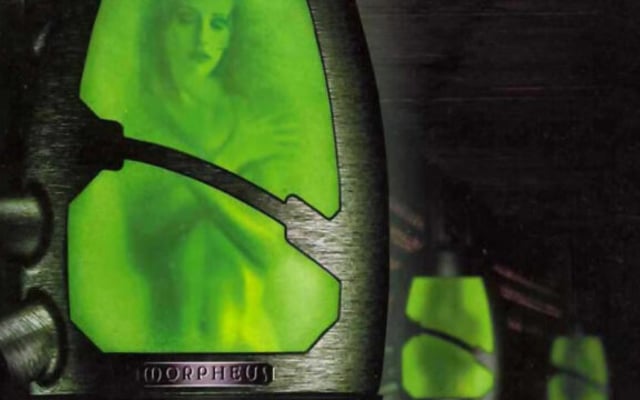
The Plot: Your adventure begins as you find yourself aboard an icebound ship in the Arctic. You are known only as “the explorer” and you are in search of the truth behind the disappearance of your father some twenty-five years ago. As the Arctic wind whistles about and you squint your eyes to prevent snow blindness, you spot a ghostly apparition–the first clue that this ship may be the Herculania (think Titanic), a famous ship that disappeared during its maiden voyage. Your first task is to figure out how to restore power to the frozen vessel, and once this feat has been accomplished, your destiny beckons as you attempt to solve the dual mysteries of your missing progenitor and the surprising discovery that there were special guests aboard the Herculania. As you will discover early in the game, these special guests were unknowingly part of a dangerous experiment conducted by a Dr. Malherbe, and now you must enter their long-dormant dreamworlds and attempt to finish what was interrupted many years ago. If you have played Amber (one of my all-time favorite games), then this part of the plot will be familiar. But whereas in Amber you had to don a special helmet to enter the dreamworlds of the apparitions, Morpheus incorporates a machine called the Neurographicon. As you find the serum that belongs to each character, you then enter a machine that resembles an Iron Maiden to begin your phantasmagoric journey. One of the more impressive aspects of the depth of the plot is the characterization of each ship passenger. You must become familiar with their individual interests and peccadilloes if you hope to advance the storyline. This familiarity with these character’s lifestyles and dreams adds a rich complexity not found in many of today’s games. All is not doom and gloom though; there are some nice subtle touches of humor in the game (a marred Honus Wagner baseball card in Billy Mexler’s stateroom) and some not-so-subtle humor (the bidet scene is classic). The plot receives a grade of A.
The Graphics: Morpheus’s graphics are for the most part what have been come to be known as “Myst-like” graphics. There is full 360-degree panning and seamless animation. Movement is accomplished via the traditional left mouse click on an arrow on the screen. While the graphics for the most part are crystal clear, I did experience some pixelation during some transitions (I played on a 200 MMX Pentium with a Voodoo 1 card and 96 MB memory). Many scenes have a surreal, almost dreamlike quality to them (this would, of course, be in keeping with the nature of the plot). There was only one occasion where I encountered insufficient graphic quality that caused a problem and that was in a grotto cave in one of the dreamworlds. Of course, part of the problem was also caused by my well-documented frustration with mazes (for fellow maze haters, the grotto cave maze is very, very short). What really stands out, though, is the quality of the video during the flashback sequences. They have an eerie feature to them that make you feel as though you are really eavesdropping on a conversation among spirits. If you have played The 7th Guest or The 11th Hour, then you are already familiar with this effect. Morpheus seems to have specific hot spots on the screen that trigger these sequences, and most of them can and must be viewed many times in order to catch the audio and visual clues that are supplied. The graphics for Morpheus receive a grade of A-.
Sound, Music, Voice Acting: As Morpheus begins, you are standing on the deck of a frozen ship, and as you turn and look at the blanket of snow that envelops the landscape before you, the eerie sound of the whistling, almost whispering wind sets the tone for the sound effects in the game. They are without par. At times they are probably too realistic. Do we really need to hear another realistic vomit effect? The music also is never intrusive. It always seems to set the tone for the scene. The music is light and airy when it needs to be and deep and melodramatic at all of the appropriate places. The voice acting, though, is the clincher. Never did I find it to be overly melodramatic. Even the voice-over of your character, the explorer, has a questioning aspect to it just as we would if placed in the same situation. The sound, music, and voice acting for Morpheus all receive a grade of A.
The Puzzles: As any true adventure gamer knows, the most integral component of any game of this genre is the adventure and the puzzle solving. Morpheus has enough puzzles for two games. Morpheus has puzzles within puzzles. Morpheus has too many difficult puzzles! The puzzles are always fair and they always make sense after you have solved them, but the nonlinearity of the game once you have activated the ship and the immense amount of information and clues that are available for digestion via exploration and flashbacks makes for a mountain of information. Perseverance, note-taking and repeat viewings of the flashbacks all become vital to complete the game. The complexity of some of the puzzles, even early in the game when you need to figure out the three-digit codes to the passengers’ staterooms, can leave you frustrated. But this is also one of those games that will invade your thoughts while you are not playing as you suddenly realize that innocuous objects are clues when placed in context with their owner. While the flashback sequences are not interactive, they are integral to the plot and also provide essential verbal and visual clues to further the puzzles along. Unlike the video clips from The 7th Guest and The 11th Hour, which were nothing more than a movie cut into small parts, the clips in Morpheus almost always provide a clue to the storyline. The puzzles in Morpheus receive a grade of B.
Is Morpheus for everyone? No. It is one of those games that the major gaming magazines will scornfully review as being too obtuse or as committing that unpardonable sin of having (gasp) full-motion video. It is also not for beginners. There are some minor problems with the gameplay. Occasional disk swapping between the three hybrid CDs mar the suspense in some scenes, and it would have been great to have a map to click on to take you instantly to a room that you had already visited. Instead, you must constantly walk around looking for the elevator or stairs to take you to the next floor. This became frustrating at times when I would remember something I saw on the other side of the ship and had to go through endless clicking to return to that spot.
What Morpheus is, though, is a solid adventure game experience wherein the sum of the parts add up to an engrossing, challenging whole. The conclusion wraps up the game nicely and makes it all seem worthwhile. It is really a feeling of satisfaction to complete this game. It does not jump on the new action/adventure bandwagon that seems to be prevalent in almost every adventure game coming out this fall/winter. Morpheus is an adventure experience for those gamers crying out for a return to pure adventure.
Randy’s Final Grade: A-.
Craig’s Review
Morpheus. It’s not a sequel. It’s not a clone. And you won’t need a 3D card to play it. It’s a plain and simple immersive and compelling adventure game we all want to play.
What’s the appeal? Great graphics, absorbing storyline, interesting characters … I could go on, and I will. Put simply, Morpheus is a massive game that pulls you into the story, into the dream worlds, and the feeling of accomplishment stays with you long after you’ve taken the last disk out of the CD drive and placed the box into storage.
The Plot: The game starts off with a video of “the explorer,” Matthew Holmes, as he records a journal entry into his tape recorder. He explains that it’s been days since he’s last seen his crew of men–separated in a blizzard. He then enters a sleep and visions appear in his head. Visions from other people’s dreams, not of his own. What are they? Whose dreams are these? He awakes to find that the blizzard has calmed down, and he sees a shadow cast nearby. What is it? As he moves closer, he sees it’s a ship frozen in the ice of the Arctic. Could it be the Herculania?
You take control of the explorer from here. Inch by inch, you solve puzzles and dig deeper into the story. As the game progresses you meet new characters, or rather the ghosts of their characters, and find the appropriate three-digit codes to enter their staterooms. Once inside a stateroom, more secrets are revealed and the mystery of Morpheus is more tangled than before. Don’t fret, though. In a matter of time things begin to make sense and the game comes to a satisfying conclusion. The plot of Morpheus receives an A.
The Graphics: Morpheus is seen through a 360-degree 3D environment. You can pan fully from left to right or right to left and slightly up or down. The graphics on the ship are quite stunning and are a pleasure to look at. After I had completed the first puzzle to move on in the ship, and then restored the power, I spent the next 15 minutes or so exploring the ship and taking in the scenery. The artists did a wonderful job.
FMV shots are incorporated into the environment to show the ghostly characters in a flashback-style effect. The best way to describe them would be to say they are much like The 7th Guest and its sequel, The 11th Hour, only they seem to me much clearer and smoother in Morpheus. I must say that these flashbacks are so well done that I can’t remember how many times I’ve jumped out of the seat when one of them came on the screen. The video, along with the jumpy music played with them, is quite an experience.
I rarely came by any pixelation, but on my slower computer I needed to play in small screen mode to get panning. I also found that very rarely did the voice-overs match the animation, but that could also be due my slow processor. At least a Pentium 133 is recommended to play in large-screen mode; however, the game was still quite thrilling in small screen. The graphics in Morpheus receive a grade of B+.
Sound, Music, and Voice Acting: Eerie music is abound in Morpheus and often it fits so well with the situation that you hardly notice it. That’s definitely a good thing. Sound effects are used when needed and always seem appropriate. I thought overall that the acting was well-done, both voice acting and FMV acting. There was, however, one annoyance I had, which was with the voice of the explorer’s father. To be frank, it stunk. The volume was not loud enough, so I was straining to hear what he was saying, and the tone of his voice was so dull I felt like grabbing him and throwing him across the room. Of course I’m not a violent person so I wouldn’t do that … but if I was I would! So watch out Mr. Holmes! In all seriousness, the majority of the voice acting were extremely well done, with the exception of the above example. This category receives a grade of B.
The Puzzles: If there’s one category Morpheus suffers in, it’s not this one. There are a variety of puzzles in the game, and they are all well sorted and designed. You start off in the game with a puzzle you must solve to get deeper into the ship. It is a bit difficult, but with a bit of common knowledge (sign reads break glass with mallet … hmm), any adventurer, be it novice or hardcore, will find Morpheus a joy to play.
After you’ve completed a puzzle, you do actually feel a great sense of completion. Sort of like when you said “look, mom, no hands!” when you learned to ride your bike with no hands.
In each dreamworld there are three main puzzles you have to beat, but some of them require more than one step. You must find three items for that dream (e.g., a flower, a flame, etc.), and you will be sent back to “reality” and move on to your next dream. After all of the dreams have been completed (there are five of them), well, I won’t say what happens, but let’s just say it’s worth the puzzles. And for the record, I came upon no puzzles that I would label twiddleware. Thank you! Finally, someone listens to us! Don’t mind me, I’m just happy. The puzzles of Morpheus receive an A+!
As you can probably see by now, I love Morpheus, but it was not always that way. At first sight, I thought it was simply another Myst clone. But I was very wrong. Morpheus is an experience no adventure gamer should be without. With a great plot, ravishing graphics, decent voice acting and a load of intelligent puzzles to top everything off, Morpheus is a definite bull’s-eye.
Craig’s Final Grade: A
System Requirements:
PC:
Pentium,
8 MB RAM
Quad-speed CD-ROM drive
640×480 display
Win 95 compatible sound card and mouseMac:
PowerMac
8 MB RAM
Quad-speed CD-ROM drive
640×480 display
System 7.5 or above