Review: Mia 2: Romaine’s New Hat
|
Mia 2: Romaine’s New Hat Developer/Publisher: Kutoka Interactive |
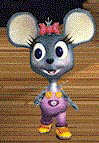 In a world where the almighty marketing dollar from a children’s movie determines what games will be released for the computer, how can any company break the Disney mold and design a creative, educational, yet interesting game that will challenge a child as well as trick him/her into learning something? It has been my experience that if a parent tells a child that a program is educational, the child will reject even the thought of it. So what is the formula for creating a game that will please both parents and children alike? Just ask the kind people at Kutoka Interactive. It seems as though all you need to do is take a cute little mouse, add in a little Indiana Jones and one part Discovery Channel, and bing, bang, boom, you have a winner.
Behold the game Mia 2 from Kutoka Interactive. This game is the sequel to the award-winning game Mia: The Search for Grandma’s Remedy. In this adventure, Mia is wearing her mother’s new hat without permission. All of a sudden a large downpour washes her into the gutter, and the hat comes off and goes down into the sewer. The hat is soon discovered by Romaine the Rat, and all seems lost for Mia. When the sun comes out, Mia climbs out of the drain and talks to the player. She informs us that the only way to get another hat is to collect sparkles (gems). It is at this point of the story that Mia encourages the child to interact with all objects within the story. I particularly enjoyed this introduction because it was presented as though I was part of the game and not just watching visuals.
The objects the child interacts with are not things that are totally hidden. A good example of this is a rubber band in the middle of the path. The challenge is not finding the object but using it properly.
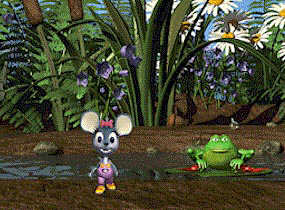 All this sound pretty good, you say, but where is the educational value parents and teachers alike are all seeking? Well, here it is! As the child interacts with the game, he/she will come across characters such as Professor Simon or Freddy the Frog, who will reward the child with a sparkle (gem) if he/she can win the game or help fix something. It is within the game that the child is tricked into learning. One such example is Professor Simon’s game that asks the child to match the picture with what he is asking. Then he asks about fruits, vegetables, plants, and trees. Another good example is Freddy the Frog’s game that asks the child to put the planets in order from the sun. Once the child clicks on a planet, Freddy gives a statement about the planet the child clicks on. This in turn allows the child to get the correct answer.
Is there anything in the game that adds additional value to make me want to purchase it? My, what a good question. Whoever thought to ask must be quite intelligent. The answer is yes. I discovered within the game subliminal comments that put an emphasis on safety. Such comments include “never dive where it is shallow” and “accidents are never planned.” I thought this added a nice touch.
Is there anything that a parent should be aware of before leaving a child unattended at the computer? Once again, this is an excellent question. I would never suggest leaving a child unattended at the computer, but since the age recommendation is 5 to 11, the child should be familiar with the computer. There is no accidental violence or anything like that. The only thing that I found is if the player hits escape, he/she can exit the game, which allows him/her to have free creative expression of your hard drive. (He/she can delete stuff by accident.)
Graphics: A
Sound: A
Fun Factor: B (I’m tough on this)
Plot: A
Control: A
Educational Value: A
Final Grade: A