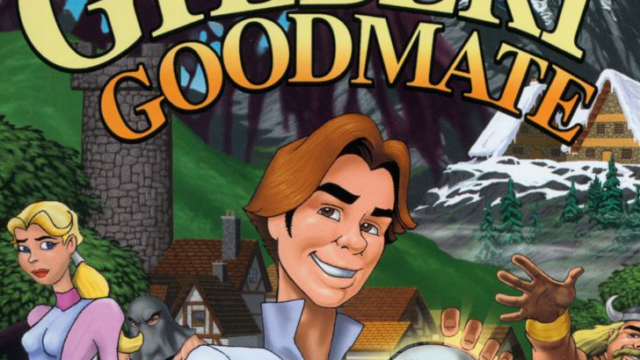
Review: Gilbert Goodmate and the Mushroom of Phungoria
|
Gilbert Goodmate and the Mushroom of Phungoria Developer: Prelusion |
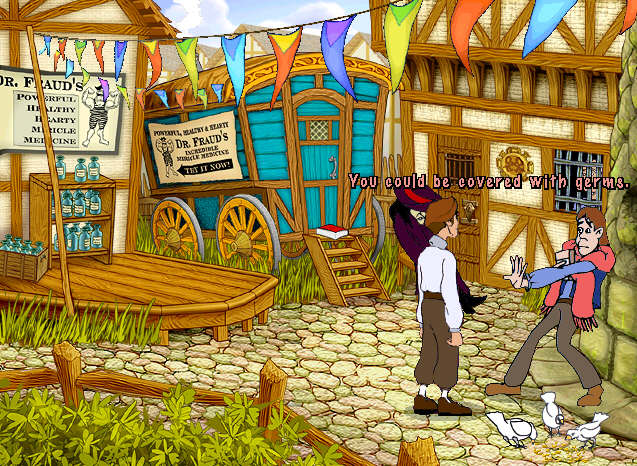
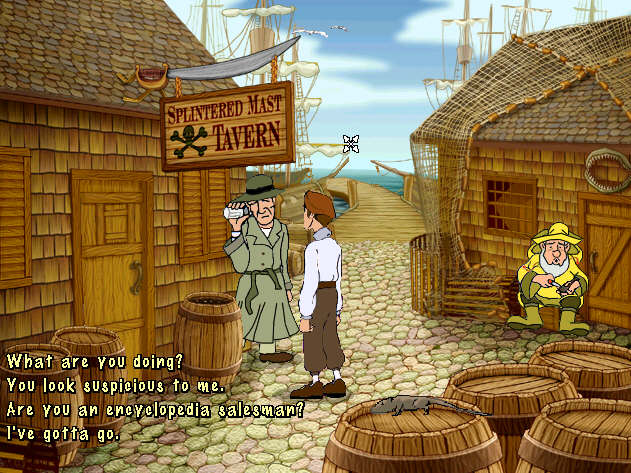
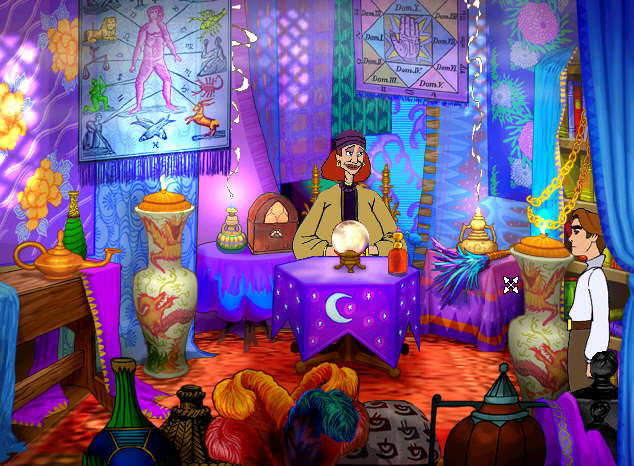
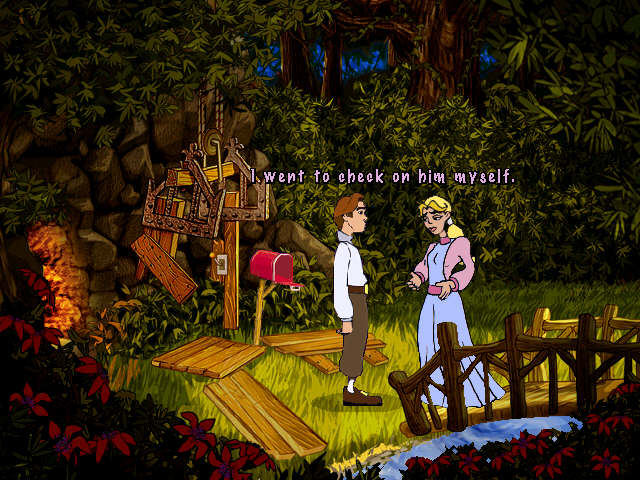
After the conclusion of Gilbert Goodmate, as the game credits begin to scroll vertically across the screen from bottom to top, there is that usual, irresistible urge to close out of the program. Another one bites the dust, time to hit the road and beat the traffic, hasta la vista baby. Then there is a voice. What’s this? Game credits don’t have voiceovers. Most times they’re buried in the back of the instruction booklet in the smallest possible font and are only read by next-of-kin bearing a Sherlock Holmes-sized magnifying glass. But behind these scrolling credits are a plethora of outtakes and bloopers from the game. Now, since this is a computer game, these are not real bloopers like the ones Dick Clark shows on television (you know, the ones that are dreadfully unfunny but seem to always inspire Dick and cohost Ed McMahon to spasmodic fits of laughter), but these were created for fun by the developers to show their fondness for the characters they have birthed. In the hallowed tradition of Fractured Fairy Tales, these outtakes are ludicrous and outrageous. The characters are irreverent and go against type: they speak into the camera, lines are flubbed, game situations are ridiculed. It is without a doubt the funniest three minutes ever included on an adventure game disk. All of which makes me wonder: why isn’t the game itself this funny?
Gilbert Goodmate and the Mushroom of Phungoria is a noble, but ultimately failed, attempt to recapture the magic of LucasArts circa 1995. If the game had patterned itself after the inspired lunacy of the outtakes, it would have sparkled and may have inspired a revitalization of the dormant 2D comedy genre. Instead, the humor is forced and laborious, the plot is stale and redundant, and the dialogue, while well-written, goes on and on and on for so long that it makes the extended conversations from The Longest Journey seem like a short story in comparison.
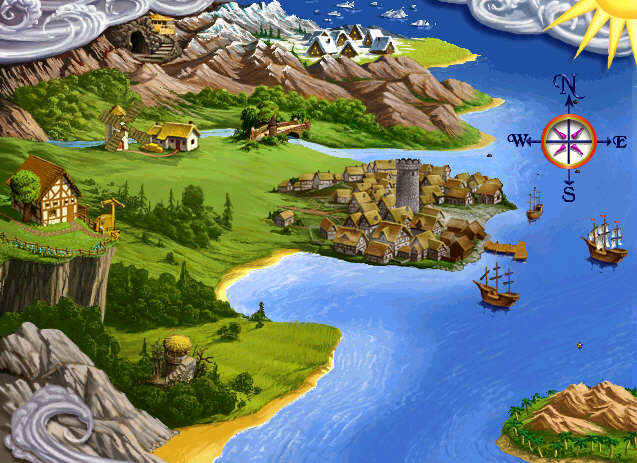
Gilbert Goodmate lives with his grandfather in the small town of Phungoria. The centerpiece of the town square is a gigantic mushroom that was once wielded to defeat an evil wizard bent on world destruction. Every year a gigantic festival revolves around the mystique of this mushroom, and every year a new citizen is accorded the highest of honors–to protect the mushroom from thieves, pestilence, and dogs that might mistake it for a fire hydrant. Of course, who else would you choose to guard such a valued icon but Gilbert’s elderly grandfather? That’s right, why bother to obtain the services of a young hotblood like Gilbert, when you can instead entrust your town’s fortunes to a doddering, senile 72-year-old (okay, so I just made up that age, but I have found from past experiences that 72 seems to be the age when gamers go bonkers). The old guy, of course, gets conked over the head, the mushroom is stolen, and now it is upon Gilbert’s shoulders to prove his grandfather’s innocence by recovering the beloved mushroom.
I would like to be able to tell you that a wild and fanciful chase now ensues; I would also like to be able to tell you that sharp-edged witticisms and sarcasm are so plentiful that they leave small, wicked cuts on your mouse finger–I would like to be able to tell you this, but in all honesty I cannot, for the pacing of Gilbert Goodmate is so lethargic that I fell asleep not once, but twice, while playing.
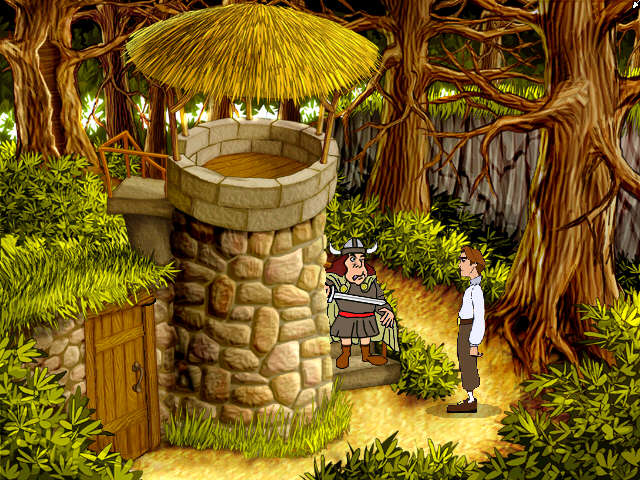
Pacing is crucial to any game, regardless of the genre. Gilbert’s ultimate downfall is that the first 75 percent of the game is devoted to Gilbert discovering the identity of the thief (and it’s not as if there are a lot of suspects to choose from), the next 24 percent concentrates on Gilbert’s search for the thief, and the final 1 percent is spent defeating the thief. To claim that the final confrontation is anticlimactic would be a supreme understatement. Yet even this would be forgivable if it were not for the never-ending litany of dialogue. Answers to questions about tea, the king, crystal balls, spies, and assorted other items drone on and on into 20-, and sometimes 30-, sentence-long responses. Most of these responses offer no revelations, clues, or even backstory. Some of them, in fact, will make you believe that you have accidentally found your way into one of Cryo’s edutainment titles, and you’ll find yourself searching for Tom Houston. A few are funny and offer some nice wordplay. When the guardian of a bridge informs Gilbert that, “None may pass,” Gilbert smartly replies, “I am a nun, let me pass.” But wouldn’t have this scenario been much funnier if Gilbert’s developers had taken a page from Monty Python and instead have Gilbert disappear and then return dressed as a nun? Too many times I found myself absorbing line after line of dialogue, waiting for the cumulative punch line, only to be disappointed or confused when there was no punch line or, as was often the case, it was flatter then Herman Munster’s head. These lost opportunities are evident in the blooper outtakes, which makes me wonder why the developers took such a staid approach. There comes a point where it is fine and dandy to pay homage–in the case of Gilbert, it is, as we are reminded during the course of the game, to LucasArts–but eventually you must let your own creative talent shine through.
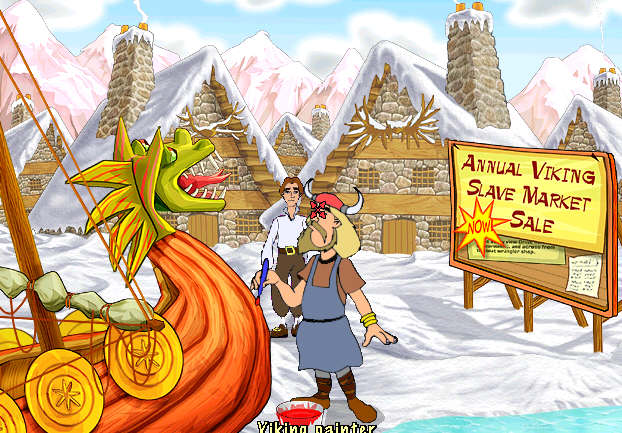
Humor is a strange bird, and certain nationalities may find laughter in a situation that another nationality will not. Gilbert Goodmate was developed in Sweden and–call this a wild guess–I’m assuming they find Vikings pretty damn humorous. There are jokes about Viking manliness, Viking women, Viking ships, Viking food, Viking culture, Viking footwear, Viking helmets–you name it and there is a joke. Charlie Chaplin, the master of comedy, believed that once was funny, twice was funnier, and three times was the limit. Watch any Chaplin film, and you will often see him repeating the same pratfall at least twice and usually three times–but never more than necessary. Gilbert’s first two Viking jokes were smirk-inducing funny; the next 998 times were not. To really drive this point home, Gilbert is eventually kidnaped by the Vikings, almost forced into slavery by the Vikings, and must escape from the Vikings. If you are already sick of reading the word “Vikings” in this paragraph, then imagine reading it about 900 more times. If at that point you are not sick of the word, then you are probably either from Minnesota or have Viking relatives.
The puzzles are, for the most part, your standard keep trying an inventory item until it works and if all else fails combine items in your inventory. While most of the puzzles are logical and only require common sense, there are a few–especially one in which you must create a fake dog–that approach the ludicrousness of the now infamous Gabriel Knight 3 cat-hair puzzle. As is the norm for almost every point-and-click game, you should pick up every available item, as you will need it at some point in the game. There is some pixel-hunting, but as I have stated before, this is part of the charm of adventure games: to stumble across a previously overlooked item and have that light bulb turn on in your head as you realize that you have just found the solution to a worrisome puzzle.
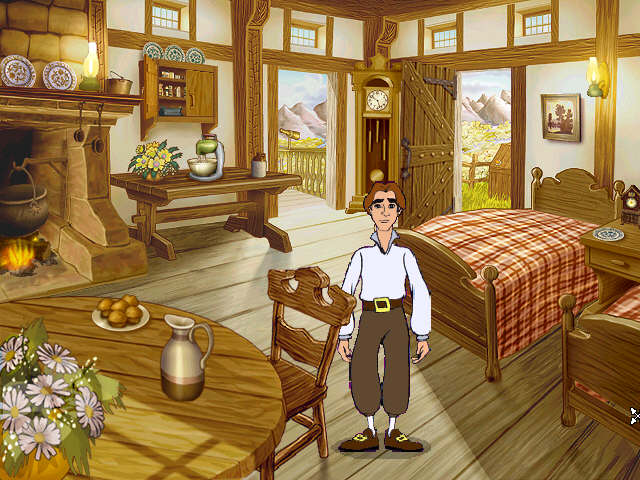
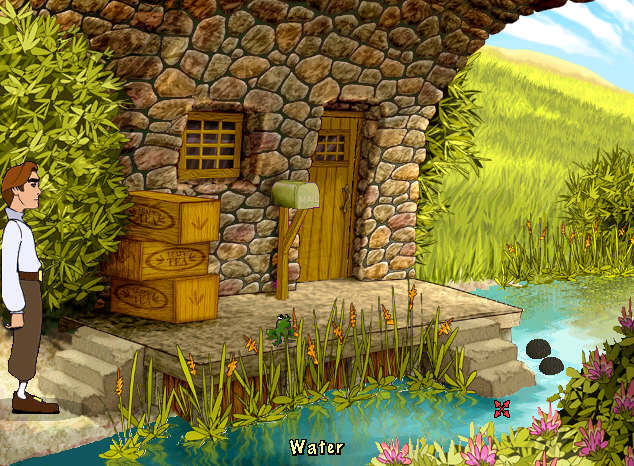
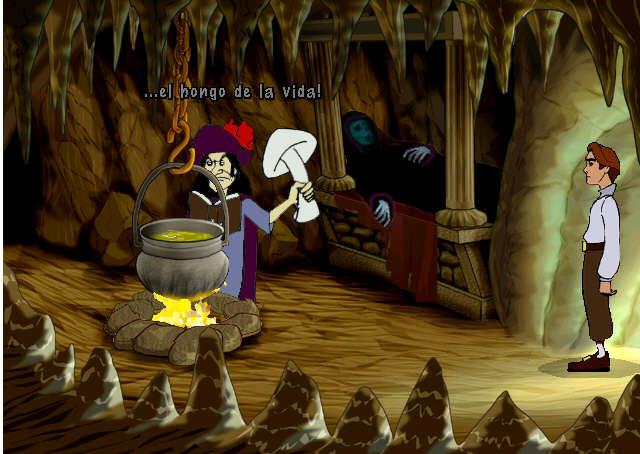
The voice acting is all done by the same six or seven professionals and is for the most part passable, but for any game or movie to reach new heights of popularity, it is an absolute necessity that the villain be larger than life. Unfortunately, Gilbert’s nemesis–the Sheriff–sounds like a poor man’s version of Saturday Night Live’s Father Guido Sarducci, who himself was meant to be a humorous imitation of Italian stereotypes. The animation is at times sketchy, but the hand-drawn backgrounds help to offset the jerkiness of some of the characters, and I would be remiss if I failed to mention that Gilbert himself is one of the slowest-moving characters yet to be featured in an adventure game.
Gilbert Goodmate comes packaged on two CDs, and the entire game can be loaded onto your hard drive to prevent disk-swapping. The interface is mouse-controlled, and character navigation is effortless. There is some pixel-hunting but nothing that should diminish your enjoyment of the game. A left mouse click brings up a clever mushroom interface that lets you interact with other characters or items, and a right mouse click displays the inventory. There are occasional bursts of inspiration when Gilbert pulls inventory items, such as a vacuum cleaner, from inside the front of his pants (is that a vacuum cleaner in your pants or are you just happy to see me?), but overall these small gems are few and far between.
Gilbert Goodmate is a game for those who exhibit a nostalgic yearning for the halcyon days of adventure gaming, and they will leave the table sated. As for myself, I love the old LucasArts and Sierra games, and they are excellent representatives of adventure gaming for the time period during which they were released. But I no more want programmers to return to those days of glory then I would want Quentin Tarantino to produce a black-and-white silent film. This is not a game that will be popular with the average American gamer, which is most likely why numerous companies have passed on the opportunity to be the distributor. It may, though, be a rip-roaring success with a European audience, who like their games slower-paced. In all fairness, it would be a nice introductory game for a novice adventure gamer, but experienced gamers will be put off by the languid pacing and relentless dialogue. If you really feel a need for mushrooms, bypass this nonpsychedelic appetizer and go instead to your local deli for a stuffed portobelo.
You really can’t go home again.
Final Grade: C-
If you enjoyed Gilbert Goodmate:
Read: Piers Anthony’s Xanth series
Watch: The Princess Bride
Play: The Monkey Island series
System Requirements:Windows 95/98/ME/2000/NT4.0
Pentium 266 MHz
64 MB RAM
4 MB graphics card (100% DirectX compatible)
8x CD-ROM drive
16-bit soundcard (100% DirectX compatible)
400 MB free HD space
Mouse and keyboard