Review: Genesys
|
Developers: Multimedia Productions, Cybelle Productions, Galilea Multimedia By Tom Houston |

In the Beginning
Whether we believe that Moses was solely responsible for writing the chronological record of the events that we know as Genesis or not, Biblical creationism is yet another of those topics that elicit diverse opinions and theories from historians and scientists.
Genesis comes from the Greek word for origins, and in the Bible it refers to God’s creation of Earth and the universe in six days. Starting with bringing into existence a watery, formless planet (Earth) and separating the light and darkness on Day 1, the atmosphere was created on Day 2, the dry land, oceans, and vegetation on Day 3, the sun, moon, stars, and other planets on Day 4, water creatures and birds on Day 5 and land animals, man and woman on Day 6. Some say that God saved his best creation for the last.
However, Genesys, the game, is not about creation, but rather about what mankind has done with God’s great gift of life and universe. Genesys takes us on a journey through the ages of mankind’s discoveries, to view important past developments and inventions that have brought humanity to the third millennium wondering about our future expectations. The premise of Genesys is that by revisiting the great historical eras of the past, we can learn from our evolution and gain insight into understanding where we are heading in the future.
For those of us who can identify with the term “senior citizen” and those who are film buffs, you will be pleased to find that Genesys is narrated by Jeanne Moreau. Now 73 years young, Jeanne Moreau was born in Paris, appeared in her first film in 1948, starred in dozens of movies in France and Hollywood, and became known for taking on very challenging roles with an extraordinary emphasis on portrayals of women of intelligence and emotion rather than glamour.
Edutainment’s the Thing
Genesys is actually not so much about providing the player with a story-based adventure, but more about making a historical presentation of real or plausible occurrences that happened throughout the major periods or ages of history. As such, unlike its predecessors, Genesys is an edutainment game that tilts more heavily toward the education content of the game.
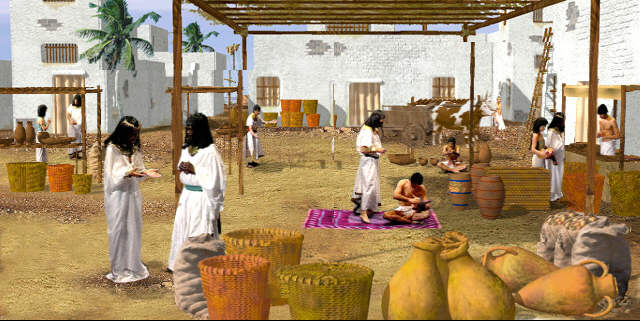
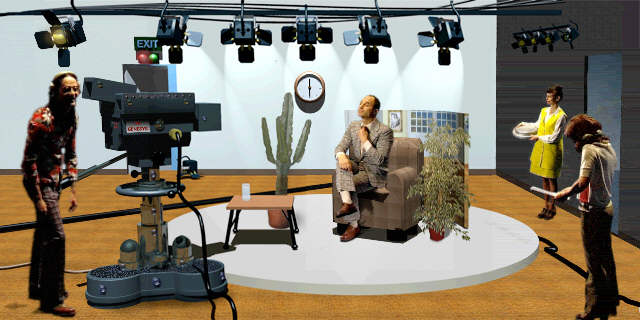
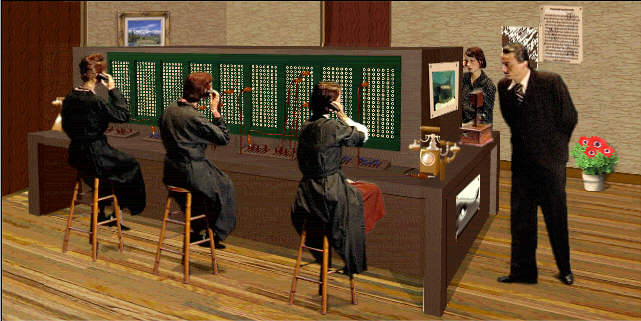
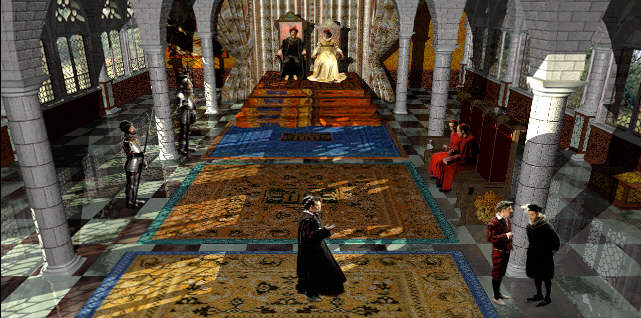
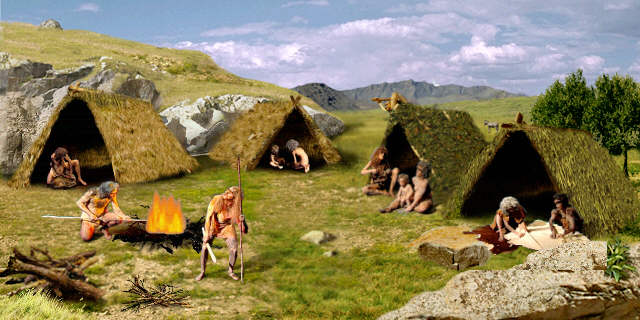
Jeanne Moreau becomes our guide through five major worlds of human progress and discovery by setting the context in a progression of beautifully animated introductions to these worlds. Starting with the Prehistoric Age, we are subsequently taken to the Age of Ancient Civilizations, the Middle Ages, the Industrial Age, and finally the Present Day.
As you move through these ages, you will be impressed by the detail and accuracy of the historical facts that are presented in the production process. The characters are all filmed in period costumes in 3D and then embedded in 2D sets that have been constructed with graphical precision as fully representative of the scenes and historical times that they depict.
In addition to the historical scenes that you will explore and the characters that you will question or listen to, there is a very comprehensive historical database of fact sheets that are not only fascinating to read but also play an important role in providing you with critical information that you will need in order to progress through the game.
Entertaining the Enigmas
Embedded into our guided tour of these five ages are 16 enigmas that must be solved in chronological order. From the earliest forms of developing useful tools, to the invention of writing and on to the present-day use of microcomputers, the player is confronted with educational, yet entertaining, enigmas that must be solved.
In order to solve the enigmas, the player must investigate scenes that contain characters and objects to interface with. There are typically up to three scenes for each enigma that must be explored, and the object is to collect into your inventory characters and objects from the scenes that can be used to solve the current enigma. The player can also listen to commentary from or between characters in the scenes that provide valuable insight into the historical significance of the times or furnish useful information about the contents of the historical database.
Along the way you will visit many interesting locations, such as China, Egypt, Africa, Europe, and America, where you will discover the key steps in the evolution of human societies.
Not all of the objects that you require in order to solve an enigma will come from the scenes, because you will also need to collect objects that are embedded in the historical database. This will encourage you to explore the database and take advantage of the rich and fascinating offering of historical information that resides there.
Once you have collected all of the necessary objects and interacted with the characters, it will be time to solve an enigma. This is accomplished by accessing what the game calls a “mystery screen.” The mystery screens are often animated and require the player to properly place the objects that have been collected in the inventory. The number of objects to be collected and placed on the mystery screen varies, but it usually includes about 10 to 20 items. The mystery screens are, in fact, puzzles of a sort in that they require a certain amount of logical thinking in order to solve them. Sometimes, solving one mystery screen will take you to yet a second mystery screen. In any case, solving these enigmas is always fun and educational.
When you have solved an enigma, you will be prompted to click on the mystery screen, and that will take you forward to the next narration by Jeanne Moreau, who will then introduce the next chapter in the game.
The Interface
Genesys is played from a third-person perspective, but keep in mind that you don’t actually control or move any of the characters. The player’s only interaction with the game’s screen is collecting objects and placing objects in the scenes or making a character talk. These interactions are accomplished by using your mouse.
By moving your mouse to the top of the game screen, you can access snapshots of the scenes that are available to you and the mystery screen. At the bottom of the game screen, you can access the inventory and three functions buttons. The Back button returns you to the previous screen that was last activated. The Quick Move button provides the player with fast access to the historical documentation, allows you to print a document, and has a search function. The Optionsbutton brings up the main menu, which has new game, save game, load game, volume adjustment, credits, and exit game functions.
Those familiar with the previous Index + games Crusader and Vikings will recognize the simple interface functionality, and everyone will find it a comfortable experience to point and click his or her way around and through Genesys.
A Spectacular Graphical and Auditory Presentation
As is to be expected with any adventure game developed and produced in France, particularly any game associated with Index +, the graphics and animations in Genesys are wonderful. A balanced blending of video, 3D, and 2D will leave you staring at the screen in awe of the beauty of the rendered backgrounds and the stunning realism of the period characters that move across or within the scenes on the screen.
The sound effects are always true to the object or thing that is making a sound (e.g., the rumbling of a locomotive or the ignition of an incandescent lamp), and the original music of Yan Volsy is captivating and especially representative of what you would expect to hear in each of the historical periods or in the geographic locations that you are observing in the scenes.
From the Beginning to the Conclusion
Genesys is the third historical adventure game from Index +. This one is from their Wanadoo Edition production company and following after Crusader and Vikings.
As previously stated, Genesys will appeal to those gamers who enjoy edutainment games. But please remember that unlike most other historical adventure games, Genesys is about 70% educational and about 30% entertainment.
Clearly, the emphasis in Genesys is on the voyage into the history of humanity and an almost philosophical link to the future whereby the message being delivered throughout the game is to wonder or suggest what the future has in store by looking back into the past.
It is when I had completed all 16 enigmas that the message turned a bit sour for me. As a conclusion to the evolution of progress through the Ages up to the Present Day, Jeanne Moreau professes that today’s problems of overpopulation, human rights, drug use, etc. prove that humanity has a long way to go.
Now, I can certainly go along with these points, but what followed was a menu of challenges for mankind that seem worthy but idealistic and had a little too much of a socialist taste for me. The challenges were presented as:
- Healthcare for all (worldwide governmental)
- Rid the world of hunger (worldwide governmental)
- Establish a unified worldwide Code of Ethics
- Live in harmony with the environment (worldwide governmental)
- Provide equal education for all (worldwide governmental)
- Share all wealth equally (worldwide governmental)
At this juncture, what had been a wonderful romp through the history and discoveries of mankind and a game with beautiful graphics and sounds became somewhat sullied by political opinion statements, which I feel (whether one agrees with them or not) were inappropriate and unnecessary.
For the collective edutainment experience and historical enjoyment of Genesys, in spite of my displeasure with the ending …
Final Grade: B
Genesys can be obtained on the Internet from the game website in Europe or in the U.S.A. from Playing Games Interactive.
Minimum System Requirements:
PC:
Pentium 166
16 MB of RAM
Thousands of colors
16-bit sound card
4X CD-ROM drive
Windows 95 or 98Mac:
Power PC or G3
16 MB or RAM
Thousands of colors
4X CD-ROM drive
System 7 or higher
