Review: Cutthroats
|
Cutthroats Developer: Hothouse By Gary Nalven |
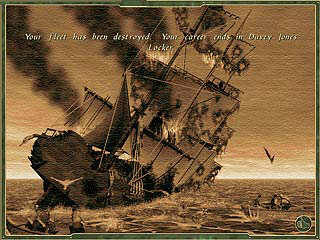 Ah, the open air, the pitching waves, the blasting cannons … a pirate’s life for me! Who wouldn’t want to cruise around the seas, raiding ports, harassing ships, and being a general nuisance to those wimpy landlubbers? Strangely, though, the gaming world is a bit lacking in pirate games. Yes, there was Sid Meier’s classic Pirates, along with a handful of other high-seas games ranging from fun to plank-worthy. However, for every one of those, there’s about a bazillion games featuring rival factions who want to take over the post-apocalyptic world. Me, I’ll choose pirating any day. And Hothouse’s Cutthroats is certainly not a bad choice.
Cutthroats covers just about every aspect of pirating, from cannon battles on the high seas to division of the plunder. It does these things very well, too. You start off with a tiny ship and some capable men. The object is to make as much money and gain as much fame as you can until you’re captured, killed, or retire the easy way. Now the question arises, “What does this have to do with adventuring?” Well to be honest, nothing, in the traditional sense. There really aren’t any characters or plots to speak of. Governors of towns will give you small quests once you gain their favor, though these are pretty random and unconnected. Which countries are at war and how you act towards those countries’ ports and ships will have an impact on how they act towards you. Still, the game is completely open-ended. Not to say there’s no adventuring, of course. I’d certainly call roaming around the Caribbean, picking fights, and threatening citizens adventure. However, the lack of a story and other adventure-ish features make you seem a bit withdrawn from the game. Plus, the open-endedness of the game will often leave you asking, “What next?” Then again, that means you can choose your own destiny, and once you know what you want to do, things go rather smoothly. Your goal may be to make a fortune from small trading operations, or to be the biggest, baddest mutha ever to rule the waves. You can be nice and not threaten anyone, heeding to other ships’ pleas, or heartlessly blow away any ship that crosses your path, and kill all its crew while you’re at it. Your actions affect future encounters. During all this, you’ve got to keep your crew happy with lots of rum and the occasional division of the plunder. In this sense, it is an adventure. The “plot” gets a B.
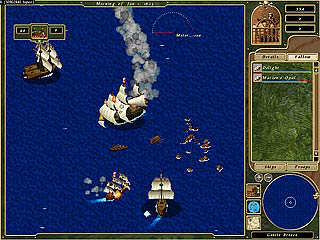
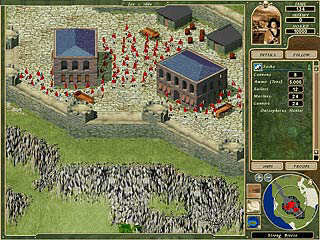 The gameplay is a mixed bag. Actually, playing the game is fun. You go around from port to port, buying and selling goods and picking fights as you like. These fights can either be battles on the water or land raids. Both types are very detailed. You’ve got to keep track of ammunition, men, etc. In my opinion, however, the designers should have skipped the land combat and concentrated more on ship-to-ship fighting. The sea battles are extremely fun, and with lots of ships around they can grow very hectic. I do wish there was a better way to control all your ships, either with better AI control or some kind of split-screen. Interface aside, these fights are tactically challenging and rewarding. You can choose to relentlessly sink the enemy ships or send your marines over to take over the ship and press its crew. Taking advantages of a boat’s strengths and weaknesses is important; those huge galleons might outrun you downwind, but they’ll never beat a quick little sloop in an upwind turning contest. Port raiding, on the other hand, seems a bit tacked on. It’s more of a “select all your troops and click on what you want them to kill” affair and seems out of place in the game. Sure, real pirates performed land raids, but only the ones who could afford to. Most stuck to fighting other ships, and that’s what I did in the game.
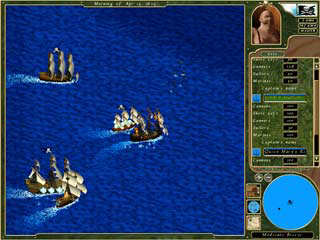 Of course, you don’t have to fight your way to the top. There is a wealth of ports in the Caribbean willing to pay a pretty penny for the goods you’ve accumulated somehow or another. The easiest way to get these is to take them yourself from a ship, but you can also use your economic genius to buy low and sell high. Goods have different rates at different ports, and if you trade with the right ones, you can make out pretty well. In fact, with patience, it’s possible to accumulate a small fortune without ever firing a single shot.
While the interface is a little quirky and some parts aren’t as great as others, the gameplay is still very fun and gets a B+.
As for graphics and sound, they’re pretty much average. The boats look pretty plain, not bad, but not great either. The battlefields are a bit better, with rolling hills and bustling cities. They do look kind of boring still, and there’s not much variety. However, the graphics aren’t too important in a game like this; so long as they don’t interfere with everything, they’re fine.
The same can be said for sound. Your pirate friends tell you what’s going on with your crew and in ports, but he can get repetitive after a while. Battle sounds are fun, but not excellent, and still feel a bit repetitive. Like the graphics, they are pretty average. All together, graphics and sound get a C.
 A word must be said on performance. My copy would not run until I downloaded the latest patch and DirectX 7, and tweaked my graphics acceleration settings (quite annoying since I have to change them every time I switch games). And I won’t say anything about the defective disk I got, or the, ah, typo on the box. I wouldn’t mind these things nearly as much if I didn’t have to pay for support. Not that I was too disappointed about these things; my experiences with Eidos haven’t been altogether good …
Despite some problems, this is an excellent pirate game. While not everything is great, it all comes together to form an extremely fun and involving adventure on the high seas. Even though there’s not much competition, Cutthroats simulates pirating as well or better than anything else.
Final Grade: B+
System Requirements:
Pentium 200 MHz or equivalent (266 MHz recommended)
Windows 95/98
32 MB RAM (64 MB recommended)
DirectX 6.1 (Included on CD)
600 MB uncompressed hard drive storage (not 250)
8x CD-ROM drive (24x recommended)
2 MB SVGA Graphics Card 100% DirectX 6.1 compatible
100% DirectX 6.1 compatible sound card
Mouse and keyboard