Review: Cydonia
|
Cydonia Developer: Aneiva 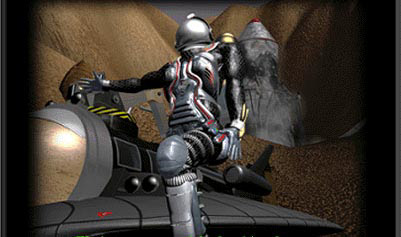 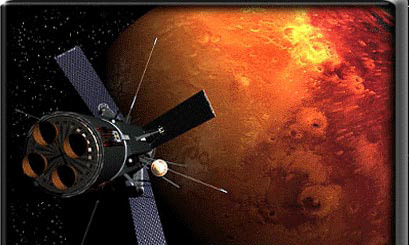 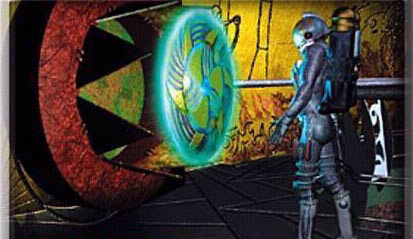 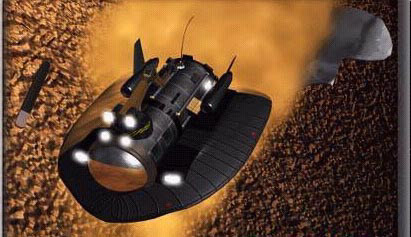 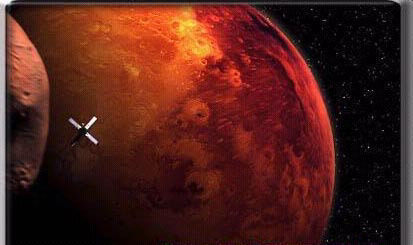 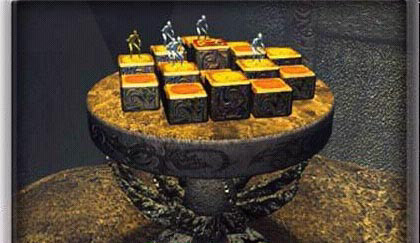 |
I must confess that I am not a fan of what we here at Just Adventure refer to as “twaddleware” adventure games (twaddleware being loosely defined as a game that exists solely for the puzzles with a total disregard for a cohesive plot or storyline). Now that my conscience is clear, let me also admit that, as evidenced by the sales figures, there is a huge market for Myst, The 11th Hour, Jewels of the Oracle and their kind. In fact, I will even go out on a limb and suggest that these games easily outsell what have become known as traditional adventure games (Curse of Monkey Island, Broken Sword, etc.).
I strongly suspect that the majority of people who are devoted to puzzle games are either members of Mensa or constituents of a higher intellectual order, such as those people who can program their VCR to record when they are not home. My idea of a challenge is, “See key in inventory. See door. Turn key in door.” Sometimes, I turn the key the wrong way. So then why review a game that I, to use a Presidential term, suck at?
Personally, I believe that part of being a good reviewer is a willingness to review genres that one dislikes. It would be far too easy too review nothing but horror/adventure games, but it is critical to one’s growth to be as diverse as possible and to objectively look at a game as thousands of others will. I am positive that the majority of you have read juvenile reviews on other sites or magazines similar to the following, “I don’t like Myst-like games (or full motion video, or adventure, or …), but my editor is making me review this new clone. This game bites because I don’t like these type of games.” Now that’s the sort of reasoning that would entice me to return to that site … not. I am doing this of my own volition.
I think that the primary reason I don’t like puzzle games is because they are too damn logical. I am not a logical person. Usually when I play an adventure game, I am able to solve the problems through my own illogical reasoning and via the trial-and-error method. This is not possible in your average puzzle game wherein logic is a prime necessity. To quote Leonard Nimoy, “I am not Spock!” But enough of my blathering. Hand me that walkthrough and let’s get this show on the road.
Already I hear some of you snickering, “A plot? In a Dreamcatcher release!” Well, not only is there a storyline in Cydonia, but it is intriguing. The year is 2012 and a severe environmental upheaval has decimated humankind by the billions and left Earth uninhabitable. A three-person crew has been sent on the spaceship Prometheus to explore the Cydonia Mensae region of Mars for the prospect of human colonization and if possible terraform the landscape for human habitation. While commencing the landing sequence, a strange force field causes the spaceship to crash. You, as the only uninjured crew member, must explore the planet’s surface to locate and eliminate the source of the force field. As your journey progresses, you will learn a new language and travel back to a time when life did exist on Mars. Interesting so far, but what differentiates this game from a hundred others of a similar mold?
Cydonia’s game content is based on actual information gathered from the NASA and Russian space programs. The Martian landscape, the mission data and archives all play an integral role in the game and are, if you will, edutainment. Yes, you will learn while you play, but not in the heavy-handed manner we have come to expect from edutainment titles. Rather, it is in the form of the equation of using your knowledge to solve puzzles and advance the game. The information you acquire in Cydonia is factual (more about this in the puzzles section) and can be, unlike other games, applicable to other situations outside of the gaming experience. But even with this wealth of information available to the gamer, the plot is still simply as I have presented. There is no character depth, there are no twists or turns. You simply solve one puzzle so that you can move on to another in order to advance the plot. The puzzles in themselves are the soul and the character of this game. Even though it was a gratifying experience exploring the planet’s surface on my own, it would have been more satisfying to have been able to have another crew member along to interact with and to advance the plot in different directions. But for accomplishing the impossible task of presenting edutainment in a painless and entertaining manner, the plot in Cydonia receives a grade of B-.
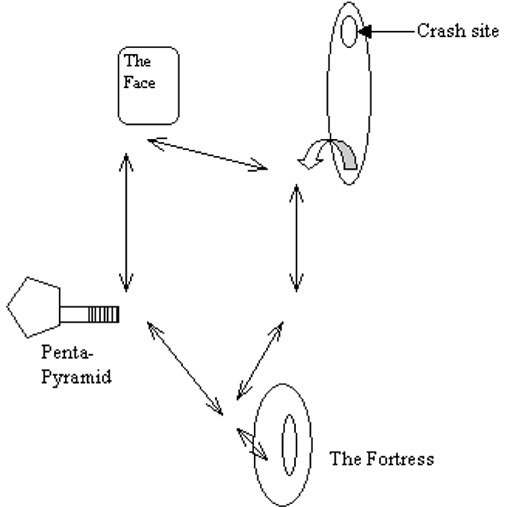
You said you wanted puzzles? Well, you got ’em. Situational puzzles, logic puzzles, time restraint puzzles, 3D puzzles–they’re all in Cydonia. The journey begins easily enough with some inventory-based problems that have to be solved within a specified time frame of 15 minutes. Before you begin to panic, rest assured that these early timed puzzles are quite simple. In fact, it is not even necessary to complete a few of these early problems in order to progress in the game. In what is a unique twist though, what problems you do or do not solve at the beginning of the game directly affect which one of four scenarios you will get at the game’s conclusion. The real game begins once you have exited the Prometheus. Your hovercraft is your means of transportation as you traverse the red planet. Early gameplay is linear in nature, but soon deviates. You soon deduce that you must travel to certain locations in the Cydonia Mensae Region–Tholus, the Pentapyramid, and the Face on Mars. The topography of this region is based on scientific findings; it is what is below these locations that drives the game. Here Aneiva Interactive has taken liberties and created underground chambers chock full of every type of puzzle you have ever seen. Language puzzles, auditory puzzles, diorama puzzles–they are just a few of the clues left by previous inhabitants. Finally, it reached a point where I was working on more unsolved puzzles at one time then I ever thought possible. Even for all my difficulties, though, I always found the puzzles to be challenging in a fair way. The solutions were never too far from my grasp. Granted, many of you will find these puzzles mentally stimulating on various levels, but I must admit with shame that my walkthrough is well-thumbed. For actually encouraging me to use my gray cells before resorting to a walkthrough, the puzzles in Cydonia receive a B+.
As in every other game I have reviewed this year, the graphics for Cydonia are a treat. The majority of the game takes place from a first-person, you-are-there perspective. Yet the cut scenes are always viewed from a third-person point-of-view. Granted, these cut scenes were gorgeous, but I found it disconcerting how the viewpoint changed during these pivotal scenes. It was as if I were no longer part of the story, but an outsider looking in. There is at times a graininess to some of the scenery, but this is easily overshadowed by the vibrant colors that are evident everywhere in the game. In fact, I do not think that I have ever seen such bright colors in a computer game. If you are going to build a sci-fi game around logic puzzles, then it never hurts that the eye-candy is top-notch, and for this reason the graphics receive a grade of A.
As you might imagine, there is not much need for an overabundance of sound effects or music in a game of this sort, but what there is, is used judiciously. The whoosh of your hovercraft, the sound of the shells in the Whalesong Chamber, the reverberation of gongs ringing all lend authenticity to the experience. The hollow, tinny-sounding music early in the game is a grim reminder that you are alone on this planet. The musical score always seems appropriate, but I would like to have more background information available. Was the music scored after playing a particular sequence or was it just tacked on? What considerations went into adding a particular musical track to a particular puzzle? As games and gamers become more complex, questions like these deserve to answered, as the overall quality of today’s adventure game is affected by more than just the plot. There was never any one aspect of the music or sound effects in Cydonia that made me take notice, but more importantly, there was also never any one aspect that detracted from a scene. For being there when you need them and for not being intrusive, the sound and music aspects of Cydonia receive a B-.
Cydonia ships on five CDs, and there is some disk swapping involved. As I am sure you have guessed by now, I did use a walkthrough to complete the game or I would have been playing until the year 2012. Do not misunderstand and think that Cydonia is extremely difficult, it is just that I am so horrible at these types of games. If you were to put a thousand monkeys with a thousand computers all playing a copy of Cydonia in one room … well, suffice it to say that the majority of the monkeys would be playing Monkey Island 4 before I would complete Cydonia.
Cydonia is an excellent first effort for Aneiva Interactive. Their creative treatment of successfully merging gaming and education can only bode well for their future releases. Dreamcatcher is to be commended for having the foresight to distribute this game.
Final Grade: B