Review: Clock Tower II: The Struggle Within
|
Clock Tower II: The Struggle Within Developer: Human |
I derive more enjoyment out of the strangest games than most people do from the classics. Case in point–Clock Tower 2: The Struggle Within. Not that the game itself is insipid, it is more a case of untapped potential and not the limitations of the Playstation but more the PSX mentality that values bombast over depth.
Let’s begin at the end for once. Clock Tower 2 has 13 different endings. Why? While this may sound commendable on the surface, who in their right mind would want to play through a game 13 times to try and find the events that trigger the different endings? Even more unforgivable are the dead ends in the game that require you to start over from the beginning. There are trigger points in the game that, if not set off, will cause the game to abruptly end a scene or two later. The problem with this, besides the frustration of having
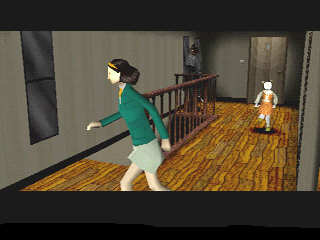
played two-thirds of the game only to start over, is that you are not sure what the trigger point was that caused the game to end early. In one instance, it was because I had not activated a samurai statue on the second floor hallway. The statue then killed a principal character who was supposed to give me a key later in the chapter. But how are you supposed to know this if there are no clues to lead you on? If I had not found a survival guide, I never would have suspected what I did wrong. Instead I would have had to constantly replay scenarios over and over attempting different options and slowing piecing together the correct solution. Sorry, but life is too short and there are too many games yet to be played.
The second Clock Tower is in no way related to the first installment of the series (sort of like Phantamsagoria 1 and 2), so it can be played without fear of being unaware of previous occurrences. Originally released in Japan as Clock Tower: Ghost Head, all dialogues and text have been translated from the Japanese. Whatever you do, do not read the instruction manual if you want to know what the game is about. It was originally written in Japanese and the is good not translation, if you catch my drift. I was so confused after reading the manual that I felt as though I had just had a conversation with Yoda.
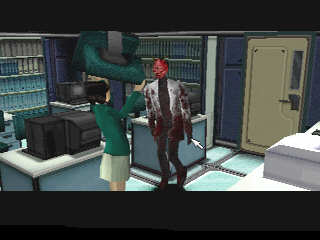
The plot for CT2 is novel. You play as Alyssa Hale, a teenager with a dual personality. Normally a quiet young lady with a gloomy personality, Alyssa has a dark side, a cruel and merciless man known as Mr. Bates who can possess her body at will. Alyssa’s only protection against these unwelcome possessions is an amulet given to her by her father, the director of a major San Francisco hospital. Alyssa has just undergone extensive psychotherapy and is recuperating by visiting a lifelong friend of her father’s, Philip Tate, and his children. Unbeknownst to Alyssa, Philip’s family is haunted by the Maxwell Curse: a mysterious figure who loves to wear a devil’s mask and slaughter his victims with a large butcher knife. If this all sounds confusing, it is, but the enigma
slowly crystallizes as the story progresses. If this also sounds silly, it is, but it is also strangely fascinating.
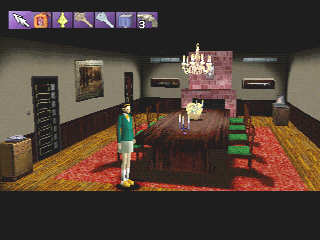
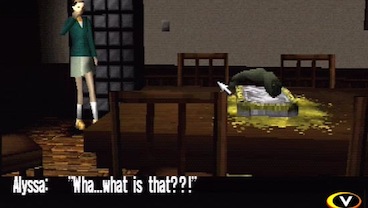
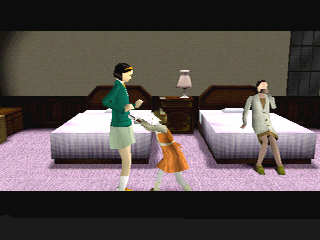
Clock Tower 2 is an old-fashioned 2D point-and-click horror game that is sectored into three self-contained chapters. Each chapter, once finished, cannot be returned to. The first chapter, “Yellow Cursed Doll,” is far and away the best. While there is a lot of to-and-fro, there are also some genuine chills as you discover dead bodies and body parts scattered about the Tate household while constantly being tracked by seven-year-old Stephanie Tate, who has turned into a knife-wielding, bloodthirsty murderer. If the final two chapters could have maintained this momentum, this could have been an excellent game. Instead, it disintegrates into a lackluster exercise of expository backtracking. The puzzles for the most part are nothing more than finding and using keys or keycards. The most interesting parts of the gameplay are those that
require you to purposely transform into the hideous Mr. Bates. There are a few inventory-based puzzles, but nothing to get excited about. To further hinder gameplay, there are traps located throughout the three chapters that when activated mean instant death. Not only is this unfair, but if you have not saved for a while, well, let’s hope you have a lot of patience.
For some reason, the beginning of a game always seems for me to be the hardest. After playing for 20 minutes, I was already stuck beyond belief. I was in the front hallway, and there were only two rooms that could be entered. Both were pitch-black, though, and I could not see a thing. So of course I increased the brightness on the television. Ah … the rooms seem to be separate bathrooms. But I still cannot do anything in either room. Hmm. Then I remembered that the disc had already been in the PSX when I started to play; obviously someone had tried this game earlier. I sought out the brains of the family (anyone who thinks at this point I am going to say “my wife” is obviously not married), my 10-year-old son Jacob:
“Jacob, were you playing this game?”
“Yes.”
“Did you get past this point?”
“Yes.”
“Well, why can’t I do anything in these two rooms?”
“Did you turn on the light switches?”
“Uh, no. Where are they?”
“Right there on the wall. When you turn on the light switches, the room lights up and then you can click on stuff.”
“Right. I knew that. I just wanted to see if you solved the puzzle the same way.”
“Sure, dad.”
“No really, I’m the editor of Just Adventure, after all. Do you think I didn’t know to turn on a dumb light switch?”
“Bye, dad.”
Maybe there is a reason, though, why the Playstation is for the younger generation. Control of the game is simple enough, as you use the gamepad to manipulate the cursor, but in a choice that would only be present in a console game, when Alyssa is being chased or in danger (known as Panic Mode), the cursor will flash red and a button on the gamepad must be pressed repeatedly in order for her to successfully escape. I felt as though I was once again pounding the keypad and running the 100-yard dash in Track and Field. Another option, the Escape Mode, is interesting and more beneficial as it offers you a chance to hide from the enemy.
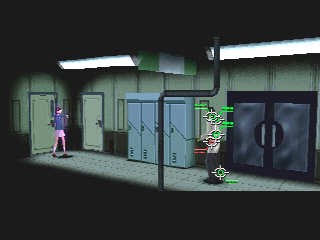
It is toward the end of the second chapter, set in a hospital, that the game entirely disintegrates as the boredom of the excessive to-and-froing degrades into a exasperating sequence where a few dozen zombies have to be eliminated using a clumsy shotgun-aiming cursor. By the time the final expository chapter has been reached, it becomes more a matter of pride and determination, rather than interest, to finish the game.
If some modifications to the gameplay were made, I wouldn’t mind seeing a third installment of this series. But gimmicks such as the Escape and Panic mode add little to the gameplay. There is a great game here waiting to be freed, but it is caught in the underpinnings of the developers being enslaved to a mentality that insists puzzles be no more difficult than finding a key for a lock or blasting away at zombies. If the plot had been fleshed out more fully and the reliance on weapons in the second chapter toned down, CT2 would have been a genuinely scary game. Instead, it winds down into a morass of dead ends, red herrings, and zombie innards.
Final Grade: C-
If you liked Clock Tower 2: The Struggle Within:
Watch: The Snake Pit
Read: The Strange Case of Dr. Jekyll and Mr. Hyde by Robert Louis Stevenson
Play: Clock Tower