Just Adventure + Review: Arcanum
|
ARCANUM: OF STEAMWORKS AND MAGICK OBSCURA Developer: Troika Games (JA Forums will be back) Review by Ray Ivey |
|
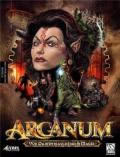
When Fallout was released in 1997, it was hailed as a landmark RPG. Its post-apocalyptic setting was a welcome change from the relentless parade of D&D-inspired wizards and elves, and the concept of an RPG without magic was downright revolutionary. Add a delightfully flexible character development system and a jaunty out-of-left-field sensibility, and Fallout added up to be a great game. Its sequel was equally beloved by RPG fans.
 Subsequent to the release of Fallout, several of the key members of the game’s creative team formed Troika games, and decided to see if they could shake the RPG world up once again.
The result of their labors is Arcanum, and it has a stunningly innovative basic premise. It takes place in a traditional fantasy world that is undergoing a mysterious industrial revolution. That’s right, sports fans, magic and tech pitted against each other in the same game! This is a tantalizing prospect for any RPG, and the good news is it’s not the only thing that’s special about Arcanum.
A QUESTION OF CHARACTER
Arcanum sports the most brilliantly open and flexible character creation and development system I’ve ever seen in a role-playing game. You pick your character’s name, sex, and race . . . and that’s just the beginning. Unlike many RPG class systems, which include many restrictions on weapons, skills, and classes, the world of Arcanum‘s character building is limited only by your imagination. Beyond basic strengths and weaknesses (elves are better at magic, half-ogres are really strong, dwarves are good techies), the rest is up to you. Want to create a high-tech elf thief? Go for it. How about a gorgeous halfling diplomat?
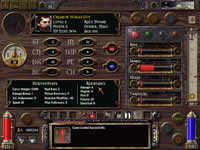 The player gets to distribute a certain number of points among the character’s base attributes (Strength, Charisma, Dexterity, Beauty, Intelligence, Willpower, and Constitution). You then follow your own path, developing your stealth skills, your magic abilities, your traditional melee prowess, your technical expertise, and even your social skills.
There’s a tremendously fun optional feature in the character building system. It’s called Background, and it lets you choose a back story for your character that essentially lowers your base stats in one area significantly in order for a juicy bonus in another. There are dozens of these Backgrounds, and they have wonderful names like “Raised by Knife Throwers,” “Mad Scientist,” “Miracle Operation,” “Special Person,” (yes, it’s what you think) and my favorite, “Nietzsche Poster Child” (more critical failures but faster experience accumulation – a reference to the philosopher’s famous line “what does not kill me makes me stronger.”) I picked “Beat With An Ugly Stick” for my techie dwarf, and got a significant bonus to my intelligence in exchange for a bargain-basement beauty score.
As the game progresses and you are rewarded with points for experience, you can spend those points on beefing up your base attributes, developing a wide range of skills, or even getting “degrees” in tech or “magick.” The possibilities are so wide-open it almost causes vertigo.
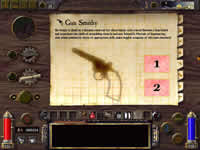 The game starts out with one of the coolest opening movies I’ve ever seen in a game; it’s like something out of a primitive science fiction epic a la “From the Earth the Moon.” After surviving a harrowing zeppelin crash, you are accosted by a curious character who seems to think you are connected to some strange religious revival. You quickly get drawn in to the politics of the local town, but the realization that you’re the target of mysterious assassins grabs a certain amount of your attention as well.
As in most RPGs, you begin weak and poor, and begin building up your experience by doing minor quests around the first town. Can you help me rob this bank? Can you help me foil some bank robbers? Can you deal with the pesky bandits guarding the bridge leading out of town? Can you sabotage the new steam locomotive the mayor’s so proud of? There’s a lot going on, and the main plot has barely even been hinted at yet.
As you develop your character, you make decisions about whether you’re going to go the tech route, the magic route, neither, or something in-between. These decisions greatly affect not only your abilities to use tech and magic items, but also the reactions you get from other characters in the game. In other words, get too good at tech, and the salesman at the magic shop won’t even talk to you.
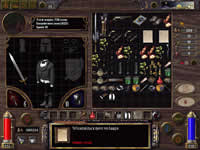 Over the course of the game’s huge story, there are many quests and sub-quests, and many of them are optional. The type of character you play also affects these quests greatly as well. Some quests are only available if you have very high charisma. Some quests are required to achieve mastery in a certain skill..
The amount of NPCs in your party is also dependent on your character. The bigger your charisma, the more people you can talk into joining you at any one time.
If this whole setup sounds intriguing and flexible, it is! And I can also report that, like any deep RPG should, Arcanum boasts a fascinating and detailed (and epic) storyline. I just wish I could say that the game is all good news. Alas, it is not.
THE BAD, THE UGLY, THE BORING
In attempting an RPG this ambitious, I’m afraid Troika has bitten off more than they can chew. For every cool feature of the game I can tell you about, there’s a dog of a feature to counteract it.
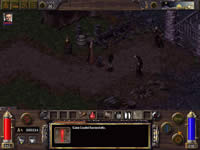
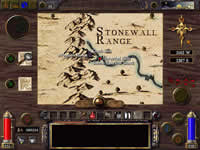
First up in the Bad News department is the game’s graphic design. The beautiful afore-mentioned opening cinematic notwithstanding, the general gameplay screen graphics in Arcanum are a surprising disappointment. The game is presented in 3rd person, overhead isometric view, and while the game takes place over a huge area, the environments are colorless and visually uninteresting. These days it seems like 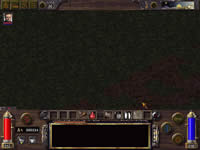 even bad games at least look good, so it’s a pretty big mistake for a game’s looks to be sub-par.
Next, movement and traveling are a big bore. Even basic movement around a town or large building is needlessly frustrating and cumbersome, and when you leave town to go journeying to your next major location, it gets really bad. Your party is constantly beset by hostile creatures that need killing. While this is valuable early in the game when you need to beef up your party’s stats, by the end of the game it becomes remarkably tedious. Especially since, on long journeys, you’ll often be interrupted for these meaningless little battles six, seven, or eight times!
The game also sports the dullest group of non-player characters I can remember enduring. The recent Bioware/Black Isle games have set the bar extremely high in this department. which probably makes this group of clods seem worse than they are. But compared to the rich parade of interactive characters in Planescape: Torment and the Baldur’s Gate series, the NPCs in Arcanum are about as exciting as an after-school Esperanto club.
The game’s worst failing, however, has to do with balance. Or, more specifically, lack thereof. Balance is a tricky tight wire act in any RPG. In a game with as much flexibility as Arcanum, it’s proved beyond the designers’ abilities. The experience point system, central to the game mechanics of any role-playing game, is ridiculously and (worse) illogically skewed in favor of the melee fighting style. The game rewards you points based on the number of times you whack a monster. So you rack up far more XP with a dull knife and low skill than with one good round of aggressive magic or devastating bullet from your rifle. I began the game excited to develop my tech skills, but began to get frustrated as I seemed to only be rewarded for putting points into the melee. So I ended up playing a tank – and I could have replayed Diablo II if I felt like playing a tank!
 Even worse, by the game’s last third, I became such an overpowered character that the endless battles became stultifying exercises in tedium. I think it’s safe to say that if I can kill a full-grown grizzly bear with one or two swings of my sword, that things are a bit on the lopsided side.
I can imagine the talented designers at Troika advising me, “Well, try the game again, this time as an elemental mage! Or an explosives expert! Or a diplomat!” And while those would undoubtedly all provide with different game experiences, I was so exhausted by the time I finished Arcanum that the idea of ever playing the game again filled me with dread.
BEST OF LUCK NEXT TIME
Arcanum strikes me as a game that could have a great sequel. If the designers can figure out a way to achieve real and compelling balance in the game – and tart up the graphics a good deal – they might have a truly great game on their hands. What they currently have is an admirable experiment that fails.
Ray’s Final Grade: C
If you liked Arcanum then:
See: The Name of the Rose by Umberto Eco
Play: Fallout of course
Read: The Difference Engine by William Gibson and Bruce Sterling
System Requirements:
PII 300 or equivalent
64 MB RAM, 4X CD-ROM
8MB VRAM
1200 MB disk space
Mouse
Sound card
DirectX v7.0a.