It’s the same for literature … I read (and love) a lot of books. To mention present American novelists, I’m a fan of James Ellroy, Jim Harrisson, Bret Easton Ellis, and Dan Simmons. Alone 1 was a very “Lovecraftian,” because the deal with Infogrames was to write three games in his universe: Shadow of the Comet, Prisoner of Ice, and Alone. I like how this writer (in terms of “private person,” it’s different) pushes your imagination. His novels are very basically built, with a particular (a mix of poor and rich vocabulary unable to describe really what happens) style that reflects his personality. My first trip in the US, in 1978, was to visit New York and Providence. I was an absolute fan … In Devil some incantations you have to discover and spell are very Lovecraftian.
Can you describe in your own words the theme of Devil Inside?
Hell exists, a horde of damned has succeeded to escape from the pandemonium. A hero who has the power to generate the devil inside him must defeat them and bring their souls back to hell. This man is the star of a weird TV channel that can film and broadcast this kind of event live, and produces a successful TV show. These are the basics of the Devil Inside script. Put more simply, Devil is a pure action adventure game where you are rewarded and challenged by the game and the audience.
Are there any particular game shows or television shows that Devil Inside is patterned after?
Not really … The creative starting point of the whole story was hearing the INXS song plus a kind of best of America Most Wanted and Cops TV report, that was broadcast late at night by a French channel (here, these shows do not exist) … Devil Inside has no message to deliver about violence in games or TV shows, except the video games are not reality. You can destroy and kill all the polygons you want, without knowing the Miranda amendment … To my part, I’m sure if a camera could film the living dead walking around, a major network, supported by sponsors, will certainly be interested by this phenomenon … Maybe Devil Inside is more cynical than other games, but I don’t think that other games had been interested or described the “television world.”
What prompted your decision to set Devil Inside in Los Angeles? Why not Paris? Is the theme of the game a statement on your part about American culture?
I love L.A., it’s a very particular town, very photogenic, sophisticated (in a kind of a way), sweet and rough … Paris is a wonderful city but in this kind of story I think that L.A is a better choice … Devil is not representative as I know or love about American culture that is richer now than French culture in paintings, music, movies, literature (even in TV, The Sopranos is a very good serial) … The story is set in the US because it’s more convenient and fits well … In your country things go faster. In Paris, if a guy see a living dead, he will call the firemen or a psychiatrist … Americans will take a gun, a camera, and phone to the TV channel next door to sell his report … Much more, in U.S. a tradition about horror exists nowadays and continues to grow with new authors or movie makers … Horror is popular. In France it’s very different. The fantastic genre in literature ends with the 20th Century and was never explored in movies (except two or three masterpieces like Les Visiteurs du Soir that takes place in the Middle Ages and was filmed in 1942).
Do you perceive a cultural difference in the way the American audience will react to Devil Inside versus the European audience?
We will certainly change some things in the game, if it is necessary. We are waiting for US focus group reactions, but we have no preconceived ideas about it.
What is the balance of puzzles versus action in Devil Inside?
First it was fifty/fifty … But when we begin to develop the game and play, our own reactions and the wishes of focus groups and testers was to tense more the game … So we increased the action part that gives more emotions. At the end, I consider that Devil is a 70-percent action game, but the result is better than the script, because all the technical and graphics team had been involved very deeply in this universe during two years … They had the time to understand it, to love it, and to translate it in terms of animations, sets, algorithms.
What type of gamer are you attempting to reach with Devil Inside–action or adventure?
Frankly, I don’t know … We just want to give new emotions to the gamers … I hope we reach that.
Are there any scenes in the game that offer the player a choice to solve a problem by using brain over brawn?
We didn’t want to realize a pure shoot them up, when you can run on corridors and kill all enemies around … So you always have to be smart and clever because your opponents are dangerous, die hard, and vicious.
Why does the male character of Devil Inside have a female double with psychic powers?
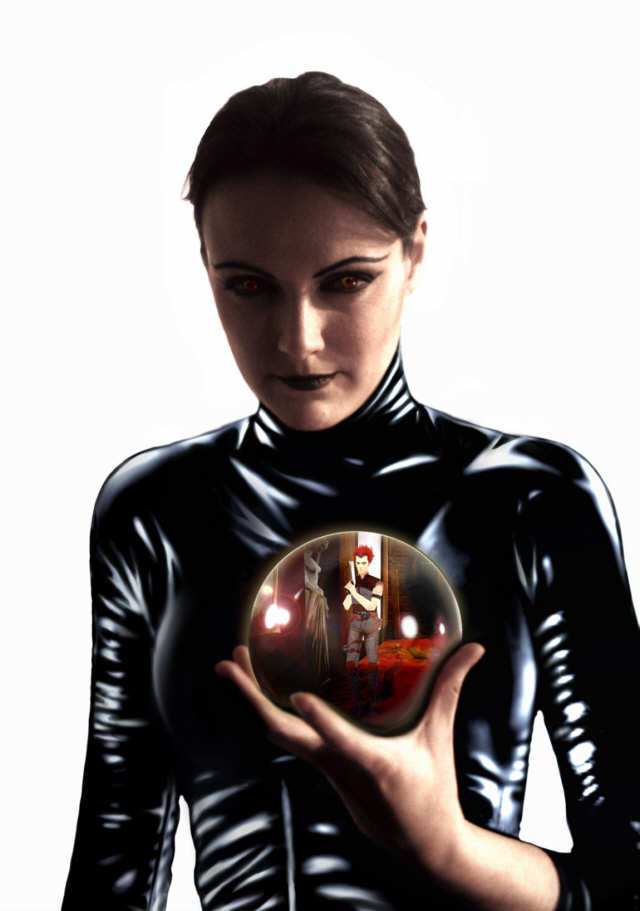
I think a female part exists in every man (and a man part in every girl …) So the psychic powers had seem to me more appropriate with a devil woman, very positive because she punishes the damned and it was amusing to imagine male gamers who play Dave (the tough guy, full of testosterone) morphing into Deva.
What’s next after Devil Inside? Do you already have a sequel planned if the game gets high “ratings”?
Devil is set to be a trilogy … Of course if the first game is a success, Devil 2 will certainly have more chances to be realized.
Are you involved in any way with the new Alone in the Dark game?
Yes, but I’m only consultant for the script.
Are there currently any plans to port Devil Inside to any of the consoles such as the Dreamcast or the Playstation?
Yes … These ideas seem to seduce Cryo (our French publisher) and us but for now, we have no further information about these projects.
Thanks for your questions … Have a very good day.
|