Gabriel Knight 3: Blood of the Sacred, Blood of the Damned
|
Review Gabriel Knight 3: Blood of the Sacred, Blood of the Damned Jane Jensen/Sierra Studios Review by Scorpia |
Learn more about this game at: |
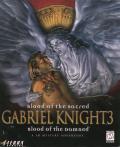
First, it was voodoo. Then it was werewolves. Now, Gabe faces his biggest challenge, going up against vampires. These, however, are not the traditional, sleep-by-day-in-coffins type, but something far more horrifying. What they are, exactly, is something to learn over the course of the game.
Gabe is hired by Prince James of Albany to watch over his infant son and protect him from “night visitors”, mysterious beings who prey on James’ family by stealing their blood. Naturally, the boy is kidnapped, and Gabe traces them to the vicinity of a small town in France, Rennes Le Chateau. It is here that the game actually begins.
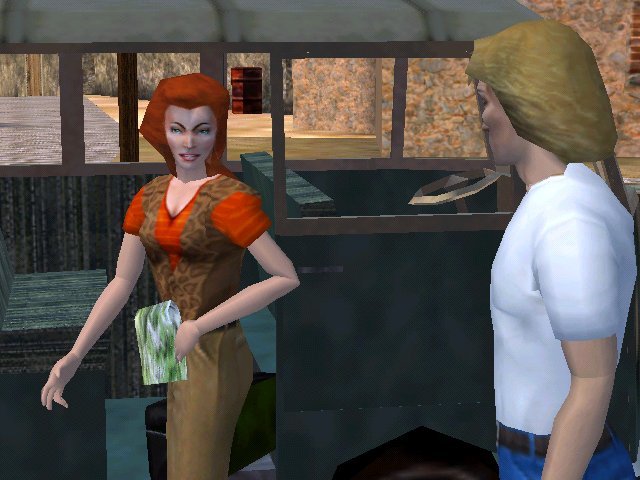
Before long, Gabe is mixed up in a tangled plot involving the Knights Templar, secret societies, political interests, a fabled buried treasure that may or may not be the Holy Grail, as well as a busload of tourists who may or may not be what they seem. Add in return appearances by Mosely and Grace Nakimura, and quite story is brewing.
Unlike the previous games, the time span in “Blood of The Sacred” is rather short, covering a mere three days. Each day is broken up into several hours, or time blocks. The action shifts between Gabe and Grace in different blocks, each pursuing separate investigations, Gabe mostly on the kidnappers, Grace primarily on the treasure, and both doing a bit of snooping on the tourists in between.
Each day is on a separate CD, and since the game progresses in linear fashion, switching of discs is minimal. Further, you can’t advance from the current time block to the next until you’ve done everything necessary regarding the main story line.
GK3 also marks a return to drawn characters, similar to “Sins of The Fathers”, rather than the live-actor vignettes of “Beast Within”. This is combined with a new feature, the “room camera”, that allows for 360 degree viewing without having to move anyone. You can look all around the current location, including up and down, while the character remains in one spot.
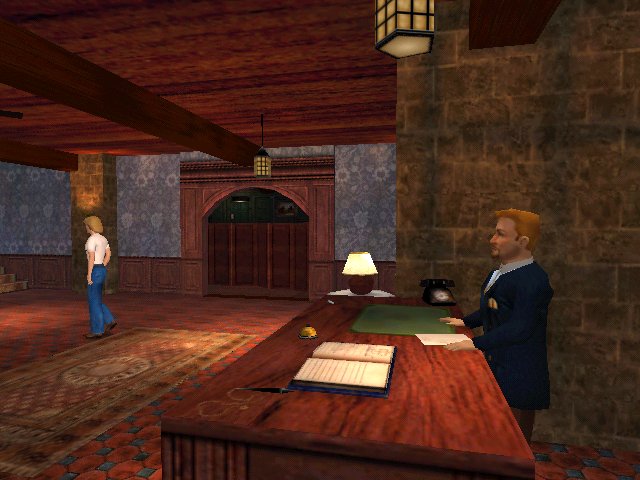
It makes for a very convenient way of examining an area, and there are no problems with that silly “you’re not close enough” message. You won’t see that here. In addition, there are up to six “camera angles” per location. These are little thumbnails, and clicking on one immediately changes the game view to that spot. This is a big help especially to anyone with a slow machine.
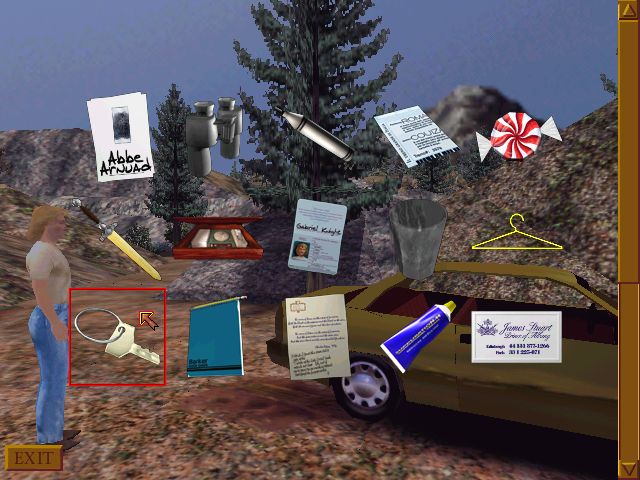
The interface is clean and simple. When the cursor passes over a hot spot on the screen, left-clicking the mouse brings up an icon bar of possible actions. These include a close-up view, a “look” (character makes some comment), talk, operate, go (to another location), use (the current inventory item), and exit back to the game. Not all icons show in all situations; for instance, “talk” only appears if the cursor is on another character.
Speaking of “talk” (heh), topics are also represented by icons. Placing the cursor on one for a short time will display a brief text note as to what subject it represents. Clicking the icon causes Gabe or Grace to make an inquiry about it.
Inventory objects can only be used in appropriate situations, otherwise nothing happens and the items remain unchanged. You can’t lose anything or “use it up” by doing the wrong thing.
For those with hearing problems, or who may want to play quietly now and then, the game is fully text captioned, including the FMV’s. Happily, there are no puzzles involving sounds, tones, or musical notes, so the hearing impaired player is on equal terms with everyone else.
I can’t really comment much on the graphics, as I played on the minimum configuration, a P166 (64M) with first generation 8M Rage card. This required some tradeoffs, such as playing in a lower resolution (640×480), and turning off some of the extra features (like the “glide camera”). For all that, the visuals were acceptable, and the game ran at a decent speed, except for panning around, which went rather slowly.
On the technical end, GK3 ran cleanly. The game crashed on me once, when Grace was booting up Sidney (her laptop), but that was a unique occurrence. I did not come across any bugs, though, of course, there may be some I was lucky enough not to experience. Given that I was playing on the bare minimum system, this is amazing.
Saving and restoring can be done at almost any time, and is fast. Save games are limited by hard drive space rather than a fixed number of slots, so you can have as many as you want. There is also a quicksave feature, invoked by the F5 key.
One of the things I’ve always liked about Jensen’s games is that she does her homework. The voodoo background in “Sins Of The Fathers”, and werewolf framework of “Beast Within” were based on historic material, rather than the usual Hollywood conception of these subjects. So it is also with “Blood Of The Sacred”, a good 90% of which is taken from factual material.
This, however, may be a problem for some players. GK3 is mostly a giant research project; much of the activity in the game revolves around uncovering information about the hidden forces at work in the story. Certainly, there are puzzles to solve, but a good deal of time is given over to conversations and reading material, and there were occasions when the game seemed more like a history lesson than an adventure.
There is nothing particularly wrong with that (especially if you’re interested in history), but I think perhaps there is a bit too much. For one thing, GK3 lacks the atmosphere of menace that pervaded the previous games. Even when bodies start showing up – and bloodless ones at that – there isn’t much sense of urgency or danger.
This is likely related to the short game span. Three days really isn’t enough time to evolve a properly sinister aspect. Everything moves along much too quickly.
That doesn’t mean the game is dull. The story is definitely engrossing; Jane Jensen has always been a good weaver of tales. In this case, though, the tale could have used a few more days to develop.
My one real quarrel with “Blood Of The Sacred” relates to the end game, where we suddenly have “Mario the Schattenjaeger”. Naturally, we expect some obstacles on the way to the final showdown, but these ought to be of a puzzle nature. Unfortunately, Jensen decided to throw in something besides that: a nasty pendulum business, and even worse, that horror of gamers everywhere, the disappearing bridge.
Why? Why, at the very end of what is an intellectual exercise, put in real-time athletics? Not only is it a very jarring note, but these things have no place in a pure adventure game. They serve only to irritate and aggravate, adding nothing of value to the game itself. Fortunately, there are only those two instances, but they are far more than enough.
Overall, Gabriel Knight 3 is, like its predecessors, a standout job. Despite the slipup at the end with real-time antics, and overemphasis on history, this is still a solid adventure with some good puzzles and a well-handled mature storyline. Gabe fans will certainly not want to miss it, and those looking for something beyond the usual shallow offerings should give this one a look.
Final Grade: A-
System Requirements:
WITH 3D ACCELERATOR: (with 4MB+ of video RAM) Windows 95, Windows 98 Pentium 166+, 32 MB RAM, SVGA, high color (16-bit) 4x CD-ROM drive Windows-compatible sound card Mouse, keyboard WITHOUT 3D ACCLERATOR: Windows 95, Windows 98 Pentium 233+, 32 MB RAM, SVGA, high color (16-bit) 4x CD-ROM drive Windows-compatible sound card Mouse, keyboard