Gabriel Knight 3: Blood of the Sacred, Blood of the Damned Review
|
Review Gabriel Knight 3: Blood of the Sacred, Blood of the Damned Jane Jensen/Sierra Studios Review by Ray Ivey |
Learn more about this game at: |

INTRO: Is it great? Of COURSE it’s great!
Okay, I’ve finished Sierra and Jane Jensen’s Gabriel Knight III: Blood of the Sacred, Blood of the Damned. I’ve completed playing the most anticipated adventure game since Riven. “Quick, Ray, quick,” you may be thinking, “Was it worth the long wait?”
My reaction? Three words: Oh. My. God.
It’s traditional at this point in a review to give a thumbnail sketch of the story’s plot. Forget it. I’ll get to the plot later. Suffice it to say that this story takes place over three days, and the action is separated into time block chapters. In some of these chapters you play as the intrepid womanizer Gabriel Knight, and in others his trusty and brainy lovesick sidekick Grace Nakimura.
Hmm. Which superlative feature should I describe first?
Let’s talk graphics first. I’m not a fan of the look of the first two GK games. The first had graphics that were, I thought, pretty behind the times. I know, I know, it was still a DOS game, but I’ve played many DOS games that are older than Sins of the Fathers that looked better. And the video images of the second GK title, The Beast Within, were downright ugly.
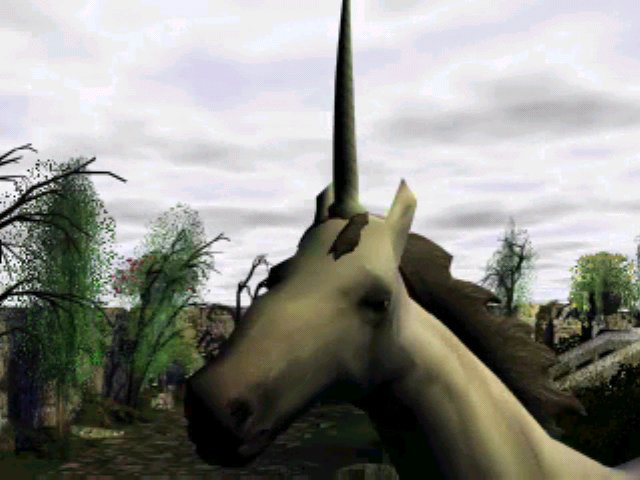
However. All is forgiven with one look at the sparkling images that fill GKIII. An entire region of southern France is recreated, including the village of Rennes-le-Chateau. Hotel rooms, estates, churches, tombs, and hillsides are all gorgeously rendered.
Did I say rendered? Yes, that’s what makes the look of GKIII so very remarkable. It’s in 3D, real-time rendered format. That means that not only do the environments look great, but they have the complete freedom of movement and exploration adventure gamers have heretofore only dreamed of (but which has long been enjoyed by action gamers).
The traditional problem with real-time rendered graphics is that they simply don’t look as good as pre-rendered ones do. GKIII represents a big step forward in narrowing this “art gap.” I saw less pixellation and degradation of image in these graphics than in any other RTR game I’ve ever seen. And believe me, I tested it! I rammed my nose right up against walls, trees, rocks, wineracks, etc. And was I ever impressed.
Next, the interface. Pure adventurists frequently throw up their hands in alarm whenever keyboard interfaces are discussed. Frankly, I was dreading the interface of GKIII. And was I pleasantly surprised! Though it does support some mouse control, I used the keyboard for movement almost exclusively. The really Way Cool feature of the interface is that you can move the camera independently of the characters. This is a terrific aid to exploration.
Any time you want to actually move the characters, a simple mouse click will do the trick. Hitting the Esc key speeds up this process considerably. Within minutes I was flying about Rennes-le-Chateau like I owned the place.
Using inventory items, implementing actions, and navigating through conversations are done with handy icons that pop up with a mouse click. It all worked like a charm. The interface quickly did what all good interfaces do: it became virtually invisible.
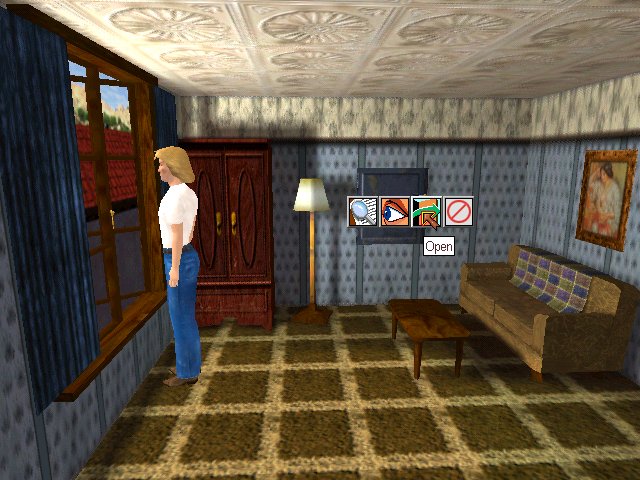
The RTR format of the game creates an amazing sense of unity within the environment. Unlike most games, closeups and long shots all feel like part of the same world. The result of all of this technical wizardry and artful craftsmanship is that GKIII creates a world that feels remarkably real to inhabit.
Also, the music is some of the best I’ve heard in any game; the score is rich, varied and entertaining.
Before I get to the two best features of this groundbreaking title – the story and the storytelling – let me talk about the few things that actually are wrong with the game.
First of all, the beginning of the game is WAY too abrupt. You actually have to read the accompanying comic book in order to have any clue to what’s going on. That’s just silly. And even after reading it, I still felt like I’d missed the first chapter of the story. This really caused me to scratch my head, as an opening movie that was all of two minutes longer would have gotten me off to a much less confusing start.
Second, and I know I’m going to make people mad here, but Tim Curry simply sucks as Gabriel. He stumbles through the role playing Knight like a narcoleptic goober. Gabe deserves better than this. Curry was fairly effective in the first game – even though his accent was atrocious – but his work in GKIII is substandard. This is a shame, because except for him, the voice acting in the game is of the absolute highest caliber. The cast includes Academy-Award-nominated veteran British film actress Samantha Eggar, and Charity James is particularly good as Grace. [See, this is supposed to be the part of the review where I talk about the BAD stuff, and I’m veering off into good stuff again. It’s unavoidable.]
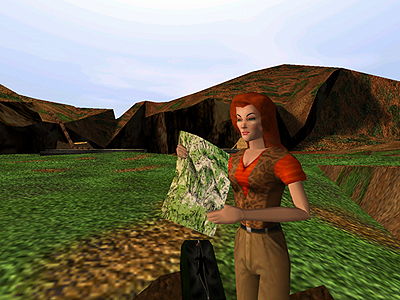
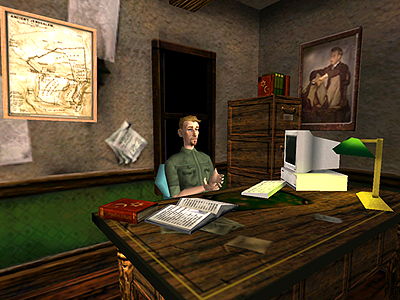
I do wish the humans were as beautifully rendered as the inanimate objects. I know this is a rapidly-developing technology, and it’s currently a problem in nearly all RTR games, but I look forward to the gap narrowing between that the rooms look like and what the people look like in games in this format.
What else is wrong with this game? Uh . . . sorry, can’t think of anything.
On to what makes this a game for the ages. When it comes to spinning stories, Jane Jensen has no peer in this industry. None, zero, zilch. This woman has incredible nerve when it comes to mining history and real locations to come up with mind-blowing stories. In GKI, she told of a voodoo cult in New Orleans that had its headquarters in the basement of St. Louis Cathedral on Jackson Square. In GKII she describes the hunt for a lost Wagner opera about vampires commissioned by Mad King Ludwig of Bavaria.
Despite the unparalleled quality of storytelling in the first two titles, the story in GKIII surpasses them in scope, ambition, and sheer nerve. I really hate to give any of it away, but let’s just say it deals with an ancient bloodline feud going back to the Pharaohs, a kidnapped infant prince, buried treasure, the Knights Templar, Mary Magdalene, vampires, and Jesus himself! If that list sounds dizzying to you, let me just tell you that in the playing of the game, it becomes absolutely intoxicating. This story has all the makings of a best-selling thriller.
Luckily for us, though, Jensen’s storytelling mode of choice is the interactive story. And in that arena GKIII is undoubtedly the best realized adventure game I’ve ever played. All of the elements of the game: the 3D engine and its accompanying freedom of movement, the excellent voice acting (with the one lamentable exception), and the mechanics of the storytelling combine to create a game experience unlike any other.
The world of GKIII lives and breathes. You feel like you’re working your way through a real mystery, with real people, in a real environment. The game is built brilliantly, in that there are frequently multiple ways to achieve a goal, and many optional scenes that augment your understanding of the story. Also, considering the freedom given the player, it’s remarkable that the story is built in such a way that there are no dead ends.
I should say that this game is hard. One of the hardest I’ve played. It’s DEFINITELY not for the novice adventurer. Rather, it’s a rich, multi-course feast for the adventure connoisseur.
Many have said that there is a lot riding on the success or failure of this third Gabriel Knight game. I’m not sure how it’s selling. And perhaps Sierra won’t make any more pure adventure games on this scale again. What’s remarkable is that they had the nerve and vision to produce THIS one. Bucking the current trend of action games and hybrids, they have pulled out all the stops to create an extreme piece of intelligent pure-adventure gaming. Jane Jensen and her team have built the most complete, the most ambitious, the most compelling, the most intelligent, and yes, call me rash, but I’m going to throw caution to the winds and say it, the finest game the genre has yet produced.
PROS: Staggeringly intelligent, dense, ambitious, challenging, gorgeous, complex, and audacious. This is the game you’ve been waiting for.
CONS: Terrible key performance by Tim Curry, unnecessarily abrupt opening.
CONCLUSION: A game for the ages. A game that shows what an adventure game can be.
Final Grade: A
System Requirements:
WITH 3D ACCELERATOR: (with 4MB+ of video RAM) Windows 95, Windows 98 Pentium 166+, 32 MB RAM, SVGA, high color (16-bit) 4x CD-ROM drive Windows-compatible sound card Mouse, keyboard WITHOUT 3D ACCLERATOR: Windows 95, Windows 98 Pentium 233+, 32 MB RAM, SVGA, high color (16-bit) 4x CD-ROM drive Windows-compatible sound card Mouse, keyboard
This review is copyright Ray Ivey and Just Adventure and may not be republished elsewhere without the express written consent of the author. Republication of said review must also contain a link back to Just Adventure.