Discworld II: Mortality Bytes Review — Part 3
|
|
|
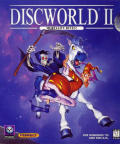
The first Discworld, based on Terry Pratchett’s humorous book series, was as zany as the novels, and a tough adventure besides. Now we have Discworld II: Mortality Bytes, and it’s cut from much the same cloth as the previous game.
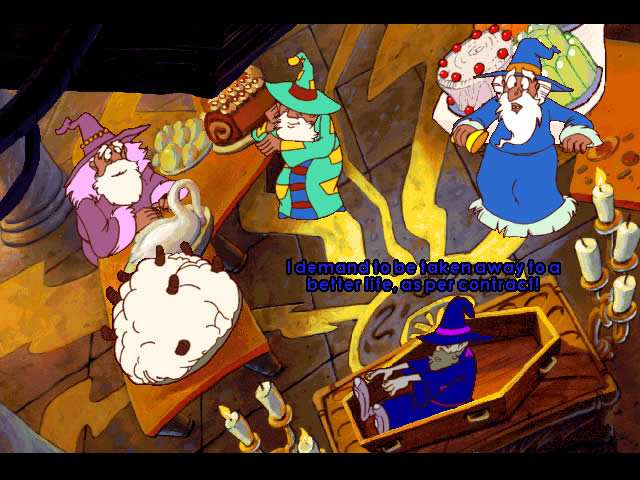
Once again, Rincewind, the inept wizard wannabe, is called upon to save the day, or rather, the dead. The dead are not really, really dead, just kinda sorta in a state of demise.
That’s because Death himself, that spooky skeletal character with black robe and sharp scythe, has vanished. No one knows why, and no one knows where. Without him around to separate soul from body, those who die are stuck in a state of undeath, or maybe living death (this is what happens when, ahem, death takes a holiday). The wizards know a spell to summon him back from wherever, but first, naturally, they need the ingredients, and guess who has to go get them. Right, our boy Rincewind.
It doesn’t end there, of course; that’s just Act I of a five-act game. Before long, our hero gets involved with making budget (low budget) movies, traipsing after wise hermits in the desert, proving himself worthy to take Death’s place, saving Death himself from, err, death (don’t ask), and ending up with a gratuitous takeoff on a famous movie finale.
In between, there is much poking of fun, blatant and obscure, at various aspects of modern culture, physics, role-playing, Shakespeare, and, running as theme throughout the game, the inanity of object-gathering and puzzle-solving. Rincewind is by no means unaware of the silliness of what he’s forced to do, and says so on more than one occasion.
As before, the game mechanics are fairly simple. The “sparkles” cursor is back, and acts as the main interface. Moving it around the screen lights up various hot spots, items or people Rincewind can interact with in various ways.
Clicking on an object takes it (if it can be taken), or uses it in some way, such as opening a door or pulling a lever. Objects can also be combined; for example, putting together a hook and a rope to make a grapple. This is an important feature, as combined items are needed in several places to solve puzzles.
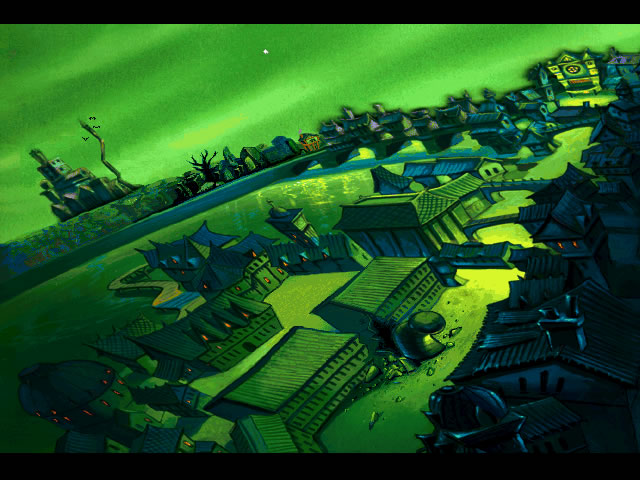
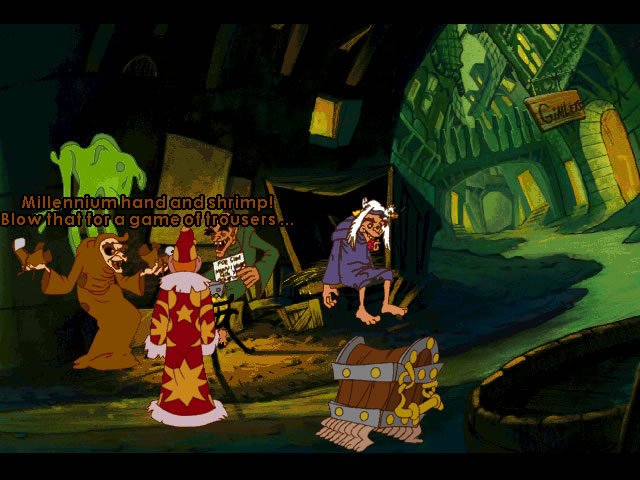
Clicking on people usually begins a conversation. As in the first game, there are no sentences. What Rincewind says is chosen by clicking on different icons: a mouth for general greeting, a jester’s wand for a sarcastic remark, a question mark for a question, and a waving hand for goodbye. In addition, there is a little thought balloon that represents Rincewind’s own private thoughts. Other icons may appear as conversation topics, depending on what Rincewind has previously learned or done elsewhere in the game.
Moving Rincewind around is also simple; you just place the cursor where you want him to go, and click. It’s important to walk around every scene, as most of them are larger than they first appear, and it’s easy to miss something if you just stay in one spot.
Outdoors, you move around on maps of the overall area. Each map has several locations Rincewind can visit; clicking on one sends him there immediately. Some places are available only during certain portions of the game, while others may require some puzzle-solving before they appear. When a new area opens up, however, it is displayed right then on the map so you know it’s now open, a nice touch.
Saving and restoring can be done almost any time, and you have a generous thirty save game slots. While Rincewind isn’t in much danger, and can’t use items inappropriately, it’s still a good idea to save often anyway. Some conversations or puzzle-solving can be lengthy, and you wouldn’t want to re-do them a second time if it can be avoided.
A variety of sound cards are supported: SoundBlaster (original, Pro, 16, Awe32), Wavejammer, Soundscape, Gravis Ultrasound, Rap-10, Pro Audio Spectrum, ESS’ ES688, and Windows sound systems.
If yours isn’t mentioned, don’t despair. Discworld II comes with text subtitles you can turn on (with or without sound), so you won’t miss much. However, if you can get sound, do put it on, as the conversations are a highlight of the game, and are much funnier with the voice-overs.
Speaking of speech (heh), it’s very good, coming through clearly, and the voices are excellently done. This is one instance where voice adds a lot to the enjoyment of play.
The minimum specs say you need a DX-100, but I found the game ran acceptably on a 486/66 with 20 megs of RAM. I suspect the extra RAM helped, as the manual notes at least 8 megs are required for playing under MS-DOS. If you want to run under Windows ’95, you’ll need at least 16 megs (this game does not run under 3.1).
You will also need 640×480 256 color SVGA. Should you have problems with that, the UNIVBE video driver is included on the CD. It works well with many brands of video cards (in fact, I use the registered version myself; it’s quite good).
The game played cleanly throughout from start to finish. No crashes, no bugs, no technical problems of any kind surfaced, and that’s with two complete playthroughs. This is definitely a tight product (although keep in mind that was under DOS; with Win ’95, who knows what might happen?).
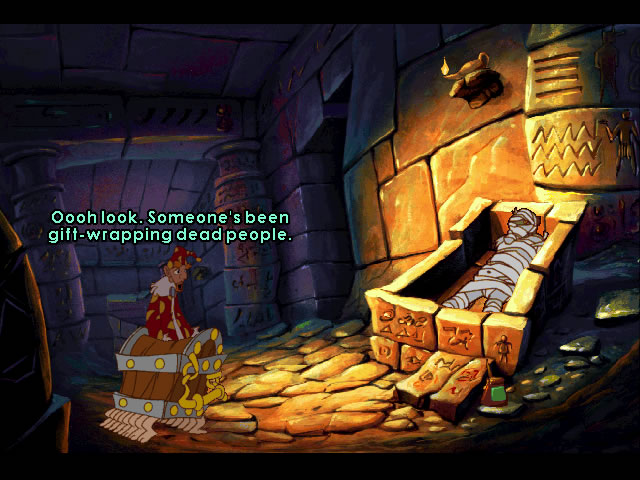
In regard to the puzzles, DW2 might be a little bit easier than the first game was, but not by too much. This is traditional adventuring, where the puzzles have object-oriented solutions. There are no “puzzle puzzles”, such as fitting together torn scraps of paper, solving four-color tile enigmas, playing variants of Concentration, exchanging chess pieces, or the like. I’d call it straightforward, but that’s not a word to use in Discworld (heh). Still, it was good to get back to gaming as it used to be.
If I have any quarrels with the game, it’s that some of the automated scenes were over-elaborate and went on longer than they should have. This was also true of some conversations, which seemed to drag on forever, and lost a good deal of their humor in the process. In those instances, the “less is more” principle should have been applied; something a little funny doesn’t always become more so by dragging it out to extreme lengths.
Overall though, Discworld II was a treat to play: funny, clever, clean-running, and a good mental workout. It’s been too long since I could unreservedly recommend a game, but I can do it now. If you need a break from “serious” adventures, if you yearn for traditional gaming, if you’d like to play something that won’t be over in a couple of days, this is the one to get.
Just Adventure Assigned Grade: A-
System Requirements:
PC version:
486/100
8 MB RAM – DOS
16 MB RAM – WIN95
2X CDROM
Soundblaster compatible