Comer
|
Comer Developer/Publisher: Shine Studio 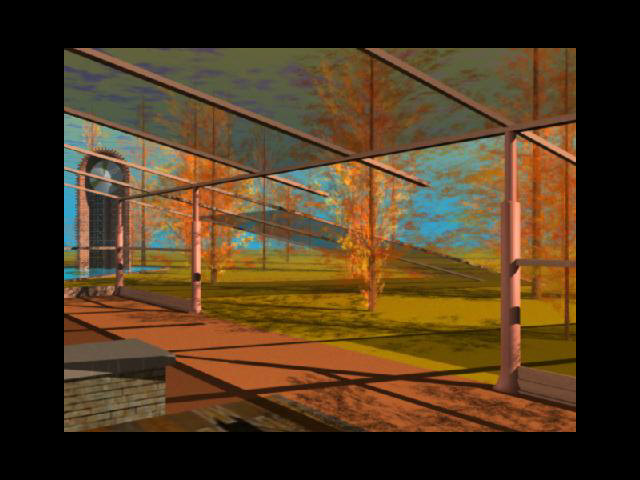  |
In these dark ages of adventure gaming, a beacon did shine into my eyes and draw me forth into the Renaissance, in the form of this small game from a small company, Shine Studio. Shine Studio is basically a one-man operation located in Hong Kong. Kyle Choi, that one man, loved the game Myst and set about to find its equal. Despite the plethora of Myst clones, he could not find anything to compare in his estimation and so set forth to create his own game. In so doing, the student surpassed his master. (Randy pointed out how sappy this sounds, but I am always full of admiration for people who are talented in so many different areas: computers, graphics, music, writing …)
You start off on a high platform overlooking a group of buildings far below. Your first task is to find your way down from the platform and into the buildings, and after solving a couple of puzzles, you are able to view a diorama depicting a maiden being sacrificed to an angry being inside a volcano and being rescued by another being. Hmm, you say, what does it all mean? You soon learn that you are the 28th “Comer” to these strange places, and some of the illustrious personages that have come before you are Einstein, Leonardo da Vinci, and Sinbad. Unfortunately, I can’t really tell you much about the rest of the story without spoiling the game for you because half the fun of the game is watching the story unfold, or at least your own interpretation of it. The story is deeply philosophical, dealing with creation mythology and evolutionary theories, and throwing in a dose of science fiction for good measure. While it built slowly, it was immensely satisfying by the end, and so I give it an A.
The graphics are achingly beautiful. All of the buildings are a mix of traditional Chinese architecture and the modernist, Frank Lloyd Wright style, with an open, airy feel and blended into the landscapes. (One of the things I really enjoyed about Comer was this cross-cultural blend of influences.) The landscapes are varied and fanciful, from a dry, brown village, to a lush green pine forest, to a volcanic lake–all are very lovely. And although there is not much animation in Comer, it being a slide-show style of game, what there is works very well. Even though the graphics are not the height of technology, I am giving them an A+ because they are so captivating, elegant, and imaginative. (I played Comer on my laptop, which has one of those newfangled active matrix screens that lent the graphics a luminescent quality. Makes me wish I could get one of those screens for my regular monitor.)
The music in Comer is quite simply the best game music I’ve ever heard. It is a mix of European classical music from the Romantic era and original compositions, all arranged or written by Kyle Choi with a distinct Oriental flavor. Mostly it is small, light music to fit the small, light places, but occasionally it opens up into powerful crescendos at exactly the right times–I was almost moved to tears in spots. (A separate CD can be purchased containing the Comer music, and I am sore tempted to get it even though I am usually just a plain ol’ rock-n-roller.) The sound effects are also well-done. What little voice acting there was is pretty marginal and hard to hear over the ambient sounds, but since there were probably two minutes total of voice acting, I am not going to let it detract from my A+ in this category.
Gameplay is point-and-click. Just like Myst, there is no inventory, but there are a couple of spots where you hold something and your cursor changes to that item (think: pages) until you use it. There are few or no hotspots, but you usually get directional arrows indicating where you can look next, and sometimes the cursor changes to a hand if you can manipulate something. However, other times the cursor gives no indication that you can do anything, and so that is part of what you have to puzzle out. The puzzles are of two types: mechanical and what-the-hell-is-going-on-here, some easy, some hard. Comer comes on four CDs, and the game unfolds very linearly such that you only have to change CDs five times total in the game. There are a couple of instances where I had to trek back and forth multiple times over the same long path–move something, go back and look, go back and move it again, go back and look again, etc.–which I didn’t particularly care for. Comer is easier than Myst, and shorter–you will probably only get ten to fifteen hours of play out of it–but it is also more fun and prettier than Myst and ever so much more gratifying. Because the gameplay is so well-designed and laid out, I am going to give an A despite those long paths.
Shine Studio warns right on its web site that you will not like this game if you did not enjoy Myst, and I would say that probably is true. However, I did like Myst, and I really liked Comer, so my overall grade is an A.
Comer is currently available only online through Shine Studio’s web site.
System requirements:
Windows 95/98
100 MHz Pentium or faster
16 MB RAM minimum
10 MB hard disk space
8x CD-ROM drive or faster
800×600 display, 24-bit True Color preferred
640×480 display, 16-bit High Color acceptable
Windows-compatible sound device