Black Dahlia Review
|
Black Dahlia Developer: Take 2 Interactive Software, Inc. |
|
Search Game Trading Zone for this game More information about this game at the JAVE! |
During the late 1930’s, Cleveland was terrorized by a serial killer called variously the “Mad Butcher” and the “Torso Killer”. Twelve murders were attributed to him, with another five possibles. The carnage stopped shortly before the second World War. Officially, the case was never solved, and remains open to this day.

On January 15th, 1947, the tortured and maimed body of Elizabeth Short, a wannabe actress, was discovered in Los Angeles. She was strikingly beautiful, with a preference for black; a reporter covering the crime nicknamed her “the Black Dahlia”. Her murder, in several ways, resembled the killings in Cleveland. And like those earlier deaths, hers was never officially solved, either.
Down the years, many unofficial solutions to both cases were put forth. Now Take2 has tried their hand at it, with their mystery adventure, Black Dahlia.
The story begins in Cleveland in late November 1941. Jim Pearson is appointed to the newly-created COI (Coordinated Office of Intelligence) to replace the hastily-retired Walter Pensky. He isn’t taking over Pensky’s work, however; Pearson’s assignment is to investigate the Brotherhood of Thule, an organization suspected of being a front for subversive Nazi activities.

It isn’t long before Pearson realizes the Brotherhood is something far more sinister, and that it’s somehow connected to both Pensky’s case and the Torso murders. Add in rivalry from the local police, the FBI, plus Nazi spies, and the complications pile up fast.
A resolution of sorts is reached just at the time of Pearl Harbor, but the matter is far from finished. The action picks up again at the end of the war, beginning in a Nazi vault, then moving to an Austrian monastery, an American air base, and a cross-country train, finally concluding in Los Angeles in 1947.
The tale is a skillful blend of fact and fiction, using, or based on, many actual events in both the Torso and Black Dahlia cases. Jim Pearson, of course, is fictitious, though much of what goes on around him, or what he investigates, is part of history. The designers really did their homework here; the fictional and real world elements are seamlessly integrated into – at least for game purposes – a plausible whole.
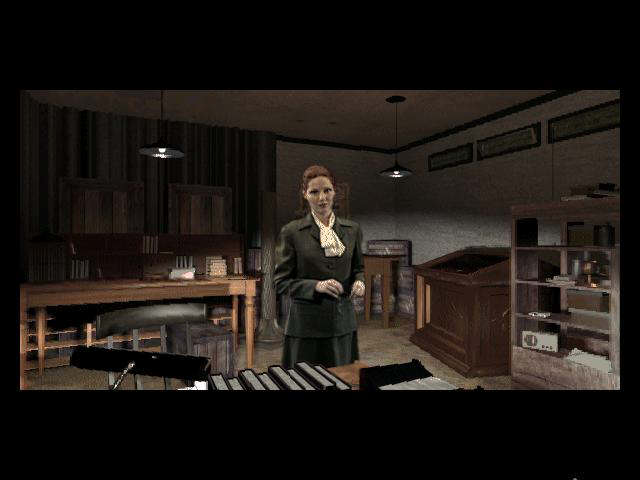
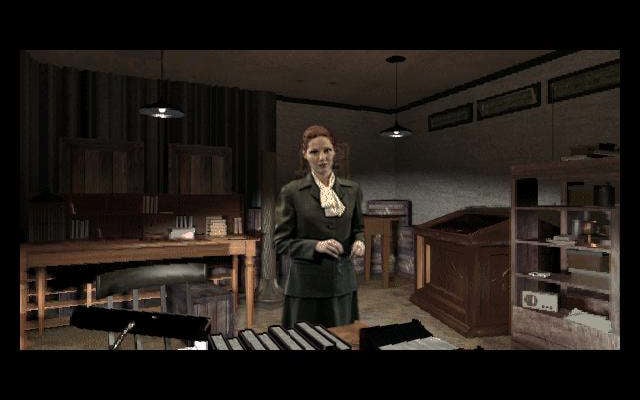
In terms of mechanics, the interface is simple. The basic cursor is a diamond-shaped rune. As it’s moved around the screen, it can change to a large pointing arrow for movement, a small spinning arrow for actions, and (when the left mouse button is held down) a circle with small arrow for turning in place.

Despite the ability to turn a full 360 degrees, however, movement is actually rather limited. You can only go in certain directions to predesignated points, rather than walk around the screen at will. This is basically the same system Take2 used in Ripper, though faster and much less aggravating.
Traveling to various locations is quick and easy. A “world map” displays photographs of places you can visit; clicking on one takes you right there. Naturally, only areas relevant to where you are in the story are shown.
Typical for games these days, the action cursor automatically performs the appropriate function when clicked: open a door, pick up an item, talk to someone, read a document, etc. The cursor has a secondary use of moving items, but it isn’t always obvious when this should be done.
For example, there’s a notepad in a desk drawer. Clicking the pad shows you what’s written on it. However, you can also hold down the mouse button and drag the cursor, thus moving the pad to reveal something under it. But there’s nothing special to indicate the pad can be moved; it has to occur to you that this can be done, which could easily take awhile.
Talking to people is simply a matter of clicking on them, and then going down a list of topics. You can sometimes also ask about items by opening the inventory box, highlighting an object, and clicking “use”. If the item is relevant to the situation or person, you get a response; otherwise, nothing happens.
Saving and restoring can be done at almost any time, and the number of save slots is extremely generous. Very likely, you will go through the entire game without having to overwrite an old position.

Black Dahlia is linear, not only in story, but also in progression across the eight CD’s. Where some games have you always switching among disks, here you move from 1 to 2 to 3 and so on. Near the end, you will go back a couple of times to an earlier disk (the game actually finishes on CD #1), but for the most part, when you’re done with a CD, you won’t be needing it again.
On the technical side, there was occasional stuttering in the FMV’s; somewhat annoying, but not a major problem. I did have a lot of trouble with CD #7, which I suspect was faulty. It didn’t sound right in the drive, which seemed to have trouble reading it, and several times the game blew out to the desktop. Once off that disk, the difficulties cleared up. Other than that, the game ran flawlessly.
Sad to say, the game is completely auditory; there are no text subtitles here. Anyone with hearing problems will have a hard, if not impossible, time playing it.
While the story is interesting, it is easy to become bogged down, mainly because of the puzzles. There are far too many mechanical manipulation puzzles in the game, most of which have no clues or hints towards their solutions.
For example, you have to open a puzzle box in the shape of a mill by pushing and pulling various parts, such as windows, doors, and the like. The only way to do this is by trial and error.
Later in the game, in the Nazi vault, you are faced with four difficult problems, of which getting the door open is only the first. Inside are three small safes, each requiring an elaborate set of movements to unlock. Again, you have no guidance towards the answers except experimentation.
Even worse, there are times when you solve a difficult puzzle for a result that is hardly worth the effort. At one point, you have to open a door by pressing panels in a certain order. The order is on a card that can be folded in various ways, as well as flipped over (thus folded from either side). When you finally get into the room, it’s just to look at something you probably examined on an earlier visit.
Naturally, all the puzzles have to be solved for the game to progress. If you don’t like this type of enigma, or have a hard time with such things, Black Dahlia will be that much more difficult for you, and not a lot of fun.
I point out that there are other types in the game, both the traditional object-oriented adventure puzzles, plus some logic/deduction problems to solve. So there is variety here, but the manipulation sort is by far the most numerous.
The character of Jim Pearson was another sore point. At the start, he is near-perfect as the new agent on the block: a bit naive, but not unduly so; occasionally brash and overeager, but in the main, fairly intelligent. We therefore expect that four years in the OSS would bring him some maturity and smarts.
Unfortunately, his secret service experiences seemed to make him more gullible than before. He mouths off to the wrong people, falls for the most obvious tricks, and allows the main villain to lead him around by the nose. After Cleveland, Pearson’s abilities take a severe downhill slide, making some events late in the game rather painful to watch.
Speaking of painful to watch, the ending is definitely in that category. At the penultimate moment, you have a choice between two actions. One leads to the “good” outcome; the other to the “bad” outcome. The supposed “good” one is far from satisfactory. This is, after all, a game, not film noir. The player deserves something better, if only as a reward for making it through to the end.
Overall, Black Dahlia is yet another in a long line of games that leaves me with mixed feelings. Period flavor is good; the story is interesting; the research well-done. But many puzzles are tedious if not frustrating, the main character declines instead of improves, and the finale is a disappointment, to say the least. Which is a pity, because with a bit more attention to the adventure side of the game, and a less dismal conclusion, this could have been a superior product. As it is, anyone who plays Black Dahlia should be prepared for an uneven ride.
Just Adventure + Assigned Final Grade: C
System Requirements:
Pentium 90
16MB RAM
4X CD-ROM
Windows 95/98
Screenshots