Adventuring Underground–Issue 3
Adventuring Underground
Issue 3
By Rob Merritt
Adventuring Underground is a weekly feature that will cover the burgeoning community of shareware and freeware adventure games available on the Internet.
The Creator’s Toolbox
Making Your Own Adventure Game 101: Class 3–The Elements of a Basic Adventure
This week we are going to dissect adventure games–take them apart and find out what adventure games are made of. Some elements are concrete and other are harder to grasp. You probably already know most of the elements but maybe haven’t given them much thought.
The most basic element of adventure games is theme. The theme is the overall setting, feeling and mood of the game. Theme is the heart and soul and of adventure games. Take the action game Quake, for example. Quake has no theme. One minute you are fighting knights, and the next minute you are fighting space marines. While that works for Quake, the same kind of psychotic grouping of theme elements would kill an adventure game. Take a look at any of the long-running adventure game series and you’ll find their themes remain consistent with each title. Tex Murphy’s theme is 1940s detective noir set in the twenty-first century.
Once you have your theme down, you need a plot. The plot element is whatever motivation you give the player to continue playing and eventually finishing the game. It could be to save the world or to bring down an evil duke. Within the plot, you would script out certain scenes, goals you want the player to achieve, and basic places for the character to visit. In Leisure Suit Larry 7’s plot, for example, Larry takes a Love Boat-type cruise while trying to score with as many women as possible.
Whatever world you create, it needs to be broken up into rooms and pathways. Rooms are the individual locations the player can visit. They break up the world into manageable parts. Sometimes, rooms have logical barriers. One room could be the outdoors, the next room is the hallway, the living room, the space-time anomaly, and so on. Other times, they are broken into puzzle areas to narrow the player’s field of manipulation. That makes some puzzles easier and more enjoyable. First-person perspective games, like Myst, use whatever is in front of the player as a room. Turn left, and the player is in a new room, even though as far as the player is concerned, he or she is still standing at the same spot. Pathways are just the way the player gets from point A to point B. As a player, you just take pathways for granted. Adventure game authors have to watch pathways very carefully. You have to make sure that the player can’t get to a certain area before he or she is supposed to.
Objects are an important and often-overlooked element. Just about everything is some sort of object. Objects can be the key to unlock a door, a book with clues, or a picture on a coffee table. Sometimes it is tempting to put only objects in the game that are directly related to puzzles. For a really enjoyable world, there must be many objects in each room that do nothing to advance the game. They are there just to exist and sometimes to be played with.
To some extent, characters are just objects that do more things. That’s an important concept to keep in mind since many game authoring tools only have objects. Adventure game authors will have to be a bit more creative to make their characters come alive. Beyond that basic level, characters can be used to give the player information, as a part of a puzzle, or just a fun way to liven up the game.
Puzzles are the final and the most recognizable element of an adventure game. When a person buys or downloads an adventure game, he or she expects to be challenged by some sort of puzzle. Some puzzles are hard, some are easy, some are seamless, and others are astray.
Object puzzles are the most common in graphic adventures. These type of puzzles require the player to use an object, by itself or in combination with another object, to overcome some sort of challenge. Using a key to unlock a door is the most basic example of this type of puzzle.
Fiddle puzzles are a staple of first-person adventure games. The player finds him or herself in a room with a bunch of buttons, knobs, dials, and/or other mechanical devices. By fiddling with these items, the player should eventually see a pattern and learn how to manipulate them to get the desired effect. Pretty much any puzzle in Myst is a fiddle puzzle.
Maze or movement puzzles aren’t used too much these days. They were very popular in the days of text adventures. The player must simply find his or her way through a maze or a series of locations.
Conversation puzzles are used to give a player a challenge when talking to a character. The player has to say the right thing to a character to get the information or item that he or she wants. These puzzles can be really boring if not done well. Blade Runner was one of the few games that excelled in the use of conversation puzzles.
Game puzzles are mini games inserted in an adventure game. The player has to win a game puzzle to solve a challenge. They tend to be copies of classic board and card games. The microscope puzzle from The 7th Guest is a game puzzle.
Timing puzzles, while popular with developers, are the bane of most diehard adventure gamers. Back in the days of text adventure games, timing puzzles meant you had a limited number of steps or commands you could type in. Currently, a vast majority of timing puzzles are action games inserted into an adventure game to make the game more appealing to non-adventure gamers. Timing puzzles can be used effectively but not often. The canyon motorcycle fights in Full Throttle were timing puzzles.
Pixel-hunt puzzles are a test of the player’s observation skills or ability to move the cursor around and click on every single pixel. Depends on your point of view. Pixels are the dots that make up the screen on a computer or TV. In pixel-hunt puzzles, the game author has created a small but important item to click on and made it hard to see in the background.
Verb puzzles are exclusively available in text adventure games. The player has to guess the correct verb to solve a puzzle. Sometimes these puzzles are unintentional, but they add to the charm of text adventures. Below is an example of a verb puzzle being worked through.
You are standing in front of a door.
>Open door
Cannot open that.
>Use door
That cannot be used.
>Unlock door
The door is unlocked.
>Walk through door
You cannot go that way.
>Enter door
You enter the door. You find yourself in a large hallway.
Enough with the dull stuff–next week we are going to bring everything together and start making an adventure game. Your homework for this week: create a character. What is the character like, and how does the character interact with the player?
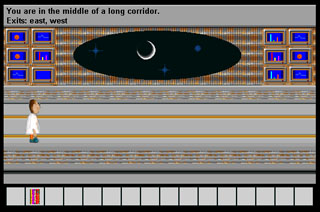 The Underground Game of the Week: Space Doubt
This week’s featured game is Space Doubt by Ambrosine. You play George, a lonely researcher trying to find his buddies on his birthday. Nothing really is outstanding about this game, but it’s a good example of what can be done by a hobbyist in his or her spare time. The story is cute and plays out well. Graphically, the game is minimalist but gets the job done. The interface is simplistic and completely fills the needs of the game.