Adventuring Underground–Issue 1
Adventuring Underground
Issue 1
By Rob Merritt
Adventuring Underground is a weekly feature that will cover the burgeoning community of shareware and freeware adventure games available on the Internet.
The Creator’s Toolbox
Making Your Own Adventure Game 101: Class 1–Why Adventure Games?
If you are like most gamers, more than once you have thought to yourself, “Gosh, I would love to make a game.” Often, this stems from the desire to play a type of game that the commercial game makers just don’t seem to be making. Other motivations include building a better game, putting your own twist on a classic game, the need for a creative outlet, or the old-fashioned desire just to do it because it’s a mountain you haven’t climbed. During the 1980s, most computer hobbyists wrote games. A couple of evenings coding in Basic, and you had your own version of Wampus or Space Invaders. Whatever the reason(s), some of you have started down that path and stumbled, and many more of you haven’t acted upon that desire. Over the next six weeks, I’m going to give you the knowledge and skills to start down the long and rewarding hobby of making your own adventure games. Many of the concepts I will be writing about will be applicable to many other genres as well, such as RPGs. Here is a quick syllabus:
Week 1: Why Adventure Games?
Week 2: Tools of the Trade
Week 3: The Elements of a Basic Adventure
Week 4: Building Your First Adventure Game Part 1
Week 5: Building Your First Adventure Game Part 2
Week 6: Advanced Topics and Summary
Game creating as a hobby can be a blast, but the path has quite a few obstacles. Once you decide that you are going to seize the day and create your own game, you have to decided exactly what type of game you want to make. Since you are reading this article, I can assume that you are primarily interested in making an adventure game. Let’s step back from that decision and analyze why this genre would be a good choice.
It’s always best to go with a genre you love. Nothing is worse than a game whose creator didn’t have his/her heart in the project except for creating a game your heart isn’t in. You will probably get frustrated and quit after a short time. Your vision mixed with a dash of passion will get you over the rough parts. Another added advantage to creating a game in a genre you love is that you already have a basic knowledge of what game play concepts work and don’t work.
Adventure games do not rely on technical wizardry, whereas other genres require a lot of eye candy in order to carry the game. With adventure games, if you have a good story and a few interesting things for the player to do, you are well on your way to creating something cool. If you create an action game with a Wolf3D-type engine, hardly anyone is going to play it no matter how clever the game is.
Unlike any other genre, there are many game creator packages that will do the bulk of the technical work for you. There are game creators for other genres, but you’ll often find they only make classic-style games like Space Invaders and not much else. Many naïve game creating hobbyists rush out and buy C++ books such as “Teach Yourself C++ in 30 Days,” only to find themselves bored, frustrated, and unmotivated. You have nothing to prove to those who insist you must use C++ and only C++ to make games. You’re doing this as a hobby and not as a career. C++ is probably the worst tool to get started with. If you want to pump the maximum number of frames per second out for a 3D game, C++ is the tool for you. Working by yourself, you’ll spend months, if not years, carving out even a simple adventure game engine before you ever begin working on the game proper. Game creation packages such as Multimedia Fusion, AGI, SCRAMM, and many others are your best tools. If you need a little more flexibility to make your vision reality, Visual Basic is preferable to C++. With tools already available, you can spend more time concentrating on game play instead of learning Windows API.
There is little in the way of commercial adventure games coming out these days. This is good for the underground adventure creator because this means his or her title will more likely be noticed, whereas the action genre is extremely crowded with commercial products made by large teams and multi-million dollar budgets. In that kind of environment, it is hard for even the best shareware/freeware action game to get noticed. Adventure gamers aren’t so desperate that they will tolerate crap, but if your game is good, it will get noticed. Odds are good that you already have the most essential ingredient for making an adventure game, a story to tell. You may feel that you don’t have anything to say. You may feel that you don’t have an idea for a game. I think you do. Something interesting has happened to you, something you’ve told friends and relatives during social gatherings. It might be the time you and a friend went hunting and got scared by what you thought was a bear but was in fact a bush blowing in the wind. Expand on it, embellish the story a little, and add challenges and you’ve got the story for a great underground adventure game. If all else fails, just do something totally bizarre and off the wall. You are free to create the world you want.
Your homework for this week: think of your five favorite adventure games and point out their similarities. What makes them your favorites? Would those be the features you would choose to include in your game?
Next week I will go over the tools you can use to create adventure games. I am rather ignorant of tools, if any, available for the Mac and Linux. I will include in the next column any information that is e-mailed to me.
Featured Underground Game of the Week: The IGNAC Demo
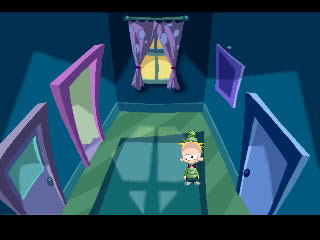 An underground title that is currently generating a lot of excitement in the Click community is IGNAC. Created using the Game Factory, the demo released late last year showed a game in development that could match the mid-1990s efforts of companies such as LucasArts and Sierra. The IGNAC demo has an interesting story concept, a friendly point-and-click interface, and a humorous tone. What really separates the IGNAC demo from the rest of the pack is the quality of the artwork. The consistent high-resolution, commercial quality graphics are presented with style and accented with detail.
Your alter ego is a school-aged child who has been sent to his room for getting a bad grade on his report card. The object of the demo is for you to sneak out without your parents noticing. There are many object in each area to explore. While short, the IGNAC demo is a joy to play. In the Click community, it is common for people to release demos. These demos are generally not like the demos released by commercial companies. Commercial company demos are, more often than not, simply a marketing tool. Click community demos are works in progress, rough concepts, or a way to exchange ideas among community members. The demos almost always have rough edges that need to be polished out for the final product. With this in mind, click on this link so you can check out the IGNAC demo yourself.
If you have any questions or comments on Adventuring Underground, please email me.