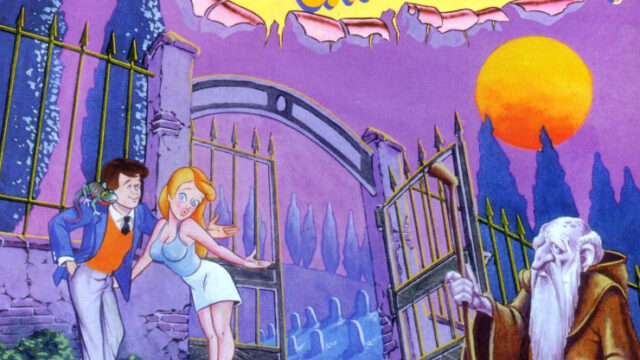
Igor: Objective Uikokahonia Review
|
Review Igor: Objective Uikokahonia
Review by Agustin Cordes |
 |
An attempt for a slightly eloquent introduction
You might have heard of Runaway by Pendulo, a generally well-received adventure game released a few years ago. It should be safe by now to say that its release meant a triumphal return to a very classic form of adventure gaming, the humorous third person point-and-click game, a style made popular for many years by LucasArts before they turned into the boring company they are today. Even with its eventual flaws, it has to be admitted that, underneath its gorgeous up-to-date graphics and novel character animation technology, Runaway was, at its heart, an old-school game. We’ve seen further examples of this kind of nostalgia streak since, most recently with The Westerner – which will soon be released in North America – that also managed to successfully marry this type of classic adventure with modern 3D technology. Curiously (or not) both Runaway and The Westerner come from Spain where this passion towards old-school gaming seems to be more pronounced than anywhere else. Whereas some adventures are still trying to somehow introduce action-y elements, Spain, during its relatively unknown but generous legacy of them, has never to my knowledge deviated from the typical form of adventure game. And yet, with both the aforementioned games, they managed to introduce novel features without sacrificing the purity of our beloved genre (OK that was lame).
The game I’m going to take a look at now was neither revolutionary or novel, and many would argue it even wasn’t the least original, but it had a huge impact in Spain when it was first released in the mid 90’s as it was the first full-blown production of a graphical adventure game. It also was, as I was saying above, a clear indication of the type of adventure preferred by the Spanish developers. The game in question is Igor: Objective Uoca… Uikoala… Uikokahuna… U-I-K-O-K-A-H-O-N-I-A!
Aaah, college life… a necessary pain
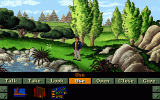
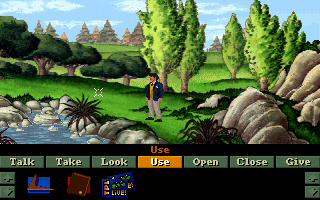
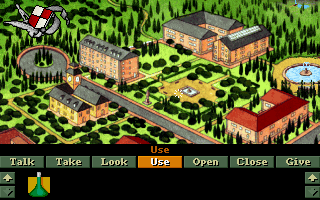
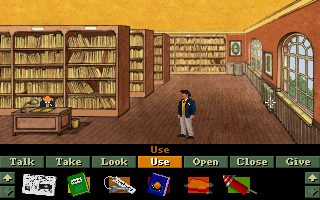
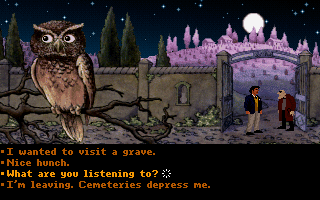
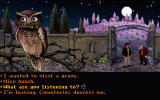
Judging by the screenshots, one could certainly think this is a long lost game from LucasArts, and it certainly looks that way. It is understandable when a new company attempts to emulate a successful type of game in their first effort. While Igor’s graphics might vaguely resemble Indiana Jones and the Fate of Atlantis, its slapstick humor is more reminiscent of the Monkey Island series. Fortunately, Pendulo didn’t blatantly rip-off a Guybrush game as the storyline is unlike anything the Star Wars company ever did. So, while Igor is a game notably influenced by Lucasarts (there are even some ‘classic’ jokes from them thrown in the mixture, as if their influence had to be clearly stated), after only after a few moments of playtime one realizes that it can stand on its own merits.
Igor is the typical student (although bearing an atypical name) doing typical student stuff: a lazy ass spending most of his time looking for girls who’d rather go to his favorite bands new show than grab a book. I mean, come on, what else is college for? However, Igor is about to suffer a radical change experiencing that odd feeling called ‘love’, a new and exciting event to him. Everything would be fine but the object of his desires, a beautiful and studious blonde girl, is being stalked by an annoying guy who has something Igor doesn’t have: good looks. I understand that our JA readers spent (or are spending in the case of the youngest readers) most of their time playing adventure games during their college years and this kind of interest toward the opposite sex was an unknown thing to them. Well, usually this is what normal people do – go figure!
Igor soon learns this girl is going on an educational trip – organized by the Biology class – to Uikokahonia, a paradisiacal island to (supposedly) study its fauna and flora. It shouldn’t take a very perceptive mind to realize that, rather than study animals, the students are probably going to behave like them but, anyways, Igor thinks to himself this would be the perfect chance to get closer to his beloved one. His hopes quickly diminish when he learns that getting invited along on the trip isn’t going to be that easy – what’s worse, that sloppy creep is also going to the island (and he definitely isn’t interested in the fauna and flora). The first step, just a minor detail, is that Igor must pass the Biology exam (kinda makes sense). Is he finally going to open a book and read something? Will his burning love force him to fill his mind with knowledge? Let’s say he eventually fixes this particular problem. Secondly, he still has a Biology paper due, again, a problem that requires all of his genius (except having to study, of course). Thirdly, those Biology bastards actually make the students pay for the trip and Igor will have to get some cash in order to visit Uikokahonia.
One thing that’s hard to deny is how funny this game can be. While there aren’t that many humorous situations (Animal House and togas come immediately to mind with mention of the word ‘college’) the dialogues, and especially Igor’s responses, often crack you up. For example, when you take a look at his bed, “There’re only two reasons to use a bed… and I’m not sleepy.” Personally, I can think of at least four reasons to use a bed but still, these types of humorous moments do manage to grab you by surprise.
Sadly, despite the well-placed jokes, the dialogues themselves are usually pretty bland. Just a little more effort in the writing department would’ve been appreciated since this type of game heavily relies on the characters and interactions with them.
No, this has nothing to do with Frankenstein

As stated above, Igor was first released in Spain and a year later, the English version was published by Optik Software. Having played both versions, I noticed slight differences between each other. The interface is more polished in the English version with better-placed buttons that make the gameplay more comfortable. I even thought the mouse response was better but that might have been under the illusion of the new interface. Also, some of the graphics in the hallway inside the college are different – they’re more detailed and crowded (however you aren’t able to speak with all the new characters).
Graphically, this is a very nice looking game. Obviously by today standards it doesn’t stand a chance but I was surprised to find that most of the scenes were still quite pleasant to the eye, especially in the colors that were adequately used to give each scene a consistent look. Bear in mind this was the best looking game ever made in Spain when it was released many years ago!
Now, during the course of writing this review (that, for one reason or another, was delayed over and over again for what seemed to be an eternity), I came across the Spanish CD-ROM version and found the voices being regular, without ever being annoying or sounding too inspired, although I didn’t try the CD-ROM by Optik Software with English voice-overs because it’s simply one of the most difficult to find versions of any game. The entire soundtrack, which was digitally reworked and now came in the form of audio tracks a la Secret Of Monkey Island, sounded much better this time. It should also be noted that the new Spanish CD also boasts all the improvements done to the game (interface, graphics, etc.) since its original release. The rest of the sound aspect was appropriate enough, with some well placed special effects and nice music here and there, but nothing too remarkable with the exception of a quirky introduction song (that makes its appearance again during the course of the game) – I just want to let you know that I still can’t get that friggin’ tune out of my head (or, in other words, it’s quite catchy)!
Movement in the game is as easy as it can get with the SCUMM-like interface. The ‘Go to’ button was removed in the new versions and with a good reason as it was useless being the default action. I only found one frustrating problem in one of the scenes where an exit location wasn’t very obvious until I moved the mouse over a corner and found it. Then I recalled I also had the same problem when I originally played the game. The scene in question is inside the university, right after you enter, but this was basically fixed in the new versions as you directly bypass that area (which I find strange – I can only guess either too many people complained about the same problem or the difference between new and old graphics was too noticeable to Pendulo).
On a more technical note, I was surprised to find that Igor runs nearly flawlessly under XP with little to no hassle. Information on how to achieve this can be found near the end of this article.
Looking for love in Uikokabaña

Or something like that. One would guess the majority of the game takes place in Uikokahonia, given the flashy name and all, but surprisingly this is not the case, which is ultimately one of the games biggest disappointments: it never manages to reach a satisfactory level of fulfillment.
Most of the puzzles are well integrated to the story but are the typical ‘use’ and ‘give’ commands. When I found one out of the ordinary, either it was admittedly clever or downright illogical and far-fetched but hey, nothing you wouldn’t find in a Monkey Island game. There is also some pixel hunting. I don’t know what’s going on nowadays but everyone seems to be complaining about it (like in Runaway for instance – when I read so many complains I was baffled as I swear I didn’t even notice it!), so I guess I’m paying more attention now. All in all, while the puzzles might be a mixed bag, none of them are bad enough to mar the adventure.
The puzzle structure itself should sound familiar as you have to solve three major tasks (independent from each other, which makes the game more or less non-linear) consisting of several lesser tasks namely: pass the Biology exam, finish a paper and get some money. As Igor is lazy and doesn’t give a heck about Biology, that’s where you come in. You’ll have to help him outwit the bad buy and get the girl – it sure sounds easy on paper, but Igor will have to put his life in danger, deal with bizarre characters and undergo personal humiliation – among other even less pleasant things – before finally reuniting with his love.
Seems exciting, does it? Well, here is precisely where Igor loses some its charm. While the setting is unusual, the storyline isn’t and it feels like it’s never fully exploited. There’s one sequence that clearly exemplifies this: the part about getting the money, where you somehow end-up playing the role of a semi-detective and must retrieve a stolen object from some dangerous individuals. What seems to be at first a challenging and promising side-plot of the game is nothing else than simply steal the object back from them with very little effort (tiny spoiler: you never even get to meet the burglars face-to-face!). In other words, it could have been much more but it ends feeling like just another mundane task.
Also, it’s my duty to inform you this game has committed the utmost sin because halfway into it there is *gasp* a huge and mean maze. Maybe the second most unforgiving maze I’ve ever encountered in an adventure game (I think Countdown earns that dubious honour). The problem with it is that, besides being a maze, all the screens look awfully similar and make mapping it with pencil and paper a must. Even worse, the designers force you to go through it twice (once heading east and once heading west). Shame on Pendulo for using this vile way of extending the game length. Thankfully, they haven’t committed this heresy since.
I’m tired of coming up with these silly headlines
It’s a shame though how Igor turned out. Not that is a bad game, far from it; it’s a very entertaining adventure that should please any fan and clearly a signal of better things to come. However, it leaves you with a very empty feeling, craving much, much more. There were so many places where it could have been expanded that you can’t help feeling this could have been a true classic, but it never manages to fully reach its potential and satisfy the player. For example, the detective part mentioned – I keep thinking the designers could have added some more action, like being captured and having to escape from the burglars. And once you get to Uikokahonia (where I was happy as I thought I was getting to explore the island!) there’s nothing to do there. I do understand that, as a first game, Pendulo probably didn’t have enough budget for a more accomplished endeavor but I can’t help but imagine the game this could have been.
In the end, this is quite a piece of history from Spain being the first major adventure production. I must admit that this game stood the test of time. I had fond memories of thoroughly enjoying it when I first played it long time ago and I was afraid this time it would be somewhat outdated. Not only I was wrong, but I think I enjoyed it even more this time – at least while it lasted. Definitely a charming adventure that could make for a great weekend provided you can find it! Now let’s cross our fingers and hope Pendulo pulls Igor from its underdog status with a re-release soon.
Final Grade: B-
System Requirements:
Are you kidding? This is a DOS game! Anyway, a VGA display, Sound Blaster compatible audio card and mouse are required to play Igor: Objective Uikokahonia.
Running Igor: Objective Uikokahonia on moderm systems:
I found that any version of this game runs under Windows 2K/XP with almost minimal configuration. In the first place, it’s fully compatible with DOSBox, that brilliant DOS emulator that no nostalgic considered gamer should be without. Digital sound effects weren’t supported on previous versions but, as of the current 0.61 release, they work great. If you find the game runs somewhat slow for you under DOSBox, it’s possible to increase the emulated instructions rate to achieve better speeds. It isn’t as difficult as it sounds – simply edit the dosbox.conf file found on the folder where you installed the program (the setup also adds a link to this file) and change the following line:
cycles=2500
The optimal setting might vary from system to system but I found a 3500 value works fine.
One other option is to use VDMSound. This handy program emulates a Sound Blaster compatible card under NT systems and works well with Igor. This way the game is ran natively under Windows but a problem arises: the mouse doesn’t works well – the buttons might function correctly but the cursor won’t move. I learned this is a 2K/XP problem where some mouse events aren’t being sent correctly to a command line window. Solving this is easy with yet another handy program called Mouse2kv and using the following values:
mouse2kv 320 240 1 1 igor.exe
where 320 and 240 is the resolution used by the game and 1 1 is the horizontal and vertical speed of the mouse cursor. I found that any value above 1 makes Igor unplayable. If the game complains about not having enough memory try this line:
loadhigh mouse2kv 320 240 1 1 igor.exe
Last but not least, the latter CD-ROM version which saddly only Hispanic speakers might enjoy right now (unless you’re a very, very lucky fellow). This version may run “out of the box” with the exception of the aforementioned Mouse2kv need, which addresses the static cursor problem. However, you might not be able to set-up your sound card because (apparently) the setup program will only run if you have a very old ISA sound card! I was shocked as the silly program wouldn’t even let me manually configure this. And I knew all I needed to do was explain the game things such as what IRQ I was using – except I had no idea what was the syntaxis being used with the configuration file. But I’m getting too technical and the article too long – thankfully I have an old ISA card and found a way around this. Simply create a new text file in the Igor folder with the following contents:
IRQ=5
And name it igor.cfg. If it doesn’t work, try a 7 instead of 5 – this is actually the IRQ of your sound card which can be easily read via the Multimedia section in the Windows control panel.
This way Igor can be enjoyed in its full glory with digital music and voice-overs under Windows 2K/XP!
I sleep now.
DOSBox homepage:
http://dosbox.sourceforge.net/
VDMSound homepage:
http://ntvdm.cjb.net/
Notes: the Mouse2kv program can be found inside the VDMSound package. To my knowledge, Igor works just fine under 95/98/ME systems without additional settings.
Screenshots