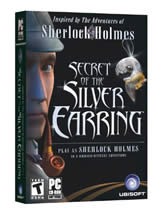
ADVENTURES OF SHERLOCK HOLMES: THE SILVER EARRING Review
|
Review Adventures of Sherlock Holmes: The Silver Earring
Review by Red Egnes |
 |
When one tackles an adventure, one likes to be prepared. Pencils are sharpened, glasses are cleaned and fresh notebooks are opened ready to write down the clues and take notes. One becomes an amateur sleuth, perusing the screen for hotspots, reading and digesting information and trying to figure things out in a logical and studied fashion.
Well, that’s the impression I’d like to give. Reality consists of frustration, cups of half-drunk cold coffee sitting around the monitor, layers of hastily-scribbled paper with half-completed solutions written on them and a sore bottom from sitting in the same place for too long. But I love it. As such, I was really looking forward to Sherlock Holmes and The Case of The Silver Earring, which on initial impressions is one of those games that makes being an adventure gamer worthwhile.
Full of charm and period detail, quaint scripts and vintage plotting, for this reviewer it was a pleasure to wander through the streets and suburbs of London alongside the eminent Sherlock Holmes and his upstanding colleague, Watson. Each backdrop is wonderfully presented in glorious textures, the character models are very well made and acted and the general presentation absolutely impeccable. Also, the crisp graphics and high resolution really help when searching for clues and objects – something you’ll be doing a lot of in this game.
As such, it’s possibly one of the best-looking 3rd person adventures I’ve played. It also sounds great with period tunes playing throughout which, although they do eventually get repetitive, really add to the oak-aged atmosphere. If they become an annoyance, fortunately they can be turned off.
The Silver Earring is a game that prides itself on detail. For some, this might prove frustrating – the first scene when you are introduced to the various characters and plot is a prime example. The venerable Colonel Bromsby (or rather, not so venerable according to the sharp-eyed Holmes) is shot during a reception he had put together for his daughter Lavinia. Unfortunately, due to mitigating circumstances, she becomes the prime suspect – luckily for her Holmes and Watson are on the case and suspect not all is what it seems.
This initial opening section sets-up the basic gameplay for the rest of the game. Expect to scour each screen closely for clues, as some are really quite small. Some might consider this frustrating to the point of pixel-hunting, but really attention to the detail is what sleuthing is all about and the game makes no qualms about it. Later on in the game, you’ll use the same skills and what initially seemed a bit of a chore unwittingly becomes a vigorous. Believe me, I would be the first to complain if this was a problem, but given the sedate nature of the gameplay it is highly forgivable and ties into Holmes’ intricate nature.
You play mainly as Holmes, although once or twice you switch to Watson who usually takes notes at his side. Both come across as great characters, with Watson’s voiceover artist really suited to the task at hand, and a script that occasionally sparkles with humor. Holmes is also reasonably well done, but despite the witty and smug banter with Watson the actor slips up a few times. This eventually gets to the point of actually over-enunciating and mispronouncing a few words – including a key characters name.
This is just one of the initial problems I discovered… despite the overall polish, there are cracks in the varnish that at first appear to be a minor blemish. Unfortunately, over time the crack widens and tarnish what could’ve been a nearly perfect adventure. But more on this later.
For now, I’m sure you’re all wondering about the puzzles. Sherlock has some great ones, all of which being pretty logical and include the magical “d’oh!” factor that makes an adventure game worth playing. Clues are liberally sprinkled, often right under your nose, and generally they’re incredibly well thought out. The interaction with the other characters is another high point, brought to a head when you discover that at the end of each scene you face a quiz. This makes conversations even more important – with each question, you must use a clue or two from Sherlock’s journal. This includes witness statements, lists of important physical clues or written evidence in the form of letters and notes picked up along the way.
The excellent and well laid-out nature of the inventory, and the ability to rummage through it when taking the quizzes make for a good test of your perception skills. You also must complete them in order to continue the game, but don’t fear because as long as you’re thorough you shouldn’t have any problems.
It’s a shame though that the ease of use doesn’t translate well to the core gameplay. Despite the precise nature of the mouse-driven interface, Sherlock is difficult to control. Unlike other third-person point-and-click games, you aren’t always able to move your character to all the open areas of an environment, even if there’s no visible obstruction. The edges are also problematic, as to move to another screen you have to find a hotspot rather than there being a smooth transition from one to the next, and they aren’t always in a natural place.
So, onto the problems. It’s really hard to write these, as Sherlock is a game I really wanted to like more and its charm simply won me over, but they’re there and they’re glaring.
Holmes’ movement can be quite slow, which is understandable considering the character and pace of the game, but when he’s dressed up in his trademark Deerstalker hat and outdoor wear he suddenly gains the ability to run. As such, when faced with a long corridor or stretch of screens to get across when he’s indoors equipped with suit and tie, it makes you wonder why he couldn’t run about to locations in the same manner. It’s a minor annoyance, but enough to be worth mentioning as it ties into my main issue.
Sherlock is such a well-presented game, obviously created with care and great attention to detail both graphically and plot-wise, that the problems end up sticking out like a dead man’s arm at a crime scene. I’ve already mentioned the voice-acting earlier, which in general is pretty good, but there are some actors who truly sound terrible and extraordinarily amateurish. It really lets the game down considering there are so many conversations and because the majority of the voices are really well done. One particular character had me cringing every time he appeared because of his stilted and horrendously weak delivery and some unintentional comedy is to be had from some hilariously bad cockney accents.
Other problems are graphical, like one certain puzzle containing some really weak design work that relies on basic recognition skills. I guarantee a good few people will slip up on it, as I did. But it’s not nearly as bad as the now infamous “psychic dog” sequence. It’s one of two sequences, the other being a strictly timed maze, that are completely at odds with the rest of the game. The psychic dog is part of an ill-advised stealth sequence that you have to complete not once but twice in order to travel between two places in the same location. The entire sequence is so ineffectively handled I have to question what it was the developers were trying to achieve.
The other “action” section – the timed maze – isn’t quite so bad as it is very clearly laid out, but for this sometime action gamer, due to the shabby nature of the transitional hot spots and Holmes’ occasional unwillingness to move, it was a little much. I urge Frogwares in future games to try to think up other means of breaking up the gameplay if they have to, as I can imagine that to some people this sort of change part of the way through a mainly sedate title is going to be a little too much to handle.
There are also various repeating sound bugs to be found, one during a puzzle that takes some time to complete and depending on what sound is looping can drive you crazy. Other problems include some graphical misnomers, including windows from the scene in the beginning set at night remaining dark later on during the day. There are also some severe errors in logic, not in the puzzles, but in the plotting. Turning a light on and leaving the door open as a guard wanders around outside after the stealth sequence makes me wonder about the efficiency of the security!
My final grievance comes from a few puzzles which have the old problem of items that can’t be picked up until they’re needed later, or hotspots which aren’t even marked when all the rest are, which is inconsistent with the majority of the game.
Yet, despite all these problems, I still have no hesitation recommending it because of its quaint charm and fantastic plotting. It’s just so likeable and contains just enough enjoyable worthwhile gaming to make some of the more unforgivable problems fade into the background. The movies that precede and end scenes are very well made using the in-game 3D engine (one particular speech involving dominoes quite enchanting), the storyline is engaging and extremely clever and the wealth of detail within the written clues and dialogue absolutely intriguing.
It’s just so frustrating that the developers failed on some really basic hurdles. It’s so annoying when a game is so near being great and falls short because of a lack of attention in a few areas. In all honesty, I hope that Frogwares produces another Sherlock game which has better continuity, drops the absurd action sequences, ups the quality of the voice acting (except Watson, who’s brilliant) and pays more respect to the high quality that they’ve set themselves in terms of presentation. If they can do that, they’ll have an absolute blinder on their hands.
As Sherlock Holmes likes to say, in this game at least – it’s simplicity itself.
Final Grade: B
System Requirements:
- Pentium III 500Mhz
- 128 MB RAM
- 16mb graphics card, DirectX 9.0 compatible (NVIDIA Geforce or ATI Radeon chipsets)
- Sound card, DirectX 9.0 compatible
- Windows 98/2000/ME/XP
- 1.2GB free disk space