Is That a Lighthouse In Your Pocket, Or . . .
|
Review Dark Fall: Lights Out
Review by Ray Ivey |
|
Is That a Lighthouse In Your Pocket, Or . . .
In the summer of 2003 Jonathan Boakes scared the willies out of us with his excellent Darkfall. Though necessarily modest in scale, it was a creepy, well-built horror adventure. Considering it was pretty much a one-man project, it was the best garage game since Cracking the Conspiracy.
The excellence of Darkfall got Boakes a contract with DreamCatcher and a chance to make another game. Darkfall 2: Lights Out is the result.
The first thing I have to say is I’m so grateful to play a horror-themed game that’s actually an adventure. Not an action/adventure, not an action game, not survival horror. There’s nothing wrong with Eternal Darkness, Clive Barker’s Undying, or Silent Hill, but it’s become achingly unusual to play a good creepy game that’s not about combat.
With its animated lighthouse, right off the bat the game shows a lot of class with evocative sound effects and the loveliest interface screen since Arxel Tribe’s Faust (remember that carousel?).
The game begins in 1912 Cornwall, England. You play a character of a young cartographer dispatched to a remote village to work on some coastline maps. Almost immediately you notice something extremely odd: A lighthouse that’s conspicuously missing from any maps you’ve ever seen of the region!
And, uh, yep, that’s all of the plot I’m going to tell you. Four sentences. No way am I going to spoil any of the cool surprises in this game. Surprises abound in the world of Lights Out, and if I tell you any more I’ll start giving them away. Wouldn’t be prudent. However, there’s plenty more to say that doesn’t involve plot spoilers…
Okay, That Sure Sounded Like a Footstep . . .
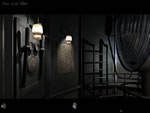
There’s quite a lot of exposition delivered in the opening environment – the cartographer’s hotel room – and from this very first scene the player learns that very methodical and observant exploration of the game world is vital to success in the game. It’s actually quite easy to miss an entire (important!) scene in this first room if you are careless.
But that’s okay, because this is not a game to rush through. It’s not long, and the environments are not particularly large (though you do get to see several of them in various, shall we say, versions).
But the game has quite a lot up its sleeve. It’s reminiscent of several of my favorite adventures: The Dark Eye, the original The Journeyman Project, Riven¸ and Dracula Resurrection. For the record, this is not a bad thing!
The game is full of puzzles that are really part of one, huge, uber-puzzle. So don’t even attempt this game without having your pen and notepad at the ready. Without careful observation and note-taking, the game will be very reluctant to give up its secrets. Most of the puzzles are of the informational variety. Keep your eyes open at all times!
Mommy!!

Fright wise, the game isn’t quite as scary as Darkfall, but it’s no less intriguing. It’s more creepy than scary – but creepy is a good thing, right?
The graphics of the game aren’t high-tech by any means, but they show a lot of taste and artistry. Details abound, and in many cases the details are interactive. In many games it would get tedious reaching over and taking a close-up look at an old family photo on the mantle, but in Lights Out it’s a pleasure, as these optional bits really add up to create a wonderful sense of place.
The different sections of the game all have different color palettes, and this further serves the drama of the story in an effective way.
I have one, tiny graphics gripe, however. I’m really, really, really over the artificial “handwriting font” that virtually all adventure games use for journal and diary entries. Trust me, artists, there is no font that really looks like human handwriting, because all fonts are too regular and consistent. The only way you can really make a journal really look like a journal is to create the language in them with actual handwriting. Have an intern do it.
My other tiny gripe has to do with something on the game box. A blurb on the box promises “numerous characters to interact with,” and this is simply not true. You do meet a lot of characters, but only indirectly – through diaries, recorded messages, notes, etc… Your actual interaction with characters is extremely limited, and it’s unfortunate that the box blurb writers got a little overzealous in making such an unnecessarily misleading claim.
The story, however, is a dandy one, and both the narrative and the puzzle design serve to create a series of increasingly intense interconnections between the game’s various environments.
The first part of the game is fairly linear, but about halfway through your journey you obtain a tool that really opens up the game world. You’re now free to travel between the game’s different areas and attempt to finish solving the many puzzles that confront you.

The sound design of the game is particularly good, from the very opening credits sequence with the evocative sounds of the surf, to the quiet but well-placed ambient noises all through the game. The sounds of Lights Out serve to very effectively raise the hairs on the back of your neck.
Considering what a good story Boakes has to tell, it’s disappointing that the ending isn’t more satisfying. However, this feels like a limitation of budget, not imagination, so it’s forgivable.
The big news is that Jonathan Boakes has done it again. Lights Out is a creepy, engaging, tastefully built adventure that no aficionado of the genre should miss. Who knows what this talented guy could come up with next if someone would throw a slightly more deluxe budget his way?
Final Grade: A
System Requirements:
- Windows 98/ME/2000/XP
- Pentium III 450 MHz or Better Processor
- 128 MB RAM (256 MB Recommended)
- 24xCD-ROM Drive (or PC DVD Drive)
- SVGA Graphics Card or better with 32-Bit Color (32-Bit Color at 800×600)
- DirectX9 Compatible Sound Card
- Mouse, Keyboard, Speakers
This review is copyright Ray Ivey and Just Adventure and may not be republished elsewhere without the express written consent of the author. Republication of said review must also contain a link back to Just Adventure.