Lord of the Rings: War of the Ring Review
|
Review Lord of the Rings: War of the Ring
Review by Ugur Sener |
 |
Published in three volumes between 1954 and 1956, J.R.R. Tolkien’s Lord of the Rings trilogy is perhaps one of the most influential works of literature. It was the Lord of the Rings that popularized the fantasy genre, resulting in the fantasy boom during the 1970’s. Tolkien’s work lead to the development of war games with a fantasy setting, which in turn catalyzed the creation of modern role playing games. The Lord of the Rings also inspired an animated motion picture in 1978 and more recently the full motion pictures based on the trilogy.
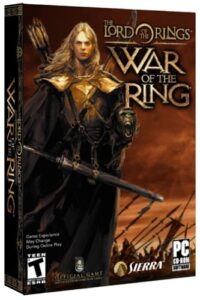
Around the time the first and the second movies came out, several video games based on the trilogy were released. Although none of these games were great successes, they gave players a chance to experience the Lord of the Rings universe first hand. Now, as the release of the third movie draws near, Vivendi enters the scene with War of the Ring: the first Lord of the Rings real time strategy game. Unfortunately, generic gameplay mechanics make War of the Ring seem like little more than an effort to capitalize on the popularity of the trilogy.
War of the Ring offers two single player campaigns, consisting of 10 missions each, giving players a chance to experience commanding both armies in the conflict depicted in the Lord of the Rings. However, War of the Ring takes more of a background story approach. Missions are based on events mentioned in the books but not discussed in great detail. The good campaign tells the story of the things Legolas, Gimli, and Boromir had to go through before arriving at Elron’ds council, whereas the evil campaign is the story of how armies of Sauron left Mordor and sieged Minas Tirith, the capital of Gondor. The fans of the trilogy are likely to enjoy getting insight into the events that are not thoroughly discussed in the books, although some may find inconsistencies.
One problem with the campaigns is that, at times, the missions feel somewhat disjoint and unrelated. For instance, upon completing the two missions about how dwarves initially defended their lands against the orc invasion, players are given access to a mission where under Legolas’s command, a group of elves are pursuing Gollum. There is no real transition between the two missions, completing the first one merely unlocks the other. To make matters worse, the campaigns fail to stand out on their own. Without a decent Lord of the Rings background, the missions are very unlikely to be enjoyable.
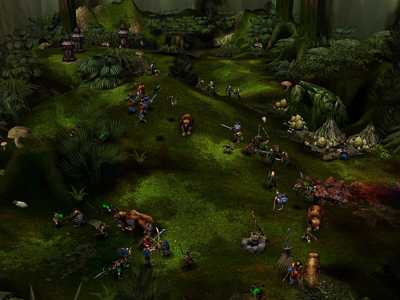
War of the Ring has music that is appropriate for the game, even though it is not particularly memorable. The voice acting is acceptable for a real-time strategy game where character dialogue is not the main focus. However, fans of the movies should not expect to hear the voices of the actors, as Vivendi has the Tolkien family license, not the movie one. Unfortunately, the graphics could have been better. The units look choppy and up close it becomes obvious that they are made of a small number of polygons. In addition, the terrain looks very confusing at times. It is difficult to judge relative terrain height and it is not always obvious what areas the units can walk through.
The game does have a good variety of multiplayer features, which might keep players interested. War of the Ring also features a nice tutorial that can teach the basics of real-time strategy games to inexperienced players. However, overall, the game will probably not present a challenge to experienced players. The problem with the games AI is not necessarily the enemy’s inability to produce the right amount or mix of units to defeat the player. Instead, War of the Ring’s AI fails when the enemy tries to control its own troops. While playing the game for this review, I was building watchtowers as a defensive line against the enemy. The enemy attacked as one of my workers completed a tower. Instead of attacking any of the towers, the enemies started chasing after the worker. By merely making the worker run in circles around one of the towers, I was able to fend off against the attack and kill all the enemy units without suffering any casualties.
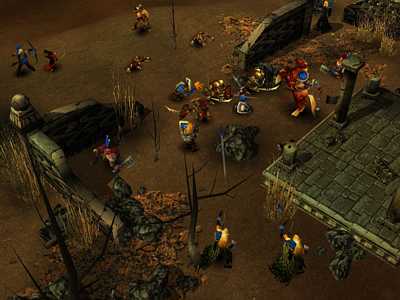
What is truly disappointing about War of the Ring is the way it fails to recognize its potential to be a great game. As many real-time strategy games, War of the Ring uses the base building formula. Mills are constructed over wells to produce food, and foundries are constructed over mineral deposits to produce ore. These resources are then used to construct buildings, make upgrades, and create the soldiers needed to defeat the enemy. While this basic real-time strategy concept works well in Command and Conquer or Warcraft settings, it fails to reflect the mood of the Lord of the Rings trilogy. Lord of the Rings is about a small number of people making a stance against the overwhelming mass of evil hordes. It is the story of a desperate attempt to keep freedom. When playing the good side, creating masses of units and throwing them against the evil armies simply feels wrong. The good armies just don’t have such numbers in the books. They rely on the heroic deeds and superior fighting skills of the few soldiers they have, which the game does not reflect at all. War of the Ring would have been a much better game if it worked like the Myth series, where a small group of soldiers are expected to defeat a much larger group of enemies. The challenge in the Myth series comes from understanding the unique abilities of each type of soldier and effectively using the limited resources available. The challenge in War of the Ring is to build the base fast and to overwhelm the enemy with a larger army.
Another reason why the game fails to capture the mood of the trilogy is that War of the Ring looks too much like Warcraft III. The cartoon-like graphics of Warcraft III worked really well for Blizzard’s real-time strategy hit. Brightly colored environments did not hinder the games ability to convey its story effectively. However, a game based on the Lord of the Rings trilogy should have had more serious looking graphics. The nature of the seemingly hopeless struggle against evil simply does not get reflected when the game looks like a cartoon.
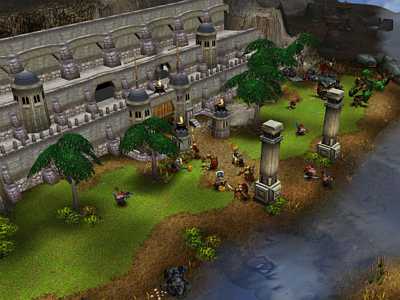
The similarity of War of the Ring to Warcraft III is not limited to the game’s graphics either. War of the Ring plays and feels a lot like Warcraft III. The gameplay dynamics of Warcraft III are almost carbon copied in War of the Ring. Upgrades are made to make units stronger. The number of camps constructed determines the number of units players can make. Heroes gain levels and have special abilities like in Warcraft III. The only difference is that instead of using a mana based system, War of the Ring uses fate points. Fate points are gained through fighting the enemy and can be used by heroes to perform certain skills or to buy certain spells. The available spells include summoning an Ent for the good armies and summoning a Balroc for the evil armies, but this little touch of originality is barely noticeable given the overwhelming similarity of War of the Ring to Warcraft III. The things a player generally needs to do in order to win a mission in War of the Ring will not be new to those who have played Warcraft III. In the end, the game ends up feeling very unoriginal. Warcraft III with Lord of the Rings characters and names sums up War of the Ring. Especially with the lack of FMV sequences between missions and the introductory sequence that merely consists of cut-scenes from the game itself, War of the Ring also feels very uninspired.
Overall, playing through War of the Ring is certainly not a bad experience. Being able to command the armies depicted in the Lord of the Rings trilogy and controlling heroes like Legolas, Gimli, and Boromir is entertaining. However, those looking for a true and original real-time strategy challenge will be very disappointed with War of the Ring. Those looking for a game that truly captures the atmosphere of the Lord of the Rings trilogy will also be equally disappointed. War of the Ring can only be recommended to Lord of the Rings fans with a casual interest in real-time strategy games.
Final Grade: C+
System Requirements:
- 256 MB RAM
- 32 MB VRAM
- 2000 MB disk space
- Sound card
- DirectX v9.0