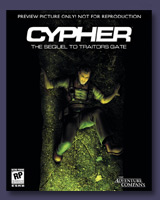
Traitors Gate 2: Cypher Review
|
Review Traitors Gate 2: Cypher
Review by Ray Ivey |
|
From the Sublime to the Ridiculous
Two weeks ago in this space I gave a stellar review to The Adventure Company’s Broken Sword: The Sleeping Dragon. When you read this review, you may well wonder if I’m suffering from bipolar disorder.
The game from The Adventure Company that I’m talking about today is Traitors Gate 2: Cypher. This will not, I’m sad to say, be a stellar review.
The first Traitors Gate was developed by a talented Swedish studio called Daydream Software, and I was a very big fan of that game, as well as the team’s earlier effort, Safecracker. Daydream did not develop Traitors Gate 2.
Alas.
What’s in a Name?
The very first problem with the game is its title. It shouldn’t be a Traitors Gate game, as the great bulk of the game has absolutely nothing in common with the sly and crafty stealth and techno gameplay that made the first game so fun.
It’s true that you you technically play as Raven, the same character that starred in the first game. But that’s about all the games have in common.
Cypher informs you that you have to stop a deadly computer virus that’s going to destroy the world. So far, so good. But then it drops you into an ancient tomb and the game turns into something completely different.
Coulda Woulda Shoulda
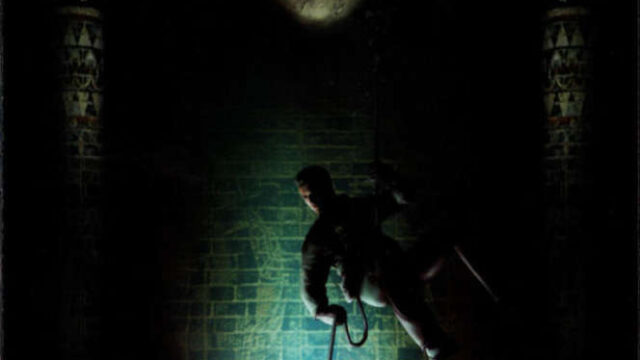
The bulk of the game consists of navigating an insanely complicated series of ancient chambers which are chock-full of life-or-death puzzles.
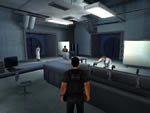
This in itself could have been lots of fun. In fact, for the first hour or so, I was having fun. The graphics are attractive (particularly nice is a reflection effect on metallic surfaces). The puzzle rooms are imaginative and visually fun. The controls are decent.
So for a while I thought, “Okay, so this is going to be sort of like Jewels of the Oracle in 3D.” And that’s a perfectly acceptable and even intriguing idea for an adventure game.
The game also has an understated, somewhat evocative score.
Unfortunately, the game’s shortcomings quickly short-circuit any possible fun.
First of all, the game is woefully in need of a map feature. This vast underground complex quickly becomes a nightmarish 3D maze. Any game with geography this complex owes the player some kind of mapping feature. Without one, you spend lots and lots of time running around halls and staircases that all look exactly alike. Fun!
The next problem are the puzzles themselves. Many of them are obtuse in the extreme, with precious little clues or indication of any kind of what your goal is supposed to be. Or unkind touches that can triple the length of time it takes to solve a puzzle — there’s an eggregious example of this problem with an otherwise intriguing boat maze in which you’re supposed to capture a key. There are three keys, and it’s almost impossible to figure out, except by luck, which is the appropriate one. So if you’re unlucky, you have to navigate the maze three times instead of one.
Even worse, there are “clues” scattered about the tombs, and the clues just make the player end up more baffled.
Having just played a spectacular example of a 3D adventure game (the afore-mentioned Broken Sword: The Sleeping Dragon), I truly missed that game’s “active hotspot” feature. Cypher gives you no such help, so you have to bump around, attempting to interact with everything. This is one of the biggest things about 3D that adventure gamers don’t like, and you’d think that a company like The Adventure Company would understand that.
It gets worse when the main character opens his mouth. Every single thing he says is terrible. When encountering a huge maze (yes, I said the “M” word again, and you have to go this particular one multiple times, yum!) he drawls, “I’m going to have to keep track of my bearings.” And when encountering a giant snake god in one room, he utters the most bafflingly bad line I’ve heard in an adventure game in years: “Ah! Sir Hiss, I presume.” What were they thinking?
When the main character in the game doesn’t take his life-and-death predicament seriously, why should you, the player? Ecchhh.
In fact, the entire game feels like a textbook example of why mainstream game media are so dismissive of games in the adventure genre these days. Get your rotten tomatoes ready, because I’m about to utter an unkind truth: Games like Traitors Gate 2 are the reason why people make fun of the Adventure Game genre.
But Wait, There’s More
I hate to tell you, but I haven’t even gotten to the worst part. If everything above was all that was wrong with this game, I still could have recommended it to hard-core adventure completists.
But.
The game has bugs in it. Killer bugs. Game-killing bugs. Yes, more than one.
I reviewed a commercial release copy of the game and these problems had not been resolved. Unfortunately, this means that The Adventure Company is shipping a game that’s virtually unplayable.
Tough Love
It’s no fun writing a review like this. I want EVERY game to be Broken Sword. And I hope someday, someone takes the very good germ of an idea this game has — Jewels of the Oracle 3D – and makes a good game out of it.
Final Grade: F
Final Grade with Patches: D
System Requirements:
- PIII 700MHz or equivalent
- 128 MB RAM
- Sound Card
- 3D Card
- DirectX 8.1
This review is copyright Ray Ivey and Just Adventure and may not be republished elsewhere without the express written consent of the author. Republication of said review must also contain a link back to Just Adventure.
Screenshots