Jerusalem: The Three Roads To The Holy Land Review
|
Review Jerusalem: The Three Roads To The Holy Land Arxel Tribe Review by Laura MacDonald |
 |
Jerusalem: The Three Roads To The Holy Land
(or why I recommend playing Putt Putt: Travels Through Time instead.)
Let’s look at the box on this one.
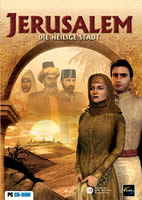
“Adrian Blake is a renowned 20th century Scottish cartographer. On his return from an expedition, he discovers his fiancee, Sophia has disappeared. He must journey through time to find her. Having explored Pompeii in the 1st century and having found Sophia just before the explosion of Vesuvius, Adrian is once more swept up in a vortex. He regains consciousness at the gates to Jerusalem.”
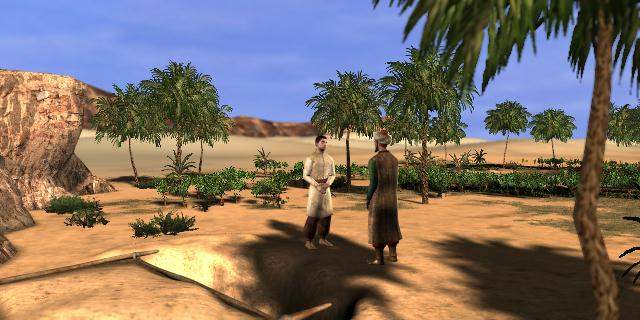
So we begin at what could be called Pompeii II. I will admit to you right here and now – I am not a big fan of Pompeii. The first of this historical based series was released by Cryo in 2000. It had what promised to be a great story line. Our hero is a man in love armed with a formidable knowledge of antiquities both tangible and cultural. He has in fact angered the gods/goddesses and as gods will do, they spirited away his true love. To regain his love – our hero must complete three quests and prove himself worthy of the lifting of the curse. Sounds pretty good so far. Let’s examine our hero’s dilemma. An old familiar plot device to be sure – but if told well – one that really doesn’t get tiresome. That was the problem with Pompeii – the telling well part. It didn’t. The graphics were nice enough, the voice talent was a bit uneven but acceptable. The puzzles middlin. But the dialogue, dull would be a step up on this one. But I trudged through to the end and shelved Pompeii, never to be played again.
So “Why – Why”, you cry out. “why would you get the sequel!!!” Good question.
I could say , I was drugged against my will or that I had too much money and had to get rid of some for tax purposes. The truth is I got it because Arxel was involved on the graphics/story end this time, early reports indicated a controversial spin on the plot and I have seen the ‘sequel better the original’ game more than just once. So, off I went to order Jerusalem. It came. I loaded it. SO far so good. Then I began the game and I was not thrilled or even mildly content. Before I get into the details of my gamer’s angst, I am sure that you are wondering about my reference in the title to Putt Putt. Well, it’s like this ..
I was playing Putt Putt Travels Through Time the other night, to review as a kids and parents game. Then I was struck by the similarities between it and Jerusalem, which I had just finished. Putt Putt gets sucked up by a time vortex. Then he is told he must recover lost objects dear to his heart, in order to set things straight and shut down the vortex. Adrian our hero gets sucked up into a time vortex and has to rescue his true love (an important object in his life), in order to set things straight and save the universe. So let’s see – Putt Putt or Jerusalem.
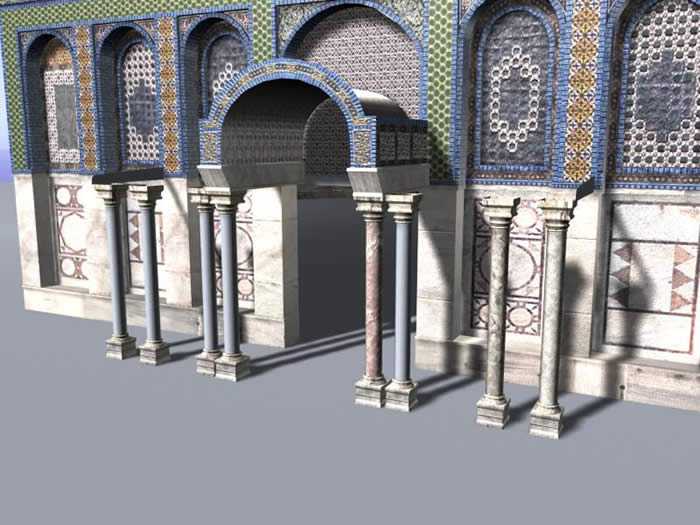
Let’s start with the visuals or eye candy factor. The graphics, actually good in Pompeii, were improved and nicely rendered in the sequel. Strong points for Jerusalem would have to be the graphics. It has the same clean well rendered look, that was present in Pompeii. In fact, I think that the character art and backgrounds are much better in the sequel. Putt Putt is a 3D cartoon based kids game. So with some sadness ( I really liked that little guy !) I have to award the look of the game and point 1 in our review to Jerusalem.
So they got it right on the graphics. Now how about the story? Like I mentioned earlier, the main focus of Jerusalem was an introduction of sorts to the basic tenets of the “three great religions”, that are prefaced upon their devotion to just one god. While interesting enough, I was already familiar with most of what was discussed. I just wanted to get to the game related plot. This was sounded good, but was just briefly touched on and not really till close to the end of the game. I would have to give overall effort at plot idea to Jerusalem. Once you have met Putt Putt and his pals – there’s not much more to be understood. So we have point 2 for basic plot premise going to Jerusalem.
So, how well was this plot developed and advanced throughout the game? This is where it really fell apart for me, as a gamer. All of the features that Pompeii had actually gotten right, were now horribly slighted. It seems that Jerusalem had flipped Pompeii on it’s head and managed to maintain the trend of a poorly done game. The plot, that was detailed enough to actually get interested in before, was now nearly nonexistent. Instead of the focus being on Sophia and Adrian, we are helped to a large dose of religious rhetoric. If I can get it straight, we are urged to merge the three great religions into a unified mass. Well that may be a grand idea, who knows? But, I came here to play a game, seek out Sophia and advance my hero’s battle against the great curse. No mention of the curse this go around and as for Sophia? Well, there’s little more than a bone thrown to that dream. Point 3 has to go to Putt Putt. It has clearly defined plot goals, advances them in a fun way and it sticks to them
Now for our game characters and NPC’s. Admittedly, in Pompeii – Sophia and Adrian weren’t deeply fleshed
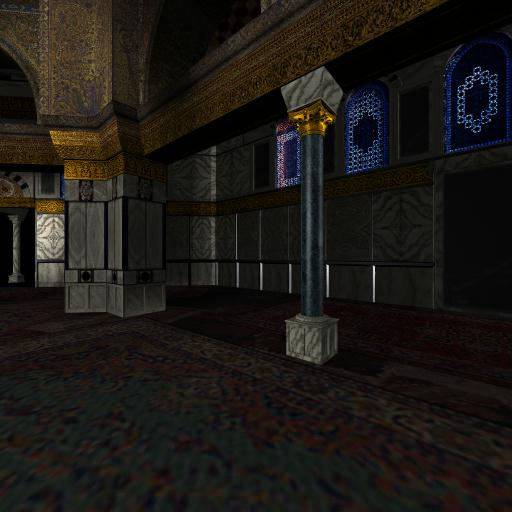
out. But, in this newest incarnation, I felt even more alienated from the characters. Adrian came across as intelligent , eclectic and essentially a perfect ambassador or ethics expert. I am not sure exactly why, but I just didn’t find him as interesting, as in Pompeii. The characters were more fully developed and just easier to get into with Pompeii, which was one of that games few strengths. In Jerusalem, the characters were preachy, wooden or just barely there. This was a large disappointment. For characters, I am greatly tempted to give the advantage to Putt Putt. These guys are cute and have little baby voices. I feel like I am playing with the cast from Leave it to Beaver or Our Gang. Maybe even Sailor Moon. You want to get them some milk and cookies. The characters in Jerusalem were whiny and boring in places. The Caliph seemed pretty dense for a guy who has managed to maintain power in a time rife with intrigue and plots. Sophia’s alter ego was annoying. Adrian was just too bland. The bad guy – well he was wonderful, but you hardly got to interact with him before pffffffft he was vanquished and gone. The goddess from Pompeii? Never saw her. So hmm, gee, this is tough. I have to give character development points and review point 4 to Putt Putt. I just had higher expectations from Jerusalem.
I will say that the game interface in Jerusalem was decent and it didn’t appear to have any glitches. Navigation around this game is accomplished by consulting a map feature – where you click on whatever location you want to go next. Some of the location hot spots were hard to locate from time to time – but this wasn’t a big game breaking problem. Dialogues are automatic many times. You click on the person that has a “talk” icon and away you go. I just didn’t get a sense of any real depth to the characters. You had to talk to folks in Putt Putt and the navigation was standard point and click. I would have to give a slight edge to Jerusalem and give them the point 5 for game interface, but just barely.
The edutainment quotient of Jerusalem was fairly high. There was the encyclopedia and other in game resources that could be read and enjoyed apart from the game. If you are a real history buff who has up until now been short on your religious history – this will appeal. I like historically based games – but never really look at any in-game side resources. I play the games to – well play a game. So this point is mixed. For those who live and die by in game encyclopedias – this point goes to Jerusalem. For others – definitely a Putt Putt advantage. We’ll call this a tie.
Finally a consideration of just overall fun. How do I say this – I think all things considered Putt Putt does Time Travel was more bearable. In Jerusalem, it wouldn’t have been so bad if you could have bypassed mind numbingly lecturing conversations and enjoyed the game – but in fact the game would not always advance without them. I have to admit – I am like the little kid in the Life cereal ads – I pretty much find something to like about almost any game, but the original Pompeii made me want to shoot the game box. I finished it finally by playing through it with a WT in hand – just to get it over with. The same applies to Jerusalem for the most part. Final point goes to Putt Putt vs Pompeii / Jerusalem – you don’t need a WT to get through it fast.
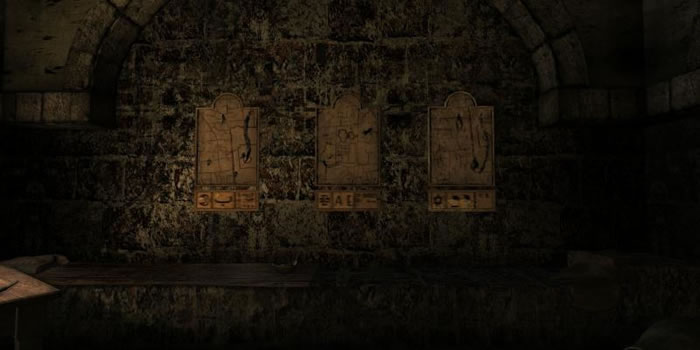
I will now open this envelope with the standings, which were calculated by some formerly prestigious accounting firm, that is out sourcing to cover legal fees. It appears that we have a tie. So if you love history, if you really had your heart set on delving ever so briefly into the conflicts between the Muslim, Christian and Judaic religions, if you really really loved Pompeii and have to see what happens next (well kind of) Then buy and play Jerusalem.
As for me, I say skip Pompeii, detour around Jerusalem and go play Putt Putt Does Time Travel. It’s motives are pure and the laughs are genuine. I have to go now, all I am missing is the cell phone. If I get it, I can take Putt Putt home and shut down the time vortex.
I don’t normally give out grades, as one person’s bliss is another person’s nightmare. I will just say, that on my personal game meter if Syberia is the shiznet and The Scroll is gamer’s hell, then Jerusalem would be close to the bottom of that list.
If you really have to have a grade then (drum roll, please)
Final Grade: D
Essentials:
I played Jerusalem on an PIII 500, SB128, Nvidea TNT card with 128 RAM.
System Requirements:
Mfr.’s Game specs are listed as:
PIII450 (P200 w/MMX min.)
64 RAM (32 min.)
8x CDRom
24 bits color (16 bits min.)