Arabian Nights Review
|
Review Arabian Nights Visiware / Wanadoo Review by Audrey Wells |
 |
Arabian Nights is an action-adventure game that revolves around a stale plot involving a Sultan who is granted five beautiful daughters by a genie. By some unfathomable decree or another, they must each be married on their twentieth birthday or face banishment from the palace. Not surprisingly, all five disappear shortly before their common birthday. Ali, the dashing hero of our game, is given the responsibility to save them, and so he sets off on an epic path that will take him to exotic locales rife with enemies bent on destruction and treacherous puzzles.
Character development is very flimsy in this game. The leading hero, Ali, is incredibly immature when it comes to wooing his five brides to be, expressing his satisfaction in a chaste kiss in the way a pimply teenage boy might. The women don’t seem to have more than two and a half brain cells, which was slightly offensive as a female player. It seemed that the sole purpose of the five barely dressed princesses was dance as seductively (and brainlessly) as possible and give away their hand in marriage for some idiotic incentive, such as the collection of a special bouquet of flowers. Yes, I know, it’s just a game. That doesn’t mean all of the characters have to be intellectually challenged.
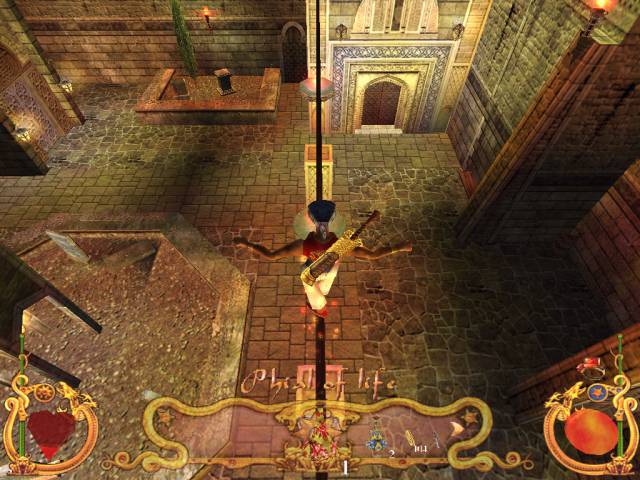
The graphics in Arabian Nights may or may not meet your expectations, depending on the sort of games you are used to playing. These graphics are not lush, pre-rendered 3D graphics of your typical adventure game. These graphics are rendered in 3D in real time, as most action games are, which means that textures (of walls, trees, faces, etc) are mapped onto the thousands of polygons that make up the environment and characters. Up close, some of the textures can be extremely pixelated, which was a bit of an eyesore. In some of the environments, I also felt that less than wise decisions were made regarding color and pattern choices – The Sultan’s Garden, for example, features a rainbow of clashing colors and patterns that, while successful in evoking an ornate Arabian look, was hard on the eyes. However, there are many environments where the graphics work very well, and overall, I was not disappointed at all by the graphics.
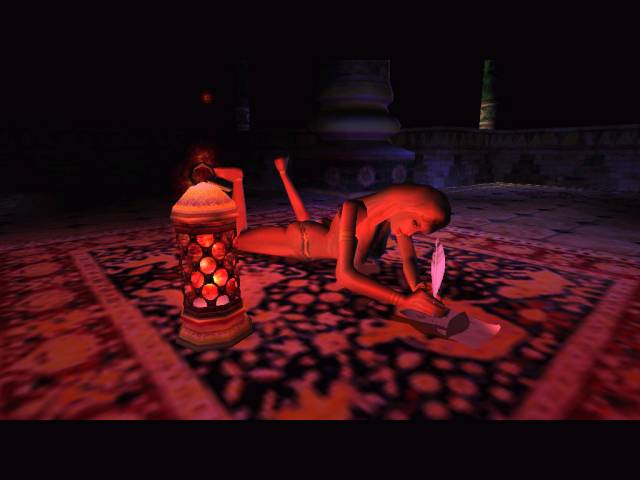
The quality of the audio in Arabian Nights is far from agreeable, unfortunately. The music, by itself, is nice enough – standard Arabian sounding music. There were a few instances where the music became distorted or quit playing altogether, but this was a minor annoyance. The voices of various characters, however, were completely aggravating. First of all, it was virtually impossible to hear the voices over the music. The separate music, voice, and sfx controls in the options menu were useless, despite my best efforts to bring out the voices over the music. I found myself leaning towards the speakers and straining to hear what was being said, which was a ridiculous workaround for a situation that shouldn’t even exist in the first place. Secondly, subtitles were not an option, which, in my book, is an absolute must in any game. If there were at least subtitles the first problem would not have been as severe.
And now on to the most important part of a game: puzzles and gameplay. This is the element that truly makes or breaks any game, in my opinion. I am somewhat of a finicky gamer – if a game bores me or aggravates me too much, I stop playing it. I have much better uses for my time than to be trudging through a game that bores me to tears or makes me want to punch a hole in the monitor. Luckily, Arabian Nights generally succeeds in the puzzle and gameplay department, because I played and generally enjoyed the game all the way from start to finish with only limited frustrations.
Arabian Nights features many standard action-adventure puzzles, all well integrated into the game. Most of them seemed original to me, but this could be because I don’t have extensive experience with action-adventure games. I also enjoyed most of the puzzles. As an example, one puzzle late in the game involves finding a way across a big pool of poisonous muck. Slabs in the water rise and fall according to the weight of what is on them, either Ali’s body or some heavy rocks that you have to hunt down in the surrounding sewers. The trick was to discover which slabs needed to be weighted, or unweighted, in order to rise all the necessary slabs above the muck to cross to the other side. I found this puzzle to be challenging enough to make it interesting, but not so hard that I felt the urge to cheat.
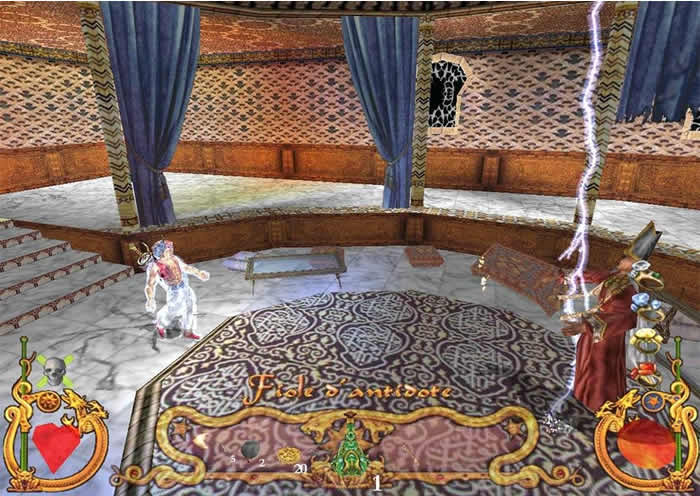
A few puzzles were not so successful, primarily the time-based ones that involve careening at top speed around tight corners using unmanageable controls. For example, in one particular puzzle, you had to sprint at top speed, leap over wide chasms, manage to run over buttons in the floor, and make it to the destination gate before it closed. Needless to say, this puzzle took many, many, MANY attempts. To make matters worse, the exact path that you have to take in order to open the gate at all is not obvious, since there is a mess of connected hallways with buttons and chasms in the floor. I certainly did not expect myself to try and find the correct combination of buttons and paths – you can imagine the difficulty of knowing the right path if I could barely get through the correct path! I was forced to resort to a walkthrough in this case. Once I knew the correct path, I finally worked out a method of saving the game at key points on the way to the gate until I was successful, thereby reducing replay.
Fighting enemies was not overly difficult, despite what the game designers might like you to think. It would be easy enough to employ a “strategy” that boils down to running up to the offending creature and pressing the attack button repeatedly. Using distance weapons, such as fireball spells, knives, and bombs can be very useful however, and developing more complex strategies to dispatch enemies should be no problem for seasoned adventure gamers. Other strategical options include sneaking up behind gullible guards, using protection spells to make yourself virtually impenetrable to attacks, and so on. The variety of enemies is nice, however – you will come to face with all sorts of malevolent animals, poison spitting undead, city guards, cultists, and several more difficult big boss types. The different types of enemies also fight differently – some will hurl knives or arrows at you, others dodge around like crazy and attack from behind, and some just use brute strength to pummel you.
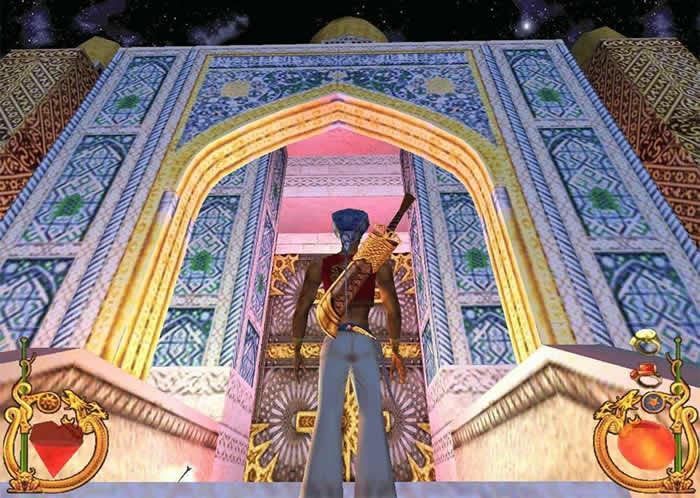
After years and years of pure adventure gaming, I discovered how little I like the extremely limited movement in pure adventure games. One of the things I enjoyed most about Arabian Nights was the freedom of exploration. This feature is not unique to Arabian Nights, of course, but if you are familiar with only standard point and click games then this will be a pleasant departure. The seven episodes of the game are each fairly large 3D worlds with many nooks and crannies to find. Exploration is usually rewarded by discovery of vases that contain goodies. If you are lucky (or very tenacious) you’ll find rings that will grant you magical powers.
Final consensus: If you are very patient, have a knack for action-oriented puzzles, and are not opposed to lots of fighting, then Arabian Nights will be a treat for you and other adventure gamers who have always wanted to explore every corner of the gaming world. Otherwise it is merely an average action game with only a hint of a plot.
Final Grade: C
If you liked Arabian Nights:
Play: Prince of Persia 3D
Read: Richard Burton’s The Thousand and One Nights
Watch: Disney’s Aladdin
System Requirements:
Pentium II 233 Mhz (300 MHz recommended)
Windows ™ 95/98/ME
DirectX ™ 7 (or higher)
64 MB RAM
8 MB Graphics Card (16 MB recommended)
Sound Card 100% compatible with SoundBlaster™