Mission Critical Review
|
Review Mission Critical Legend Entertainment Company Review by Michal Necasek |
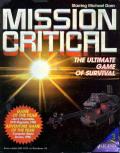 |
When I first saw the Mission Critical box I thought the game had something to do with Star Trek. Which of course only goes to show how little I know about Star Trek. In my defense I must say that I was fooled by the label “A Must-Have for Star Trek Fans” prominently displayed on the box. After having played the entire Game, I would tend to agree with the label.
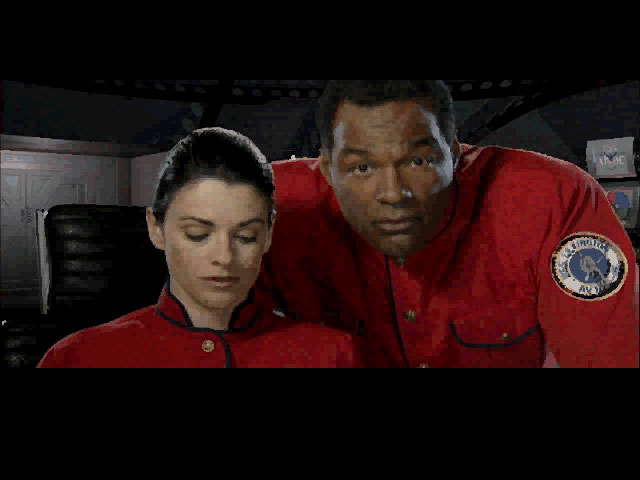
Mission Critical is not directly related to Star Trek in any way yet it does share some of the themes: space exploration in a future world filled with wondrous technology, heated space battles, mysterious alien artifacts, and tough decisions which may decide the fate of mankind.
In the surprisingly long opening FMV sequence we find ourselves aboard USS Lexington in 2134 A.D. and over sixty light years away from Earth. Battlecruiser Lexington is escorting a small science ship, USS Jericho, on a secret mission towards an unexplored planet called Persephone.
Unfortunately it soon turns out that the mission isn’t as secret as it was supposed to be (spies perhaps?), as the UN’s (yes, that’s United Nations) heavy cruiser Dharma emerges from the planet’s shadow and attacks the Lexington. To explain a bit: in this particular future there had been a rift between the USA and UN. United States and several other countries quit the UN and entered into a drawn-out war of attrition against UN countries. If the Lexington’s mission is successful, the secessionist countries will likely be the ultimate victors – so far the war isn’t going too well for them.
And now the outlook isn’t too rosy either. The UN’s Dharma outguns Lexington and after several damaging hits it’s apparent that there is no way for the Lexington to win. Yet the mission is critical and the captain, Dayna, comes up with a truly desperate plan. He opens a communications channel to the UN ship and offers unconditional surrender. The UN captain accepts and requests that crews of the Lexington and the Jericho must board their ships’ transport shuttles and arrive at The UN’s Dharma within 20 minutes. Captain Dayna agrees.
That doesn’t sound like a way to win does it? But wait, there’s more to the plan. Without telling anyone, Captain Dayna and First Lieutenant Tran load a small but rather powerful antimatter bomb onboard the shuttle. They also stun one officer and leave him behind. As the shuttle docks with the UN cruiser, the bomb is detonated, blowing both shuttles, the UN ship and everyone on board to smithereens, but leaving the USS Lexington and the Jericho relatively unharmed.
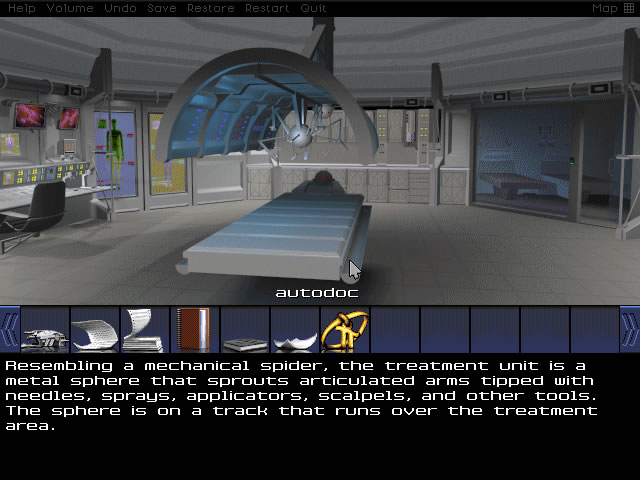
It doesn’t take too much mental effort to guess who the one man left behind is. Yes, it’s you! This is where the actual game starts. You wake up to discover that you’re all alone with no other human within many light years. Which wouldn’t be so bad if the Lexington’s main computer was working, if the reactor wasn’t leaking coolant and on the way to melt down, and if the hull hadn’t been breached (that’s sorted in increasing order of importance for you). Your life expectancy is some twenty minutes.
You could kick back and relax and spend the last twenty minutes of your life in peace. Or you could actually do something about it. Being a seasoned adventurer (and you are, right?), you opt for the second choice. Patch up the hull, put the reactor back on track and fix the ship’s main computer. Nothing you couldn’t handle.
After the immediate danger is taken care of, you can really start worrying. First Lieutenant Tran left two recordings behind which give you some hints about what Lexington’s mission really was: an anomaly had been spotted on the surface of the barren planet Persephone. Whatever it was didn’t look natural at all and was assumed to be some sort of alien artifact. Hopefully some really advanced technology could be recovered. To give you more background about the war: the UN wanted to stop the advancement of technology, arguing that technology has screwed humans and the Earth enough. But the US-led coalition claimed that technology was improving human life and shouldn’t be, couldn’t be, and wouldn’t be stopped.
So there you are. You manage to open up a communications channel to the nearest Coalition-controlled planet and talk to a USN admiral. He informs you that there are more UN battleships approaching your position and orders you to retreat. You cheerfully give him the finger (figuratively speaking) and decide to battle it out, aided by an experimental combat system, highly effective and with rather nasty side effects.
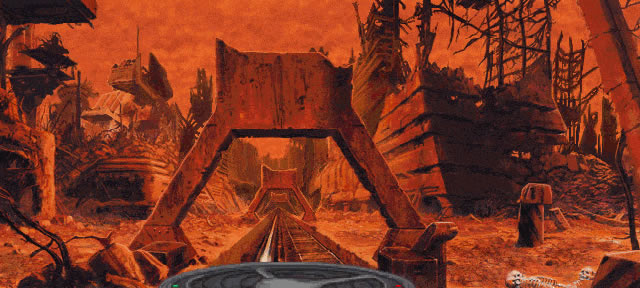
Come to think of it, I’d better stop right here before I spoil the entire game for you. You’ll have to win the battle on your own. But I can say that it is only after you succeed that the story gets really strange. Storytelling rule #17 says: If you want to make a story truly weird, introduce time travel. Opportunities for paradoxes abound and they’ll blow people’s mind very effectively and cheaper than certain illicit substances.
And paradoxes there are. Like the fact that the story of Mission Critical ends before it actually began. Just thinking about it gives me a headache. Which means it’s time to look at the technical details of the game.
Mission Critical comes on three CDs and it shows. The graphics are SVGA 640×480; they are quite good looking. Better yet, FMV is high-res as well without any interlacing. Every bit of dialogue has voiceovers. And there’s almost no CD swapping — certainly nothing annoying.
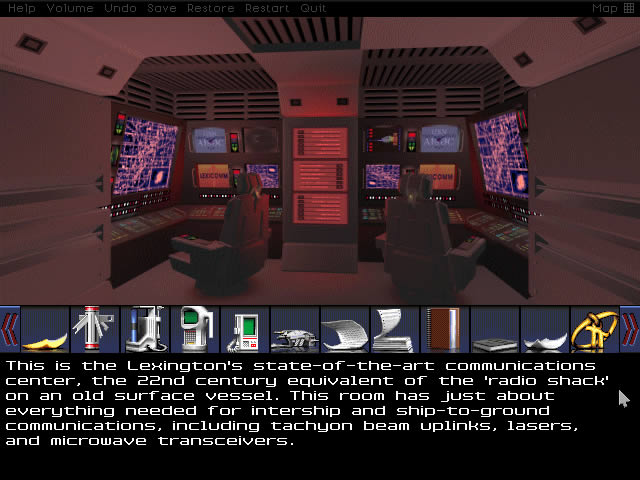
The graphics of Mission Critical look quite good in my opinion. The game screens are mostly static with little animation but with smooth transitions between scenes (fortunately you can skip the transitions). The interface is classic point and click, Legend style. Each object has a specific action associated with it. And you can pop up a handy little map if you get lost, which shouldn’t happen often because most of the locations in the game aren’t very large.
Sound samples are crisp and clear, all dialogues have voiceovers (including everything you say) but there are numerous helpful text-only descriptions. I love a game where you can click on anything and get a meaningful description. Somehow games like that feel much more real to me. There is also pleasant (or dramatic, where appropriate) background MIDI music.
Puzzles are almost exclusively inventory based. They solutions are logical, sometimes so obvious that I overlooked the right thing to do the first time. Overall difficulty is easy – that’s how I rate games where I didn’t even think of downloading a walkthrough (why anyone would need one for this game is a mystery to me). I must not forget to mention that there are several space battles which are part action but mostly strategy. You have to control USS Lexington’s battle droids in combat against enemy ships and their droids. I say this part of the game is mostly strategy because you can slow down the passage of time practically to a halt and run the battles in slow motion. You can adjust the difficulty of the battles, or skip them altogether if you wish.
The little manual that ships with Mission Critical deserves a mention too. I’m not sure why, but I started reading the “Legal Stuff” section – and to my great surprise, I couldn’t stop. Here’s an example why: an explanation of what indirect and consequential damages are in non-legal terms and why Legend won’t be liable:
“For example, you may be playing our game when a friend passing by is distracted by some of the graphics. He walks into a floor lamp. The lamp falls over, scaring your cat. The cat streaks from the room, upsetting a heater which sets some curtains afire. Unfortunately, it is a windy day and the fire is soon out of control. Three days later Chicago is still ablaze. If we took out an insurance policy against such remote contingencies, we would have to charge $1599.99 for the game, and you would not be reading this lame copy. Anyway, we do not assume liability for things like this, even if the city is a small one like Muleshoe, Texas.”
If this is not the number one funniest license agreement, I’d like to know what is. And now on to the summary.
Mission Critical has an intriguing and mind-bending story, posing some rather difficult questions about the relationship of mankind and technology and our possible future(s). If you’re a sci-fi fan, you really shouldn’t miss it. If you can’t stand science fiction, you should avoid this game at any cost. My only gripe was (you guessed it) the combat sequences. Not that they were bad – it’s just that in my opinion they shouldn’t be in an adventure game as they tend to dictate a completely different pace. But on the whole, Mission Critical is a high- quality game in the best tradition of Legend Entertainment Company. I give it an A-.
Final Grade: A-
System Requirements:
DOS/WIN95
486/33
4 MB RAM
SVGA VESA
Soundblaster