Zork Nemesis
|
Review Zork Nemesis: The Forbidden Lands Developer: Activision |
|
Search Game Trading Zone for this game More information about this game at the JAVE! |
There is probably no adventure gamer who has not at least heard of the Zork games (Corollary: If you haven’t heard of Zork, you’re not an adventure gamer). While Zork Nemesis is not a direct continuation of the original Zork adventure games or even the much later Return to Zork, it does take place in the Great Underground Empire. It is not required to have any prior Zork experience to be able to play Zork Nemesis but it is necessary to understand all the references to its predecessors spread throughout the game (those are not essential to solving the puzzles however).
Before starting to play the actual game it helps to carefully read a small booklet included in the box (if you have the box that is – I didn’t the first time I played Zork Nemesis ). This booklet is in fact an excerpt from the Frobozz National Archives and contains the journal of Agent Bivotar who was assigned to investigate the disappearance of four “Citizens of importance and stature whose welfare is of the utmost concern of … the Empire”. The journal describes Bivotar’s journey through the Forbidden Lands, a region afflicted by some sort of curse and overshadowed by a mysterious and daemonic Nemesis.
Again, it is not strictly necessary to read the journal. Most of the information contained therein can be found somewhere in the game. But the journal is a handy reference and even contains the solution to one or two puzzles if you are looking carefully enough.
From the journal it is apparent that Agent Bivotar’s journey ended in or near the Temple of Agrippa deep in the Forbidden Lands. And that is where you start. It is not clear who you are but it doesn’t really matter in the end. In the temple you soon find the four missing Citizens – Madame Sophia, Bishop Malveaux, Doctor Sartorius and General Kaine. They are all dead, apparently murdered by the Nemesis, but they speak to you (magic, you know) and plead you to help them. There is a way to resurrect them through alchemy – they all had been alchemists in life. If you know nothing about alchemy, rest assured that you will know a fair bit by the time the game is over because alchemy is central to Zork Nemesis and almost everything revolves around alchemical signs, planets, metals and elements.
At the beginning of the game you are confined to the Temple. Your first task is to recover an element (Fire, Water, Earth, Air) associated with each of the ex-Citizens. The elements were apparently hidden somewhere in the temple by the Nemesis whose alchemical lab you will discover in the Temple.
Once you find all four elements, you will be able to travel to the homes of each of the four alchemists (Conservatory, Monastery, Asylum and Castle). Each of these is a completely self-contained area and in all four you need to ultimately find a secret lab and purify an alchemical metal (Tin, Copper, Iron, Lead). With the metals in hand you are able to bring the dead alchemists back to life and go on to the Grand and Somewhat Unexpected Finale of the game where all the mysteries of the Nemesis will be revealed.
In your travels you will also learn about Lucien Kaine (son of General Kaine) and Alexandria Wolfe, a stepchild of Bishop Malveaux raised in his Zorkastrian Monastery and a student of Madame Sophia’s Conservatory (a violinist). These two young people fell in love (predictably) but the relationship was fiercely opposed by Lucien’s father who was a soldier and had no appreciation whatsoever for Lucien’s artistic tendencies.
And last but not least you will learn of Quintessence, the elusive Fifth Element which the four alchemists apparently set out to create, even though it is hard to tell what exactly the Quintessence actually is. For some reason the four elements and alchemy seem very attractive to game designers and many adventures contain references to them. I suppose it’s because the elements, planets, metals, symbols and their relationships make good puzzle material.
And Zork Nemesis is primarily a puzzle game. There are clues strewn all around the place, many of them in old books dealing with alchemy and letters and journals of the protagonists. There is also an intriguing story presented in an unusual (though not completely original) way: at various places in your travels you will see scenes from the recent and not so recent past (FMV clips). From these flashbacks you will be eventually able to understand all the important events and motivations leading to the final confrontation.
The interface to Zork Nemesis is simple (perhaps deceptively simple) point-and-click with the ability to pan around 360 degrees in most places. There is not much of an inventory to speak of – you can only switch between the items you’re carrying by right clicking and there is no way to combine inventory items. But that’s OK since most of the time you only carry one or two items anyway. Whenever you place the cursor over an object that can be manipulated, the cursor will be highlighted.
The puzzles are of medium to high difficulty. Not because of lack of clues, on the contrary – there is more of an information overload and it is difficult to recognize which bit of information is important and which isn’t. Each of the five areas is relatively large. As a consequence the game takes a while to finish, certainly don’t expect to solve it in one evening. Taking notes is a must for solving certain puzzles so keep paper and pencil handy.
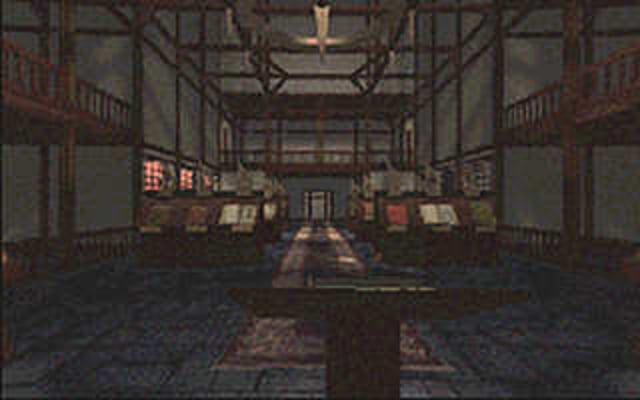
Zork Nemesis runs in 640×480 High Color resolution. The static images look very good, the cutscenes less so because of interlacing, but still quite good. The sound is of good quality technically and the ambient music is very pleasant to listen to.
The game comes on three CDs but there is surprisingly little disc swapping. As I mentioned earlier, each of the five major areas can be (though doesn’t have to be) completed in one go and with some luck it might be possible to finish the game with as little as 3-4 disc swaps, which is negligible for a game of this size.
It is possible to get killed at several points in the game, unfortunately (or fortunately?) it happens so rarely that I more than once forgot to save early, save often and then was in for a nasty surprise resulting in a forced replay of a lengthy game segment.
I shouldn’t forget to mention that while Zork Nemesis is quite serious for the most part (if a game can be said to be serious that is), there are occasional glints of Zorkish humor, usually pertaining to the history and culture of the Great Underground Empire.
Zork Nemesis is an enjoyable game with quality art, lots of puzzles and some surprising story twists. The environment is rich and detailed and exploring it is fun, although the amount of information can be overwhelming at times, making it difficult to spot clues. When everything is summed up, my final grade is an A-.
Final Grade: A-
System Requirements:
PC
CPU: 486/DX2 66 MHz
RAM: 8MB
CD-ROM: 2X
SOUND: 100% Sound Blaster 16-compatible sound card (for digital and general MIDI audio)
VIDEO: 16-bit high-color SVGA (640×480)–thousands of colors; VESA local bus or PCI video card with 1 MB of RAM
OS: DOS 6.0 or higher or Windows 95/98
The Windows 95 version uses Microsoft DirectX
Mac
Power PC
System 7.5.1
2X CD ROM drive
16 MB RAM (8 MB free)
35 MB free hard disk space
thousands of colors
13″ monitor
Sound Manager 3.1