R.I.P. Sierra
R.I.P. Sierra
For those of you who aren’t aware, Sierra On-Line, the pioneers of the graphic adventure, closed down their central division on Monday, putting 125 people out of jobs and laying to rest a twenty-year legacy. Josh Mandel, an employee there for many years who worked on some of Sierra’s best-loved games, offered to write a few loving words about this once-great company. We hope you enjoy. Our prayers are with the families of ex-Sierra employees.
By Josh Mandel
February 25, 1999
On Monday, the last vestige of the original Sierra On-Line was laid to rest in Oakhurst, California. That branch, recently renamed “Yosemite Entertainment,” was shuttered on Monday, February 22nd, putting most of its 125+ employees out of work.
You may not care for what Sierra has become since the days when dozens of unpretentious parser-driven graphic adventures flowed, seemingly effortlessly, out of Oakhurst. But there’s no denying that, back then, Sierra On-Line was the life’s blood of the adventure game industry.
Maybe the games were a little more rough-hewn than those of its competitors–not that there were many competitors at that point. But Sierra kept adventure gamers happy and fed, gamers who would’ve otherwise starved to death on the arguably more polished, but frustratingly infrequent, releases of Lucasfilm Games (as they were once called).
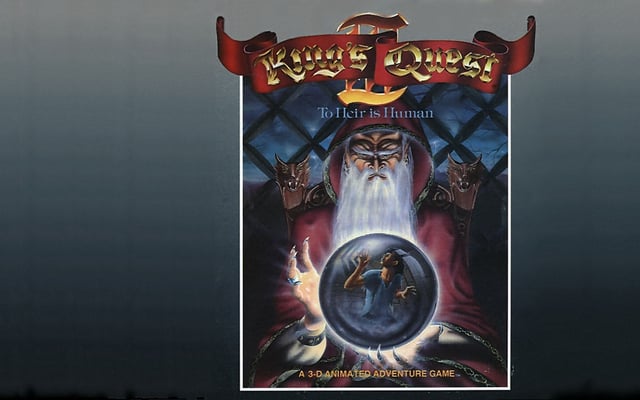
Sierra alone grew the industry in other ways, too. It was Ken Williams who, almost single-handedly, created the market for PC sound hardware by vigorously educating the public to the AdLib card and, shortly thereafter, the breathtaking Roland MT-32. He supported those cards in style while other publishers wanted nothing to do with them. It was Corey and Lori Cole who invented the first true hybrid, replayable adventure/RPG. It was Christy Marx’s lump-in-the-throat ending to Conquest of Camelot that reminded us that not every computer game had to have a group hug at the end. It was Mark Crowe and Scott Murphy who made us want to kill off our onscreen alter ego, to see what inventive, gooey death had been anticipated for us. It was Roberta, before anyone else, who invented strong female heroines. It was Al Lowe, bringing up the rear (literally and figuratively) by creating Leisure Suit Larry, the most popular, pirated game of its decade. We knew this because we sold far more Larry hint books than we sold of the actual software.
It was the Sierra News Magazine (later InterAction) that let us feel like we knew the people making these games, that they were a family-run business, staffed by people who lived an isolated life, surrounding by idyllic, ageless beauty and creating games that were a labor of love. That was, at least for awhile, an accurate picture. This was a family we wanted to feel a part of, for good reason, and people came from thousands of miles away to take a tour and see how real it all was.
But what makes the closure of Sierra On-Line’s Oakhurst facility (recently renamed “Yosemite Entertainment”) a bigger, sadder event than most game company closures–including the far larger decimation of 500 Broderbund employees–is that this was not just a game company, this was a community.
Oakhurst is barely a dust mite on the mattress of America. It existed, for a long time, as a miniscule stopover for tourists on their way to and from Yosemite National Park. As recently as 1991, the mountain-bound town had not a single stoplight, just one grocery store, a single-screen movie theater, and one video rental store. There is no broadcast television (the mountains block it all). The nearest larger town is Fresno, 45 miles distant over the mountains. In severe snowstorms, the town is virtually cut off from the world. And the cable company there is still so provincial, so disdainful of outside influence, that there is no MTV offered, no Nickelodeon (or any MTV-owned stations), nothing to disturb the elderly farmer-types have been the chief population since the Gold Rush days.
Sierra was the second-largest employer in town (the phone company being the largest). Thus, the people of Sierra did not simply work together as they do in most of the country. These people are families, roommates, and neighbors. The person who works in the cubicle next to you may be your girl or boyfriend, your spouse, your landlord. He/she may well have been in your wedding party, and may have driven you 45 miles to the hospital when you were sick (how else could you have gotten there?). Secrets never stayed secret for long; divorces, trysts, and personal traumas all were public knowledge. People at Sierra weren’t just working together, they were living together. Now their lease has expired and the family will all at once be scattered.
The town has grown somewhat. The theater is now a multiplex, but Rusty still gives you his unabashed opinion of each film on the recording when you call for the movie times. There are several stoplights in town now. There are several supermarkets, more hotels, and the infamous “Talking Bear” has undergone a recent facelift. But the town still revolves around Sierra and tourism. And tourism may not be enough to support the town, at least in the winters when much of Yosemite (“the park” in local vernacular) is closed.
With Yosemite Entertainment gone, not only are more than a hundred people out of work (some of whom are fabulously talented), but an entire community has been wiped out with the stroke of a pen. It will be morbidly interesting to see whether or not Oakhurst’s economy can bear up under the mass exodus that will result.
Some may argue that Sierra lives on in Bellevue, Washington, where Al Lowe, Jane Jensen, Roberta Williams, Mark Seibert, and a handful of Oakhurst refugees still labor diligently on games side-by-side with scores of newer talent. But games like KQ:MoE and LSL7 have a distinctly different flavor than the seat-of-the-pants, funny, touching adventures that Oakhurst once produced. They are commercial.
Invariably, in a company that grows the way Sierra grew, innovation gives way to emulation. Whereas Sierra’s management once strove to make it solid, profitable, and yet fun, they now strive to dominate other companies, force annual growth in the double digits, and (like so many other companies) cut jobs mercilessly to improve the bottom line and thrill the stockholders. Yet the Ghost of Sierra Past still walked the halls in Oakhurst. The rooms were adorned with the art of glories past, the artists and programmers who helped to create those glories were, in fair measure, still living and working there. Now that spirit has been exorcised by scrubbed, glad-handing executives who don’t know, or don’t care, what those artists and programmers could do when they were motivated and well-managed.
People, living and working closely together in the pursuit of shared joy, were what made Sierra games great. Thank you, Ken, for creating something utterly unique, something warm, fun and beautiful. Damn you, Ken, for allowing others to tear it down.
Whether you were a Sierra fan or not, we are all diminished by the loss of history, talent, and continuity within the gaming industry. Rest in peace, Sierra On-Line.