Outcast: An Alone in the Dark for the New Millennium?
Outcast: An Alone in the Dark for the New Millennium?
By Randy Sluganski
February 13, 1999


Six years ago, I-Motion changed the face of adventure gaming, though no one realized it at the time, with the release of their now-classic Alone in the Dark. This French horror classic in now widely recognized as the first action/adventure game. What made this game different? While some previous adventure games had contained arcade sequences, none had dared feature combat sequences that relied on the atrophied hand/eye coordination of the usually placid adventure gamer. Blocky 3D polygon technology and cinematic camera angels combined to enhance the ethereal aura of the game atmosphere. There is very little story development; you are a private investigator trapped in a possessed Lovecraftian mansion and your goal is to escape unscathed while working your way from the attic to the bowels of the estate. There was an immediacy to the plot that kept the adventure gamer on the edge of his seat. Action sequences battling otherworldly monsters, a 3D environment, multiple camera angles; what had I-Motion wrought on adventure gaming? The past six years have brought many excellent attempts to imitate the success of the original Alone in the Dark. There have been two sequels, and while both are good, they don’t match the suspense or originality of the first. Probably only Capcom’s Resident Evil series has come the closest to matching the freshness of that first clash with the denizens of the dead. Well, that was then, but this is now. What have you done for us lately, I-Motion?
I-Motion is once again about to make tidal waves in the action/adventure category with their projected March release of Outcast. A 3D game that does not require a 3D accelerator card? An action game with enough action to please the most diehard Quake and Doom fan? A nonlinear adventure game with as much adventure and as little action as the adventure gamer demands? Outcast looks to be all of these and more.
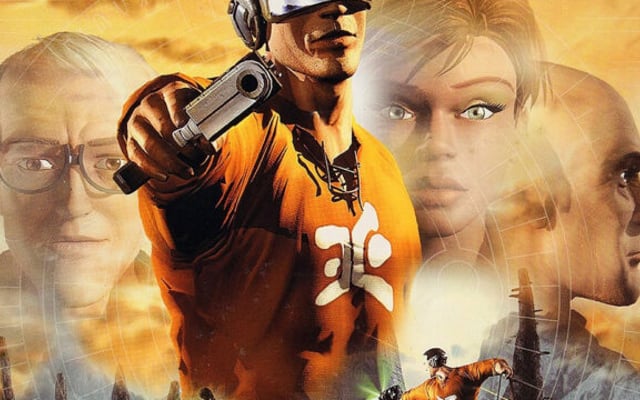
Outcast’s story revolves around a soldier named Cutter Slade, a commander of a covert U.S. operations unit, who is extremely driven to do his best and can quickly adapt to changing situations. His mission, and your goal, is to prevent a wayward scientific experiment from destroying Earth. Outcast is nonlinear with no set path to follow in order to complete the game. Cutter may explore the six unique worlds and parallel universes as needed. How serious is I-Motion about turning Outcast and Cutter Slade into a profitable franchise? Infogrames, the distributor, has released an eight-page character biography that outlines the personal history and genealogy of Cutter and the three main supporting cast members. There are also over 20 different character types who, thanks to the advanced artificial intelligence programming, enrich the game with varying levels of intelligence and adaptive behavior that responds to changing elements in game play. What exactly does this mean? Well, if Cutter shoots an innocent person in a town, the populace might treat him negatively until he carries out some positive actions. Because the temperament and reaction each nonplayer character has to a particular situation might differ in various instances, it will be the player’s choice whether to use brute force or one’s wits and cunning to advance through the game.
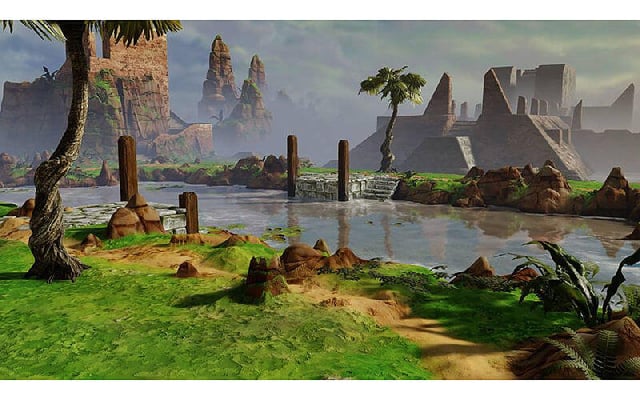
The characters themselves were created by more than 17 days of motion capture in order to provide realistic limb and body articulation. Their facial movements during speech are generated in real time and are determined by what the character is saying. The 3D effects were done in the software, thus eliminating the need for the player to have a 3D card installed. The game engine for Outcast will also adapt itself to the power of the player’s computer so that a more powerful PC will provide much-enhanced graphics, while a lower-end PC will still experience high-quality 3D gameplay with slightly diminished visuals. This is great news for both the action gamer with a killer 3D card and the adventure gamer still plodding along without the newest upgrades. The minimum system requirements are only a 200 MHz Pentium with 16 MB RAM, a 4X CD-ROM drive, and a SVGA graphic card.
As wonderful as the scores for Mask of Eternity, Quest for Glory V and Grim Fandango were this past year, they cannot hold a torch to Outcast. The game offers nearly 60 minutes of original music, performed by the 81-piece Moscow Symphony Orchestra and a 24-person choir. The score is a sweeping, grandiose affair that far exceeds anything that has ever been done in a computer game. If the I-Motion marketing department is not preparing a separate release of the game’s music, well then shame on them.
We have so far only scratched the surface of Outcast’s potential. I have not yet mentioned the action aspects of the game, the various weaponry or such fancy phrases as “voxel-based technology” and “procedural animation.” These are areas that usually concern the action gamer; the adventure gamer is more concerned with plot and character development, and from what I have seen so far Outcast should please the adventure fanatic and action gamer alike. What is most worrisome, though, is the thought that maybe I-Motion has bitten off more than it can chew. By trying to please everybody, will they please no one? Or will Outcast be the first game to successfully cross genres and appeal to two diverse groups of gamers? We will all find out together this spring.