The Book of Unwritten Tales Review
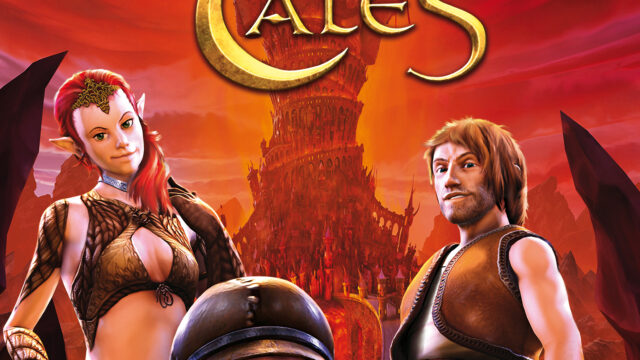
Where would the modern entertainment industry be without the fabulous denizens of Middle Earth? I ofttimes find myself wondering what J.R.R. Tolkien would make of all that hath been wrought in the last half century from his Lord of the Rings cosmos — books, movies, games, Halloween costumes, you name it. For the first decade or so after the trilogy’s publication in the mid-Fifties it was, apparently, difficult even to track down a copy. Then the Sixties counterculture hit and adopted Tolkien’s towering work as its own. Ever since, the growth in elven fantasy has been exponential. Tolkien was famously anti-technology, however. He even hated the automobile. So he likely wouldn’t have taken to the personal computer, and perhaps not even to the adventure game, so many of which, from the very first on, owe him an Ent-sized debt. The latest example is the point-and-click fantasy game The Book of Unwritten Tales, which follows the adventures of a Fellowship of the Ring-like group who all hail from a marvelous place called Aventasia. Actually, as is so often the case these days with major adventure games, TBoUT comes to us again from Germany. But Tolkien drew upon a lot of Germanic folklore for his tales, so that’s appropriate. We first encounter the Elf Princess Ivo, then the wanderlusting gnome Wilbur Weathervane (a rather Frodo-like fellow), and finally the swashbuckling Nate and his Muppety sidekick Critter. During the course of the game you will play as all of these characters, occasionally switching back and forth between them to accomplish certain tasks. To foil the dastardly plans of the villainous Munkus and his even more dastardly sea-anemone-ish mother, all four of these heroes, with your help, must team up and work their wending way through five long chapters of humorous, inventive, far-flung adventuring. The Book of Unwritten Tales is easily the best-looking, best-produced and best-written adventure game I’ve played in years. It has a terrific real-time 3D-ish game engine that somehow manages to work effortlessly even on my standard-issue laptop. (Magic, perhaps?) The scenes and the characters have a palpable depth, giving the player a much greater sense of “being there.” The story, while certainly derivative of Prof. Tolkien, is well-written, well-paced and as engrossing as it is enchanting. The non-player-characters have, for once, real character. The locations are not only beautiful but rich with clever detail. The voice acting is, for the most part, excellent. This is an English cast dubbing a German game, remember. The voice of Wilbur is the standout but even Nate, an obvious Han Solo ripoff with his caustic charm, won me over by game’s end. The music is the pretty, atmospheric symphonic strains we’ve become accustomed to in recent years. You probably won’t be switching mid-game to iTunes to download the soundtrack, but you won’t mute it in the Settings panel either. As I say, the game ran beautifully on my graphics-cardless laptop, which only barely meets the minimum processor demands. The game did crash on me at one spot, though I subsequently learned how to circumvent this conflict (I’d tried to talk to an NPC too soon). And, during the very last scene of the game, the until-then admirable onscreen English text gave out, reverting to its native German. (The voiceover remained English.) I believe I was playing a pre-release review copy, however, so even these two minor glitches may not survive to the final release candidate. I can only wish and hope that every adventure game developer adopts whatever game engine King Art GmbH employed here. Whatever it is, it’s remarkably efficient. A few months ago I reviewed Hamilton’s Great Adventure and had to reduce the graphics down to near monochromatic postage stamp dimensions simply to get it to run. There really is, to my way of thinking, only one flaw in The Book of Unwritten Tales. No, it’s not the writers’ impish inability to resist any and all game and movie associations that came to mind. A complete list of references would no doubt fill pages, but some of the more blatant ones include: yet another “Indiana Jones croaked here” visual; the return of the stone disks from [Indiana Jones and the] Fate of Atlantis; an audio and video homage to the film Mission Impossible; the whale’s uvula from King’s Quest IV; and on and on. There’s even a leftover punch-the-direction-arrows minigame from [Leisure Suit Larry:] Magna Cum Laude. Veteran adventurers may be amused; novices will be mercifully spared. And no, it’s not the small irritation that you can’t speed up the player character’s transit across the screen. You can double-click exits to transition a mite faster to the next area. You can also click through dialogues and cut scenes, though you won’t want to the first time around. No, the one real flaw in the game is the most common one nowadays — too easy. I realize that for many adventure game players ease of play is in fact a virtue and not a shortcoming. I’m sorry, but I cannot accept the recent dumbing down of puzzle difficulty. Puzzles are what differentiate an adventure game from an illustrated interactive story. You can no more have a great adventure game without challenging puzzles than you can have a grand opera without an orchestra. TBoUT does indeed have puzzles. Lots of them. Most are traditional adventure-game puzzles, although including a handful of minigame exceptions like the one mentioned above. But the difficulty has been surgically removed from almost every one. The developers, I’d guess, have been keeping a watchful eye on those devious folks at Telltale Games. The inventory and dialogue-tree puzzles are still there, but the available choices have been so circumscribed that it’s only a matter of a minute to shuttle through every possible combination. Once an item has served its purpose, it disappears from your inventory; the same for any hotspot in the scene. Combining or using inventory items only offers onscreen text when an action can be performed. Moreover, your character will often append to an item’s description precisely what you have to do to or with it. One could argue that all of these puzzle innovations are helpful. That’s just it! They’re too darn helpful. Leave at least some of the game for me to discover on my own, please. There are even a couple of occasions where the game mocks the “old-style” convoluted adventure puzzle solution. Amusing, yes, but I’d have preferred the puzzles over the satire. I do applaud the developers for not including the entire panoply of modern help systems. Aside from a brief spate of tutorial-ese at the very outset of the game, the onscreen prompts disappear. The game does let you press the spacebar to light up all the hotspots on any screen, but even I begrudgingly admit this is a shrewd feature. The pixel hunting in TBoUT isn’t brutal, but there are a few smallish, far-flung items that might well elude you. It’s the old conundrum, though. A game that’s too hard is frustrating, a game that’s too easy isn’t satisfying. How does a developer make a game challenging yet not frustrating for every level of player? Perhaps it’s impossible, but I have a suggestion. A game doesn’t need to be chock full of tough puzzles. Even a handful will make a game challenging. The Settings panel lets you turn on and off many features, why not have a tough puzzle feature? When you turn it on the game adds a handful of posers, or perhaps the solutions to certain puzzles get harder. The most obvious example is a door that’s unlocked in the easy version and locked in the harder. Something needs to be done, because beautiful scenery and expert voiceovers, charming as they are, cannot make for a fully satisfying adventure game. The Book of Unwritten Tales is a gorgeous piece of work but I felt zero sense of accomplishment when “The End” flashed on the screen after my twenty enjoyable but tension-free hours of gameplay. The conundrum extends to grading the game. Everything about The Book of Unwritten Tales deserves an A, if not higher. Even the puzzles are smartly executed. Only their difficulty has been ratcheted down. Players who prefer an easy time of it will love this game. Those who relish a challenge will be disappointed. I can only settle the dispute by awarding the game an A for the former group, and a B for the latter. The story ends — as one might expect from something titled “Book of Unwritten Tales” — with a blatant discussion of upcoming adventures by our band of heroes. Maybe the developers will exhibit in future installments as much sympathy for puzzle fans as they do now for story lovers. I append below a list of the open source software that King Art made use of for TBoUT, in the interest of abetting any and all other developers who wish to emulate this game’s exemplary engine: • Ogre3D (www.ogre3d.org)
System Requirements:
|