Enter the Story: Les Misérables Review
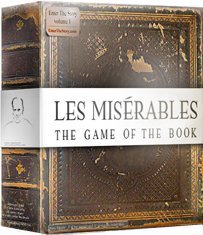
 Over at Enter The Story, Chris Tolworthy has embarked on a truly ambitious project. He is building a network of interactive graphic novels with strong adventure game elements, based on a plethora of classical literature. Currently he has finished such titles as Dante’s Divine Comedy, Hesiod’s Theogony, (called “Genesis of the Gods” in the series) and Charles Dickensens’s A Tale of Two Cities. Upcoming soon, is the exciting Alexandre Dumas (of Three Musketeers fame) novel: The Count of Monte Cristo. Say, a network? Yes, interestingly, Chris is building a huge ‘game’ in which all of the stories (once purchased) interact with one another. I had a look at the first title in the ‘Enter The Story‘ series, being a rendition of Les Misérables, the well-known and beloved novel by the 19th century human rights activist Victor Hugo. 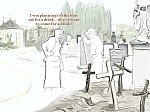 The graphics have been done in a muted minimalist style, with backgrounds that look like watercolor washes. The characters themselves are done in simplistic black and white lines that felt to me reminiscent of looking through a rather elegant comic book. I found the animations natural, pleasant, and effective. In Les Misérables, the characters are often rendered a bit too indistinctly, though, so much so that I sometimes lost them in a crowd. (This seems to have been improved in later titles in the series). Luckily there is an interface function where one can access recent characters via a very useful interactive list of the most recent object/characters interacted with, accessed by pressing ‘R’. There is also a map (‘M’) with most recent places visited, and a hint system (‘F1’). The hint system and interface are introduced in a rather unusual way. At the start of the game, you die as a baby, and suddenly you incongruously find yourself as a grown-up woman, an angel in heaven, where you meet the author, Victor Hugo, who will guide you on your way whenever you ask his help via pressing the F1 key. 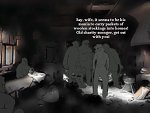 The ‘angel’ aspect and unusual interface and gameplay jarred a bit at first, but one soon grows used to it, and it can be rather fun because of the novelty. Another novelty is that gameplay takes place in both first- and third-person viewpoint. It works like this: gameplay consists mainly of you (as the angel Peri), causing people to act by suggesting ideas to them. (This takes place by right-clicking on the chosen person and then right-clicking on the object you want them to think of.) However, some of the gameplay (or ‘puzzles,’ if you will) also take place by controlling the hero of the game, Jean Valjean, from a third person viewpoint where you can make him move or interact with other characters, all via point-and-click. This might be a little confusing until you get the hang of it, but it does make for a bit of welcome variety in the gameplay. As might be expected from a game attempting to precis such a voluminous novel as Les Misérables, there is no voice-acting, but plenty of text. Since one would expect people interested in classical literature to enjoy reading, this shouldn’t be too much of a problem. In fact, a lot of the text from the novel was cleverly worked into the gameworld via the thoughts of the people populating it. By double-clicking on people you can access their thoughts, which are very often a reflection of Victor Hugo’s commentary in the novel. The musical score consists of a variety of orchestral and choral works, most of it quite enjoyable, especially the pieces that provide a suspenseful background to the bits of the game where an atmosphere of tension is required; I think it does the job very well.  The game follows the novel quite faithfully, with a smallish exception perhaps, of the actions required of you regarding Napoleon Bonaparte. That might just be me nitpicking, however. All in all, imagine what Les Misérables would be like as a comic or interactive novel. Now imagine the latter with adventure game elements in addition, and what you have is: Enter the Story: Les Misérables. Sadly the game can feel like a chore at times, and the gameplay can become a tad tedious. Although difficulty-wise it is sometimes hard to work out what to do next in the game, I felt a lack of some nice “sink-your-teeth-into-it” puzzles, (there are no inventory or mechanical puzzles), but otherwise it was an enjoyable enough experience for me to consider trying out some further titles in the series at a later date. A Tale of Two Cities (already available) and especially The Count of Monte Cristo (available soon) promise to be of particular interest. Les Misérables is being offered entirely for free at the Enter The Story site, so if you are interested in classical literature or in events/stories surrounding the French Revolution, or simply curious about the Enter The Story project, it certainly cannot do any harm to give it a try.
System Requirements (PC):
|