Graphic Adventures Review
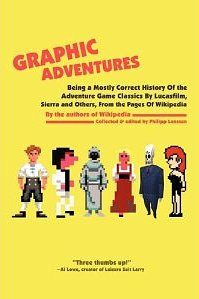
If you have ever posted any information about graphic adventure games from the late 1980’s or early 1990’s on Wikipedia, then you may soon be receiving royalties from the sales of Graphic Adventures: Being a Mostly Correct History of the Adventure Game Classics by Lucasfilm, Sierra and Others, From the Pages of Wikipedia. Well, not really, as there are seven pages of legalese in small print towards the back explaining the licensing of this book and its source articles. Actually, Graphic Adventures (or GABAMCHOTAGCBLSAOFTPOW for short) is the brainchild of one Philipp Lenssen who had the nifty idea of accumulating the articles about specific graphic adventures that have been posted on Wikipedia and assembling them into book form. For those unaware, Wikipedia is a ‘living’ online encyclopedia that is in a constant flux of change as readers share and edit information on basically every subject imaginable. What Philipp has done is take this information, edited when necessary and added some screenshots and interviews from online sources such as Just Adventure. So, as the saying goes, why buy the cow when the milk is free? Well, if you’re anything like me (which I truly hope you’re not), then you just like to have the smell and feel of a book in your hands. Lenssen is first and foremost a hardcore graphic adventure fan and knows his material beyond what is posted on Wikipedia and while I don’t question any edits he deemed necessary, I do have to wonder about some of his choices. The first 211 pages are a comprehensive and entertaining read on the history of Lucasfilm (as LucasArts was known at the time) and the classic games they were churning out one after another. Part II, is a history of Sierra, a company that once again gets short shrift as classics such as Gabriel Knight: The Beast Within, Gabriel Knight: Blood of the Sacred, Blood of the Damned, Phantasmagoria 2 and King’s Quest 4- 7 are totally disregarded. Instead, in what I consider to be a major gaffe, the addition of a ‘Part III..And All the Others’ is a scattershot and watered down attempt to spotlight additional popular graphic adventures of the era but seems to have no rhyme or reason as it jumps from Shadowgate, to Return to Zork, to Future Wars, to Myst. What really would have worked much better – and I realize that I’m jumping ahead here – is to have extended the Sierra chapter approximately another hundred pages and then simply end the book and consider it Volume 2 of a three-part series. Volume 1 could have then been a comprehensive history of the text adventures, many of which outside of Infocom’s oeuvre remain obscure, and then a Volume 3 leading off with Myst and its overall influence on the genre up to present-day classics such as The Longest Journey and the Syberia series. But rather than complain about what isn’t, I would rather applaud Philipp Lenssen for taking the initiative to bring the graphic adventure genre to the forefront and sincerely hope he has plans to continue his project forward into uncharted territories. You can purchase Graphic Adventures here. |