Amertis Review
 If you are a Myst-hater, then you do not want to play this game. Might as well move along right now. If, however, like the industrious, talented and somewhat mischievous amateur creative team of Amertis, you love most things Myst, and games like it, then the strange lands of Amertis are just where you want to spend the next week. Eight years ago the same members of this team (give or take a few), released an online adventure game called Atlantzone. The laid-back hero of that game, Rodrigue Grandcœur, a solicitor in the fictional sleepy French town of Atlantzone, got caught up in an intrigue that, while occultish in nature, remained in real world locations — as depicted by the game’s photos of (I presume) actual exteriors and interiors in the South of France. Now, M. Grandcœur is back, as is the young woman he met in his previous adventure, Petronille. This time, however, Petronille has asked Rodrigue to help her sell her uncle’s dilapidated, abandoned house — a rambling old pile emptied of almost everything except for one fabulous secret. Well, it isn’t long before Petronille disappears into thin air up in the attic and it is up to you, as Rodrigue, to track her down and bring her back. To do this, you will have to discover and then learn how to use a strange jeweled metal icon to take you to the even stranger lands of Amertis. There you will at last leave the world of photo realism and enter the fantastic realm of whatever 3D software app the team used to render the backgrounds. You see, Petronille’s uncle was an inventor (are there uncles in games who are not?) and he concocted that jeweled icon to transport people to worlds of his own making where toy figures come to life. 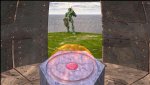 It’s a good thing Petronille’s uncle didn’t charge anyone to travel to Amertis because he would have run into serious copyright trouble. Not only is the basic premise of Myst’s ages borrowed, but so is the plot of Myst 3: Exile, and even some of the furniture. In your travels throughout Amertis you will run across a tree house from Channelwood and even that manhole cover from Riven. And yet, as is true of so many of the supposed Myst clones, Amertis still manages to be its own game. One aspect that strongly sets it apart from Myst (and Amerzone and Rhem and all the other games which the creative team here duly pay homage to) is its extreme Frenchness. While the English version of the game has subtitles, the “character” of the game still strongly comes through the French mp3 dialogues. Even if you don’t speak a word of French, you will get the “sense” of most of the characters from their expression and tone of voice. There’s a microphone on the upper part of the game’s screen that you can click to turn off the voices, but you will miss a lot. The oddly flirty Barbie dolls inhabiting the South Seas volcanic island, for instance, are the most amusing collection of coquettes you’ve ever run across. On the island inhabited by ceramic garden gnomes, you will meet some extremely bourgeois French blowhards. The other two islands have been populated by battery-powered metal robots and plastic figure Native American Indians. They too, are all quite French. What’s a French robot or French Indian chief sound like? Well, you’ll have to play the game.
 Atlantzone could be downloaded or played online (and still can be), but Amertis is a 200 megabyte download only. The game runs full screen or in a standalone Adobe Flash Player 9 screen. I’m taking the full screen thing on faith, because all I ever got when I launched the Amertis.exe was a black screen. One tap of the escape key, however, brought me to the Flash Player window. That, as far as I could tell, was not resizable, and on my widescreen laptop it didn’t quite all fit. Otherwise, the game ran without difficulty on Windows 7. Just remember that the space bar calls up the menu where you can save, load and quit. Although the first-person-perspective experience of wandering around the various locations of Amertis will be the closest you’ve come in a long time to meandering around the ages of Myst, there are differences. Amertis relies much more on traditional puzzles than Myst, shoehorned into the story sometimes cleanly and sometimes without apology. There is, of course, a generous supply of the usual point-and-click inventory puzzles — finding items, combining items, handing over items, etc. Like Myst, though, the puzzles give no quarter. You are going to have to observe and think your way through. Some of the puzzles are even multilayered — just when you think you’ve got that combination right, you learn there’s another twist to incorporate. The puzzles, in fact, are the best part of Amertis. If you don’t enjoy solving, even sweating, over puzzles you will not enjoy Amertis. The game had been available only for a few months when I played it (March), but already the bombardment had begun on the official website for easier puzzles. The English walkthrough had finally been posted, however, so that may quell the uprising. Though the game’s creators had already relented and reworked the early part of the game to make a road maze easier. (Here is a reverse spoiler — if you want to play the game as originally intended, don’t consult that map you find on Rodrigue’s desk.) 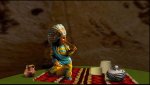 Speaking of mazes, the one thing likely to drive you batty about the game is its navigation. Like Myst, it uses a slide-show format with little hand icons to move around. But finding all the areas you can visit and figuring out where you’ve landed after you’ve clicked is often a Mystery. Amertis is offered as freeware with the usual postscript plea for donations. One of the things that struck me while playing Amertis was the realization that “free” games have a lot of freedoms that commercial games can’t afford. When you produce and distribute a game for your own amusement, you don’t have to worry about complaints — it’s too this, it’s too that. You can include challenging puzzles and not have to apologize for it. Early on, in the uncle’s house, you run across a classic wood-block version of Klotski. As always, this puzzle takes a long time to solve, even when you’ve done it a dozen times before (the best and most maddening version is the piano-mover puzzle in The 11th Hour). The kicker, though, is that when you finally solve it, you learn it has nothing to do with advancing in the game. It was just for fun. Whee! Can you imagine the howls if a commercial game maker ever tried that?
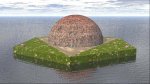 Amertis, despite its undeniable amateurism in many areas, feels and plays like one of the more original games you’ve run across in a long time. Yes, even despite the massive aping of other adventures. From what I glean from the game’s website, the creators of Amertis aren’t even overly experienced artists or coders. They’re just enthusiastic adventure gamers who love to cobble together fun adventures of their own. This is undoubtedly why the visuals in the game vary widely. Some of the 3D environments (the South Seas isle) look quite competent, while others (the plastic Indians island) look like they were created by someone who just got Photoshop for Christmas. And yet, unlike most modern commercial adventures, Amertis has a soul, the way Myst had. When you played Myst you got the feeling the game’s creators were as wide-eyed about it all as you were. As with the artwork, the music, sound effects and the translation can get a bit uneven, or even screwy. You can almost see the game’s creators pasting it all together on their home desktops. You can’t really compare Amertis to a multi-million-dollar product from a big gaming publisher. But Amertis is more than just an admirable amateur effort. In many ways, it is better than many commercial efforts. More genuine. It took me over a week of serious playing to get to the end of the game, but by then even its shortcomings had turned endearing. Overall, I give Amertis a final grade of A minus.
|