|
Articles
Is Flash the Future of the Adventure Game?
by Greg Collins
November 7, 2006
|
 The future of the adventure game is understandably a concern for adventure game fans, especially those of us who remember its brief glory days in the Nineties as the 800-pound gaming gorilla, dominating all genres, becoming the darling of the large commercial game producers. Ever since its fall from that grace, gaming pundits have been proclaiming the adventure game’s overall demise. But the adventure game didn’t die, it merely got toppled from the top spot. It was just another step in the genre’s overall evolution, an evolution that has, like most things in the computer world, taken place with blistering rapidity. The future of the adventure game is understandably a concern for adventure game fans, especially those of us who remember its brief glory days in the Nineties as the 800-pound gaming gorilla, dominating all genres, becoming the darling of the large commercial game producers. Ever since its fall from that grace, gaming pundits have been proclaiming the adventure game’s overall demise. But the adventure game didn’t die, it merely got toppled from the top spot. It was just another step in the genre’s overall evolution, an evolution that has, like most things in the computer world, taken place with blistering rapidity.
In the span of less than thirty years, the adventure game has gone from a novelty played on mainframes at universities, to Infocom and the commercial text adventure, to Roberta and Ken Williams’ King Graham follies at Sierra Online, to SCUMM (not an evil empire bent on world destruction like SPECTRE, but rather an ingenious gaming system), to the Miller Brothers and Myst to… okay, you get the idea. The point is that the adventure game concept has been implemented in a wide array of gaming platforms. I hear tell you can now play Myst on your mobile phone. Only thirteen years ago, people had to buy a faster computer equipped with something called a CD-drive just to be able to handle its massive specs.
 It’s amazing, really, how versatile the adventure game is. I suppose someone could write a text-based first-person-shooter, if they were insane enough. I don’t know how much fun it would be to play. “Kill multi-tentacled giant green thing with portable howitzer.” “I don’t understand multi-tentacled giant green thing.” “Kill enormous monster with howitzer.” “I don’t understand enormous monster.” “Kill all with howitzer.” “The incredible humongous Flibberdigibit has eaten you. You are dead. Do you want to restore, restart or quit?” I suppose the FPS might fare a little better on LucasArts’ SCUMM platform. The action verbs could be: Look, Pick Up, Annihilate, Blast, Incinerate, Straff, Decimate, and Devour. Overall game play might be a little slow, however, for the genre’s hard-core fans. It’s amazing, really, how versatile the adventure game is. I suppose someone could write a text-based first-person-shooter, if they were insane enough. I don’t know how much fun it would be to play. “Kill multi-tentacled giant green thing with portable howitzer.” “I don’t understand multi-tentacled giant green thing.” “Kill enormous monster with howitzer.” “I don’t understand enormous monster.” “Kill all with howitzer.” “The incredible humongous Flibberdigibit has eaten you. You are dead. Do you want to restore, restart or quit?” I suppose the FPS might fare a little better on LucasArts’ SCUMM platform. The action verbs could be: Look, Pick Up, Annihilate, Blast, Incinerate, Straff, Decimate, and Devour. Overall game play might be a little slow, however, for the genre’s hard-core fans.
Adventure game fans, on the other hand, have adapted to pretty much every gaming system that has come along. Why is the adventure game so adaptable? In part, because it has to be to survive, but also because it’s based on a very simple, yet powerful idea. It’s a treasure hunt. It’s an irresistible (well, to fans at least) combination of story and puzzle-solving. Of course, the FPS is based on an even simpler concept kill everything in sight. But the FPS depends on great visuals. It’s difficult to shoot something you can’t see.
What then is the future of the adventure game? Obviously, it’s going to keep morphing to adapt to whatever system pops up next. It probably is doubtful that the commercial houses will ever take it up again, but the adventure game will continue to thrive because there are too many talented programmers out there who love adventure games. And because it has become remarkably simple or comparatively simple for one person to build a satisfying adventure.
 As I look around the world-wide web in 2006, I have come to the conclusion that the likeliest immediate future for the adventure game is on the Flash platform. Most of us by now are familiar with delightful online adventures like the Samorost games, 1 and 2. I must admit, my first impression of these Flash adventures was as charming curiosities. I didn’t imagine that the Flash format was versatile enough to accommodate a full-fledged, satisfying adventure. And, frankly, I still have my doubts about this. It’s just that I think the Flash format is now so dominant, so universal, that it will trump all competitors. If, as I believe, the future of the adventure game depends on the creations of talented enthusiasts, then the Flash platform seems inevitable. As I look around the world-wide web in 2006, I have come to the conclusion that the likeliest immediate future for the adventure game is on the Flash platform. Most of us by now are familiar with delightful online adventures like the Samorost games, 1 and 2. I must admit, my first impression of these Flash adventures was as charming curiosities. I didn’t imagine that the Flash format was versatile enough to accommodate a full-fledged, satisfying adventure. And, frankly, I still have my doubts about this. It’s just that I think the Flash format is now so dominant, so universal, that it will trump all competitors. If, as I believe, the future of the adventure game depends on the creations of talented enthusiasts, then the Flash platform seems inevitable.
There’s certainly no lack of other candidates out there. Even I have taken a look at the AGS (Adventure Game System) program for Windows and imagined I might create a credible adventure out of it. Assuming, that is, that I pick up some creative talent and initiative somewhere along the line. The other platform that I would have bet on only a year or so ago was Java. If, as everyone and his sister is predicting, that more and more of our content is going to be accessed via broadband on the web, and less and less is going to be bought in jewel cases at brick-and-mortar or even online stores, then Java would seem to be the likeliest candidate. But, while I’ve run across some very clever and enjoyable games written in Java, they have been dwarfed in number by Flash games. As a non-programmer, I can only conclude that writing games in Java is not for the faint of heart. In short, it’s probably a heck of a lot like writing in C+ or at least Visual Basic.
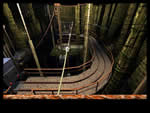 The other likely candidate was Flash’s big brother Director. Even I can tell that Director is much more powerful that Flash. And we know excellent full-fledged commercial adventure games can be written in it, since we already have the exemplary Rhem and Rhem 2 by Kurt Mueller. Those two games, however, took Mr. Mueller years to produce. And they have to be shipped on discs because the files are so large. Flash, on the other hand, uses bandwidth-friendly vector graphics and can be downloaded in, well, a flash. The other likely candidate was Flash’s big brother Director. Even I can tell that Director is much more powerful that Flash. And we know excellent full-fledged commercial adventure games can be written in it, since we already have the exemplary Rhem and Rhem 2 by Kurt Mueller. Those two games, however, took Mr. Mueller years to produce. And they have to be shipped on discs because the files are so large. Flash, on the other hand, uses bandwidth-friendly vector graphics and can be downloaded in, well, a flash.
Flash is also a heck of a lot cheaper than Director. I think that what happened is that over the last few years, those people interested in building games took a look at what application they could best afford. The last time I checked, Director was selling for something like $1500. Then there are those other professional apps like Maya, that run something like $2000 to $3000. And then you have to learn how to use them! Flash is apparently easy to learn, relatively inexpensive to purchase, results in small file size and is universally applicable. What’s not to like? That’s why I think it’s inevitable that more and more adventures are going to be found online and in Flash format.
Which still leaves the burning question of whether full-length adventure games can be written in Flash and deployed on the web. Compared to other game genres, the number of “genuine” adventures in Flash is still tiny. If you go to one of the big Flash game sites like Miniclip, it’s hard even to locate the adventure titles, and most of those are really some sort of action-adventure hybrid. I don’t think we can count on the commercial sites to provide real adventures in Flash or anything else. Anyone seriously trying to make money will not buck the current trend of providing first person shooters and more first person shooters. Again, we must rely on the talented adventure-game enthusiast.
 Along with the Samorost folks, one of the most impressive of these is Pinhead Games. A Case of the Crabs is still one of the most satisfying and lengthy adventures I’ve played in the Flash format. Another game I’ve been very impressed by is Chasm, an adventure I ran across while surfing the web. I’m not sure about its current availability, but it’s worth playing if you can find it. The game is copyright 2002 by the Australian Broadcasting Corporation and the listed URL is www.transience.com.au but the last time I tried to load that page I got an “unknown.” The address www.abc.net.au/gameon/chasm/chasm.swf, on the other hand, still will load the game into your browser. What the Australian Broadcasting Corporation and Tourism Board had to do with backing a Flash adventure on the web is an intriguing issue in itself. Along with the Samorost folks, one of the most impressive of these is Pinhead Games. A Case of the Crabs is still one of the most satisfying and lengthy adventures I’ve played in the Flash format. Another game I’ve been very impressed by is Chasm, an adventure I ran across while surfing the web. I’m not sure about its current availability, but it’s worth playing if you can find it. The game is copyright 2002 by the Australian Broadcasting Corporation and the listed URL is www.transience.com.au but the last time I tried to load that page I got an “unknown.” The address www.abc.net.au/gameon/chasm/chasm.swf, on the other hand, still will load the game into your browser. What the Australian Broadcasting Corporation and Tourism Board had to do with backing a Flash adventure on the web is an intriguing issue in itself.
Chasm, though, is a very enjoyable and fairly long adventure. It’s one of the few games I’ve run across that encourages me to believe that maybe there is a rosy future for the “traditional” adventure with a .swf file extension. Like all Flash games, the bright, glossy vector graphics are a little hard on the eyes at first, but one soon gets over that.
Another encouraging Flash adventure is Arcane, produced by or for Warner Bros. to promote something or other. That doesn’t matter. What matters is that Arcane, which comes in eight episodes, is another well-written, longish adventure. I don’t know if the Warner Bros. website is still hosting it, but you can find the Arcane episodes elsewhere on the web now. The sheer fact that a large entertainment entity like Warner Bros. would even associate itself with an adventure title is heartwarming.
 My fullest praise, however, must go to Jonathan May whose www.woolythinking.com site offers (at last count) four truly excellent games. Two are adventures and two are pure puzzle games, but I would enthusiastically recommend all four to any adventure-game lover. The puzzle games are The Dark Room and its sequel The Dark Complex. The adventures are Archipelago and its sequel Return to the Archipelago. The best adventure games give your brain a good workout, and these games certainly do that. Perhaps the adventure-game traditionalist would not find him or herself at home among the islets of the Archipelago. There is some Flash-like frustration to be found in being frequently disoriented compass-wise and the lack of any character interaction. Like Chasm and A Case of the Crabs, however, the Archipelagos make me believe that Flash can deliver a full adventure game expericnce. Are any of these Flash adventures as impressive and monumental as Mr. Mueller’s Rhem titles? No. But the Flash adventure saga has essentially just begun and I am eager to see where these amazingly creative gamemakers take it. Myst and Riven, after all, were glorified Hypercard stacks, and they kicked off a gaming revolution. Flash adventures, it seems to me, have that potential, and even more, because there are so many talented “amateurs” out there. And, hey, so far all of these games are provided online free of charge. Like the best adventure games, that’s hard to beat. My fullest praise, however, must go to Jonathan May whose www.woolythinking.com site offers (at last count) four truly excellent games. Two are adventures and two are pure puzzle games, but I would enthusiastically recommend all four to any adventure-game lover. The puzzle games are The Dark Room and its sequel The Dark Complex. The adventures are Archipelago and its sequel Return to the Archipelago. The best adventure games give your brain a good workout, and these games certainly do that. Perhaps the adventure-game traditionalist would not find him or herself at home among the islets of the Archipelago. There is some Flash-like frustration to be found in being frequently disoriented compass-wise and the lack of any character interaction. Like Chasm and A Case of the Crabs, however, the Archipelagos make me believe that Flash can deliver a full adventure game expericnce. Are any of these Flash adventures as impressive and monumental as Mr. Mueller’s Rhem titles? No. But the Flash adventure saga has essentially just begun and I am eager to see where these amazingly creative gamemakers take it. Myst and Riven, after all, were glorified Hypercard stacks, and they kicked off a gaming revolution. Flash adventures, it seems to me, have that potential, and even more, because there are so many talented “amateurs” out there. And, hey, so far all of these games are provided online free of charge. Like the best adventure games, that’s hard to beat.
|