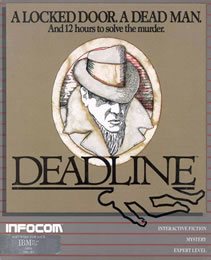
Deadline Review
Early History of Interactive Fiction Games Tell the truth. Have you ever played an interactive fiction game? Maybe you are too young to know what IF is. Perhaps you are so hooked on to-die-for graphics that a game without pictures is beneath your contempt. Or is it possible that there are so many great modern games on your to-do list that you just can’t make room in your schedule for an oldie. If any or all of these reasons/excuses apply to you I suggest that you give consideration to some of the finest interactive fiction games ever developed. Infocom is the magic word. Today we take computer games and the Internet for granted. After all, haven’t they always been available? Not!! In 1972 a young man named Willie Crowther wrote an elementary text based game called Colossal Cave. The player could enter a computer-simulated environment and type in what to do next, all in simple English. Willie put the game on the mainframe computer at Boston University where he was a student. In 1976 the game was improved and expanded by Don Woods. Local college students played the game over the ARPAnet, a primitive ancestor of our much-loved Internet. In 1977 Dave Lebling and Mark Blank, students at the Massachusetts Institute of Technology Laboratory For Computer Science, were involved in the development of an early programming language called MDL (Dynamic Modeling Group, affectionately called Muddle). Along the way, Blank and Lebling added more MIT big brains to their development group, Tim Anderson and Bruce Daniels. These pioneers of computer gaming developed game maps, house plans, wrote a story and slowly but surely Zork 1 (at the size of one Megabyte) was a playable concept. Infocom was officially founded in 1979 by Tim Anderson, Joel Berez, Marc Blank, Mike Broos, Scott Cutler, Stu Galley, Dave Lebling, J. C. R. Licklider, Chris Reeve and Al Vezza. Infocom went on to become a huge star in the computer gaming market and developed a large selection of IF mystery, science fiction, comedy, fantasy, horror and espionage games. In June of 1986 Infocom was sold to Activision for 7.5 million dollars. That’s a tidy sum even by today’s standards. Unfortunately (for Infocom) the gaming public had become hooked on graphic adventures. By May of 1989 Infocom was forced to lay off 16 of its 26 employees. The games published after 1989 were developed by different authors and the original concept of Infocom was lost in the spin of the new and flashy. Deadline: Press reviews from the past According to Matthew Murray, “Deadline is computer gaming’s first serious murder mystery, and still one by which all others must be judged. Deadline set a standard in complexity and plot development that has yet to be matched. With numerous different suspects to interview and motives to sift through, trying to solve the murder is hardly easy. There are over ten possible endings to the case, though only one that is the most successful conclusion. Deadline is a game that no adventure game fan or mystery buff should leave unplayed.” Time Magazine called Deadline “part of the latest craze in home computing”. The New York Times said that Deadline was an amazing feat of programming” and Electronic Games awarded it the Best Adventure Game of 1983 award. The Game: What its all about Late one night, Mr. Marshall Robner locked himself into the library of his home, a colonial estate in New England, and took an overdose of anti-depressants. Or at least that is what everyone assumed. The local Medical Examiner found that suicide was a reasonable conclusion and Mr. Robner’s family did not have ideas that indicated otherwise. But rumors and suspicions become rampant and soon you, playing as the chief detective on the case, are asked to investigate the possibility of murder. You aren’t comfortable with the finding of suicide and to further complicate your life, you only have twelve hours to crack the case. Can you do it? First of all, you must examine the house and grounds for clues, analyze everything that you find, and check for fingerprints. You will also need to interview all of the game characters, looking for inconsistencies in their stories. Careful note taking in an interactive fiction game is vital and can mean the difference between success and failure. Included in the game package you will find paper copies of the Medical Examiner’s report, a lab report concerning a tea cup found near the victim, blueprints of the house and gardens, memos from the Lakeville, CT Police Department, and extensive interview notes that include information from Mrs. Robner (wife of the deceased), Mr. Dunbar (personal secretary of the deceased), Mr. Baxter (business partner of the deceased), Mrs. Rourke (the housekeeper), and George Robner (son of the deceased). Was this suicide or murder? Mr. Robner had a history of depression and was taking medication for it. He had spoken of suicide. Ah, but he left no suicide note. A note is not essential but it certainly helps. As you investigate you will find that Mr. Robner had problems with his wife, his son, and his company. You will need to follow these people constantly and ask lots of questions. Don’t overlook anything. Look at footprints, locate and examine a hidden closet, and read Mr. Robner’s diary. What about the destroyed document that you find. Could it be a will? Can you find the guilty party or parties and solve the crime? Is it a crime? Arresting someone before you have a tight case can mean the death of a jury verdict. Playing Deadline to a successful conclusion requires concentration and diligence. It is not an easy game. But you will find that it is well worth your effort. Deadline can be purchased new or used at Amazon.com as part of the Infocom Adventure Collection. These games could turn your long, hot summer into an exciting trip into your imagination. Why not give this one a try? Coming Soon:
|