The Elder Scrolls IV: Oblivion Review
|
Review The Elder Scrolls IV: Oblivion
Review by Ray Ivey |
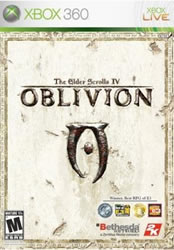 |
The Elder Scrolls IV: Oblivion is the latest in Bethesda’s legendary series of sprawling RPGs set in the exotic world of Tamriel.
The series has offered games that were widely considered to be mixed blessings, offering enormous role-playing freedom in a buggy or otherwise unwieldy package.
To be able to talk about Oblivion with any perspective, it’s necessary to take a quick look back at the most recent game in the series, 2001’s The Elder Scrolls III: Morrowind.
Morrowind was a frustrating mix of spectacular virtues and vexing weaknesses. On the plus side, the gameworld was stupefyingly huge, complex, strange, handmade, mysterious, and beautiful. The game offered a flexibility in character creation and development that was a virtual role-player’s wet dream. The problems with the game included a clunky interface (particularly regarding inventory and the quest log), lifeless NPCs, endless generic-feeling quests, and a general lack of urgency that eventually caused an entropic exhaustion in many of the players.
Morrowind really drove me crazy. I can’t remember another game I loved and hated so intensely at the same time. The whole time Bethesda was developing its follow-up, Oblivion, my mantra (oft-repeated to the Bethesda folks themselves) was “If they can keep everything that was great about Morrowind and fix half of what was wrong with it, they could have an RPG for the ages!”
Dynamite Quests
Everything about questing in Oblivion is superior to its predecessor. First of all, the Quest Log works beautifully. It allows you to keep track of current, active and completed quests. In addition, it tracks the steps of multi-part quests. Finally, it gives you directional help so you can find the object of your quest more easily.
But it’s not just the way you keep track of quests that has been improved. The quests themselves are vastly superior to those in Morrowind. Instead of generic-feeling, listless fetch quests, Oblivion offers a multitude of interesting, story-driven adventures. These missions involve everything from foiling fraudulent vampire hunters to pacifying a lonely old sailor ghost; from exposing corruption in a city guard to morally compromising an honest man. You’ll step into an oil painting, fight pirates (and pirate ghosts!) and harvest bear teeth.
The game’s main quest line involves the death of the current Emperor (voiced by Patrick Stewart), seeking his secret heir, and dealing with a series of portals to hell that open all over the land. This main storyline is interesting and rewarding, but it’s just the beginning. You can have an entire career (with hefty quest lines) as a thief, fighter, mage, assassin, or all four. You can roam the land seeking out ancient shrines where you can do the bidding of despotic old gods. You can fight your way up the gladiatorial ranks in the Imperial City’s Arena. You can become a vampire hunter, or become a vampire yourself! Or you can simply freely adventure through the land, disturbing bandits, beasts, demons and undead in a myriad of wilderness camps, ruins, and dungeons.
Obviously, there’s lots to do in Oblivion!
The Story
As in all four Elder Scrolls games, the story begins with you in a jail cell. In fact, it’s the same exact cell in which your character begins in the first game, Arena. You don’t know who you are or why you’re there, and before you can think about it too much who should show up in your cell but the Uriel Septim, the Emperor himself! He’s accompanied by guards, and appears pretty agitated. But he stops short when he sees you. “You are the one from my dreams!” he exclaims. (Of course you are.) You are ordered by the guards to follow the Emperor and his contingent through a secret passageway out of your cell and into an underground labyrinth. Within a few minutes, the sovereign has been assassinated and you are charged with finding his hidden heir.
This early sequence serves as the game’s tutorial, during which you learn the basic skills of the game, including combat, magic and stealth skills. Along the way, you are asked where you are from, which is the game’s way of determining your race. Like Morrowind, the game has a generous assortment of races, all with different appearances, lore, strengths and weaknesses. These include Nords (great fighters), Bretons (super magic users), Imperials (great at personality skills), Argonians (think lizards), Khajit (cats), Red guards (the best pure fighters of all), Rocs (tough but hit with the ugly stick) and an assortment of Elves.
All this is dramatic and exciting, but an even cooler process is japanning “under the hood” during this prelude. One of the interesting characteristics of all Elder Scrolls games is the organic way they help you determine what kind of character you are going to play. In Oblivion, the game is observing how you are playing this prelude part of the story. Which skills are you stressing, and which are you ignoring? Depending on how you are playing, when you get sent on your mission after the Emperor is dead, the character speaking to you makes an assumption about your class. “You seem to me to be an Assassin,” he might say. Or “Knight,” or “Agent,” etc. (He assumed I was a “Dungeon Decorator,” but that’s neither here nor there.)
At this point you can agree with his assessment and your character class is automatically assigned. Or you can choose from a dizzying array of prebuilt classes.
Here’s how a character is built in Oblivion. Two primary attributes are chosen (out of these six: Strength, Endurance, Personality, Willpower, Speed, Intelligence), and then seven (out of a possible twenty-one) primary skills are chosen, along with a focus in Combat, Magic or Stealth.
The many pre-built character classes are based on combinations of the two primary attributes. Hence, a Strength/Personality character is a Knight; an Endurance/Personality build is a Pilgrim, an Intelligence/Willpower character is a Mage, Strength/Intelligence = Spellsword, Speed/Agility = Archer, and so on and on.
As if these many combinations were not enough, you can build your character completely from scratch, choosing your own primary attributes and primary skills and then naming the class yourself.
Oblivion follows up this extremely flexible character creation system with a remarkably organic leveling system. In this game there are no experience points at all, and no skill points to spend upon leveling up. No experience points or skill points in an RPG? Yep, you heard right.
Skills are leveled in the most natural way — by using them. Thus, if you want your Blade skill to increase, swing that sword a lot. Want your Mysticism ability to shine? Summon, summon, summon. Etc. Leveling occurs when you’ve leveled your seven primary skills (in any combination) a total of ten times. At that point you get to increase your stats a bit, and can even get bonuses depending on what combination of skills you improved.
The system works remarkably well, and really allows the character development system to get out of the way of the player so she can simply play naturally.
Another plus is that none of the skills you don’t choose as primary skills are blocked off to you. They just increase more slowly, and don’t count toward character leveling. But that doesn’t mean you can’t raise them to impressive heights. For example, I played a pure Mage with zero fighting skills among my primaries, but by the end of the game my Blade skill was nearly 100.
Many activities which were clunky or a downright pain the ass in Morrowind are much smoother in Oblivion. Alchemy, spellcasting, summoning, speechcraft and lockpicking are all solid, intuitive, rewarding, streamlined, and fun.
The variety of skills in the game give you lots of opportunities to have fun in different ways. Develop a silver tongue with the Speechcraft skill. Get devilishly good prices with Mercantile. Become a burly warrior with Blade, Blunt and Block. Enjoy thievery using Security to pick locks and Sneak to go about your nefarious way undetected by enemies. Repair and even improve your armor with Armorer. Brew powerful potions and poisons with Alchemy. Use Illusion magic to hide yourself, Destruction to nuke your enemies into submission, Alteration to get past locked doors, Conjuration to summon powerful enemies, or Restoration to heal and buff yourself and others.
Music
Lucky for us, Bethesda was able to secure the services of the remarkable Jeremy Soule to compose the score for Oblivion. Soule is simply the best RPG game composer working; he provided the memorable music for Icewind Dale, Neverwinter Nights, Guild Wars, Star Wars: Knights of the Old Republic, and of course, Morrowind. Soule understands the job of the musical score in an RPG: To create the sense of epic urgency and importance. The music in Oblivion is, not surprisingly, superb.
Presentation
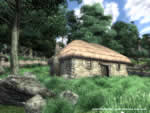
The overall presentation of Oblivion is top-notch. There’s great attention to detail, not only in the visuals, but in the writing. I’ve talked about the imaginative quest storylines, but there’s an added bonus for gamers who like in-game reading: There are over 400 books in the game, which provide a rich background to the lore and history of The Elder Scrolls setting of Tamriel. Reading some of these books will even provide you with skillups!
Whole Lotta Game
While there’s not the stupefying amount of content that was present in Morrowind, there’s still tons to do in Oblivion. I completed the game in about 110 hours, and that included the Main Quest; the Arena, the Thieves Guild, Mages Guild, Fighters Guild and Assassins Guild quest lines; about half of the Daedric Shrine quests and about 80% of the Miscellaneous quests. If I had pursued the remaining Daedric quests, the Wilderness quests and a couple of long item-collection quest lines, my playtime could have easily clocked in at closer to 150. Finally, if I’d scoured every extra freeform dungeon and ruin, the number could be pushing 200 hours. That’s a lot of game value!
Graphics
Duh. It goes without saying that the graphics in Oblivion are jaw-dropping. The character models are rich and detailed, the colors are vibrant, and the fancy new technology used to create the outdoor areas is quite impressive. It’s really great to stand under a tree, look up, and see and hear the leaves and branches swaying and rustling in the breeze.
You can theoretically get slightly sharper looks on the PC version, but the XBox 360 version is no slouch.
NPCs
There was much criticism of the lifeless NPCs in Morrowind with their generic and listless conversation. This has been greatly improved in Oblivion. For one thing, every single one of the many thousands of lines of dialog are spoken, which is quite an impressive feat. The voice acting is rock solid as well, which is no surprise considering the cast includes Sean Bean and Terrence Stamp). The much-touted “Radiant A.I.” Bethesda talked about so much makes the characters feel more lifelike. They engage in conversations with each other, and as you progress through the game they will react to various aspects of your reputation. You’ll start to get comments like “You have the hands of a healer!” or “Look at the muscles on you!” (yes, I also get this one in real life constantly). When you ask rumors, you’ll often even hear tales of your own exploits.
Make Your Own Kind of Music
All of this richness of content and flexibility of character development means you can pretty much play Oblivion like you want to. You can play it as a hack and slash or as a stealth game. You can sweet-talk your way to success or pick off your enemies from a distance. Oblivion truly lets you “role play,” which is a huge accomplishment.
Travelocity
Another handy feature in the game is the Fast Travel system. You can travel to any city in the realm from the beginning of the game, and to any other point in the game once you’ve discovered it on foot. This makes questing much more efficient.
The Downside
Graphics, cool character system, great quests, lively PCs . . . so is the game a homerun? Almost.
I’ll now discuss the aspects of the game which disappointed me.
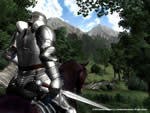
Graphics: Complaints about the graphics? Hold on. This is more of a design complaint. Oblivion‘s design is very standard High Fantasy, with the requisite Medieval European or Romanesque architecture. And the wilderness areas are very pretty . . . but they all look almost exactly alike. In addition the world of Oblivion (consisting of the Imperial Province of Cyrodill) is much, MUCH smaller than the island of Vvardenfell in Morrowind. I miss the enormity and fantastical strangeness, not to mention variety, of Morrowind‘s wilderness. I miss the vastness of the country side — it made exploration exciting and scary. I miss the wild and alien architecture in the cities.
Also, as in Morrowind, the animations for the spell effects were particularly disappointing. As you moved up through more powerful spells in a given category, the animations would stay disappointingly the same. This really cut into the fun of playing a magic-based character.
Conclusion
My hope for Elder Scrolls V (the sales of Oblivion pretty much guarantee it’ll happen) is that it returns to the strangeness and vastness of Morrowind with the Fast Travel feature, livelier NPCs, better interface and tightened quest structure of Oblivion.
But don’t get me wrong. These complaints are minor in the face of Oblivion‘s spectacular virtues. My hats are off to Bethesda and 2K games for taking what they’ve learned in previous iterations of this sturdy series and moving the franchise forward in a huge way. Oblivion is a blast to play, and it’s a considerable achievement in the annals of electronic role-playing games.
Final Grade: A
(find out more about our grading system)
PC System Requirements:
Minimum System Requirements:
- Windows XP, Windows 2000, Windows XP 64-bit
- 512MB System RAM
- 2 Ghz Intel Pentium 4 or equivalent processor
- 128MB Direct3D compatible video card and DirectX 9.0 compatible driver
- 8x DVD-ROM drive
- 4.6 GB free hard disk space
- DirectX 9.0c (included)
- DirectX 8.1 compatible sound card
- Keyboard, Mouse
Recommended:
- 3 Ghz Intel Pentium 4 or equivalent processor
- 1 GB System RAM
- ATI X800 series, NVIDIA GeForce 6800 series, or higher video card
This review is copyright Ray Ivey and Just Adventure and may not be republished elsewhere without the express written consent of the author. Republication of said review must also contain a link back to Just Adventure.