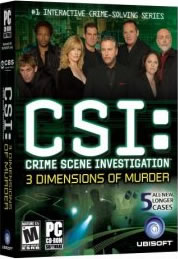
CSI: 3 Dimensions of Murder Review
The #1 show in America is also the #1 interactive crime-solving series, and the latest entry shows us why. No introduction should be necessary for this skilled bunch of Las Vegas crime scene investigators, whose two previous adventures have left some things to be desired. But Telltale Games, new to the franchise, is good at listening to their audience; criticism from previous installments (including last year’s CSI: Miami) was taken into serious account for this new game. 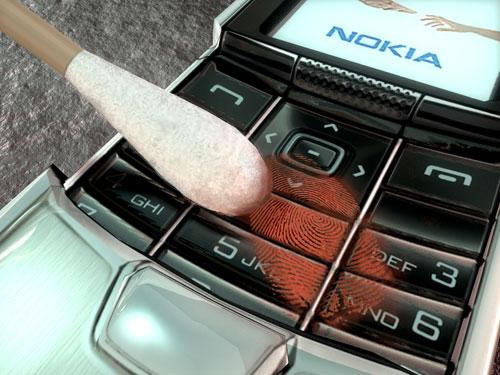 The game is appropriately named, as the series now features 3D graphics that immerse the player further into the storyline. There are some definite positives to this change: the locations look much more realistic and more interactive; you can pan left or right at any close-up shot. When you use your tools, they actually look like they are being used. And the characters have realistic facial expressions and other twitches that make them more interesting to watch. However, with three dimensions come blocky sprites, which is true for some of the characters. In cases where it is prevalent (and let it be known that this really didn’t bother me in many characters), faces appear blocky, figures have a fuzzy outline, and hair moves in one piece like a wig. I was a little disturbed by the opening cinematic, which displays blockiness at its worst, but it’s not as bad once you get into the game. All the voices are done beautifully. Particularly, in case four, the actress who plays the victim’s wife is unbelievably convincing. The only complaint I have is the voicework for Sara Sidle. Jorja Fox, who plays the CSI on television, did not do the voicework for the game, and neither did Marg Helgenberger for Catherine Willows. Both were voiced by sound-alikes. Catherine’s sound-alike fooled me. Sara’s was emotionless and sounded rather bored. Hopefully they can get both TV actresses to reprise their roles in future installments. Players of the previous CSI mysteries will be no stranger to the interface. It consists of four main tabs: collected evidence (subdivided into trace, documents/photos, and items), available locations (including the lab, morgue, and Capt. Brass’ office), case file (subdivided into victims/hints, suspects, and video recreations), and the options menu. This time around, whenever you receive a new piece of evidence you are given a close-up view. You are then able to look at it from all angles and thus analyze it further. The game has an option called “tool assist,” which, when you highlight a suspicious area, brings up the correct set of tools you need (detection or collection – yep, all the usual suspects) and highlights 1-3 possible tools you may need to get the job done. This can be turned on/off with the options menu, but is turned off to begin with for the Advanced and Master levels. I played Normal, but found the tool assist to be too easy. 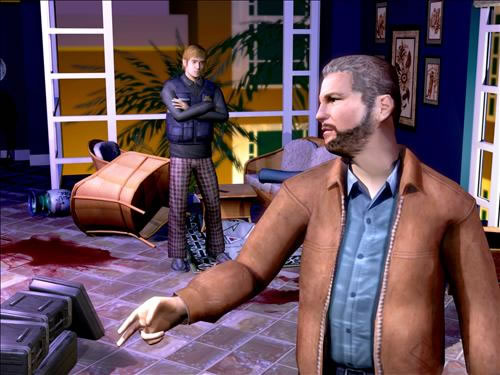 However, I suggest you turn on location and evidence tagging. The keyword to success in this game is: THOROUGH. Everything requires a fine-toothed comb. In some cases, this amounts to pixel hunting. With location tagging, you’ll know when you’ve found everything there is to find in a certain location. With evidence tagging, you’ll know you’ve run a piece of evidence through every possible test. I wouldn’t even suggest an experienced gamer play these features turned off; there’s so much double- and triple-checking to do that it will prove incredibly useful to know when you can stop wondering when you’ve found all of the clues, especially since the tiniest clue will trigger another question somewhere. Following that line of thought, you will do a lot of back and forth in this game. Your lab findings will trigger a new question at X, which will lead you to a new question at Y, which will lead you back to X, which will send you to Z, etc. Let’s not forget that in between your short visits is the loading screen, with whom you will become good friends by the end of the game. Transitioning from location to location requires that you stare at a glorified CSI logo for at least twenty seconds. I can’t argue that the wait wasn’t always worth it, but I could have done without. Most of the puzzling you do in this game, other than finding clues (in some cases pixel hunting), is done in the laboratory. You are on your own this time; Greg Sanders is no longer there to do the lab analysis for you (instead, he is your partner on the fourth case in place of Catherine, who drops by occasionally to offer her advice). You have five tools at your fingertips: trace analysis computer (fingerprints, footprints, tire treads, documents, etc.), DNA computer database, chemical analysis machine (for powders, suspicious substances, etc.), comparison microscope (mostly for hairs), and an assembly table (used to rearrange torn letters). When you’re in the field and need evidence processed immediately, all of these machines go into your GMC Yukon Mobile Analysis Unit. It’s pretty cool! 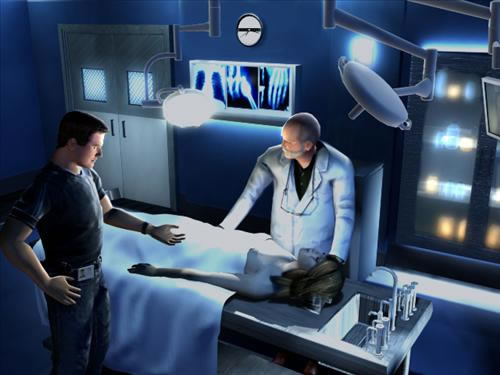 Plotwise, there is little to say. The general synopses are promising, but stories either lack depth or have too much. Important information is sometimes given too quickly to be processed fully. The dialogue, though well-written, tends to run in circles. Some of the interrogations seem to go on forever. Matching and collecting blood samples grows tedious after the first two cases. Mysteries feel longer than necessary, mostly due to the plot “twists” that won’t shock anyone who’s read your typical detective novel before. As in all of the previous CSI games, the fifth and final mystery incorporates characters from the preceding four. This time, however, they did a good job incorporating other characters, and I felt both proud and successful at the end of the game. The big technical problem with this game, other than the occasional dialogue skip, was that the game had a tendency to shut down my computer at random stages in the game. If my laptop wasn’t able to start up quickly, and if the game didn’t include handy automatic saves, I would have pulled my hair out. It’s a real shame, because this game is otherwise very impressive, despite a few small errors in the subtitling. All I can say is, every time I see a stain on my clothes or a mysterious splotch of paint on the wall, I have a strong urge to swab it. This game deserves a solid B (worthy of a + if UbiSoft releases a patch), and one can hope there will be more of these games to come. If you haven’t gotten your hands on one yet, or if you weren’t impressed with the others, I can highly recommend this game. Final Grade: B System Requirements:
|