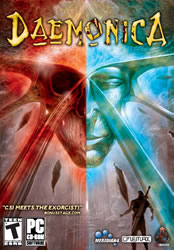
Daemonica Review
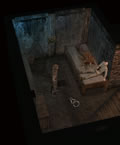 Against all odds, adventure games seem to be evolving. Over the past few years, there have been repeated attempts to move the classic adventure game formula into new directions. Majestic and Missing: Since January brought the online experience to the genre. Indigo Prophecy used the format of an interactive movie to generate the adventure game experience. Broken Sword: The Sleeping Dragon reimagined the traditional point-and-click adventure in a true 3D setting. Daemonica is the latest of these brave attempts to push adventures beyond their ossifying point-and-click roots. It doesn’t knock the ball out of the park, but it’s nevertheless an admirable attempt. For an adventure game, Daemonica is presented in an unusual format: It’s an isometric third person perspective in a true 3D environment. In other words, it looks reminiscent of games like Neverwinter Nights or the Baldur’s Gate: Dark Alliance games. Yep, it looks for all the world like an RPG. But don’t click your BACK button just yet! Despite the format, this is an honest-to-goodness adventure game. You play a character with a dark past and special power: The ability to go into a trance and speak to the dead. The game takes place in and around a small village where a gruesome murder has just taken place, and it’s your job to get to the bottom of the mystery. 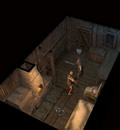 To be able to enjoy this game the most by embracing its strengths and mitigating its shortcomings, the player should approach Daemonica as a graphic mystery. The entire game takes place in a relatively small area: A village and a few areas around it. This is the lab for your detective work. To solve the mystery, you’ll have to get to know this game world like the back of your hand. You’re also going to have to like reading. There’s a rich vein of storytelling in the game, but it’s mostly in text. Lots of text. Lots and lots and lots and lots of text. And you can’t just click past it, either, or you’ll not only miss valuable clues, but you’ll pretty much miss the point of the game. So patience and an eye for detail are the order of the day. The murder you’re called in to investigate at first seems open-and-shut. A young woman is found dead, and her distraught lover is found covered in her blood. The suspect is hanged before you even get to town. You have to begin tugging at the various threads in the story to unravel the actual truth. One interesting aspect of the game is that, despite its concerns with demons and spirits, it takes place in the “real” world, not a made-up fantasy setting. In other words, it’s not somewhere that looks like England in the Middle Ages, it is England in the Middle Ages. There’s a strong vein of Catholic church history woven into the plot. And while its historical roots may not be as dynamic and gripping as those in, say, Gabriel Knight: Blood of the Sacred, Blood of the Damned, it’s still a treat for the player with an interest in history. Sound: The sound design is minimal, but effective. The score is unobtrusive but helps create a dramatic atmosphere. Except for the narrator, there’s no voiceover acting, and alas, the performance by the narrator is merely adequate. Okay, that’s being kind. His accent sounds very phony and he sounds like he’s at breakfast sleepily reading the back of a cereal box. Considering how much we have to hear this guy, letting such a lame performance slide was a pretty big mistake. 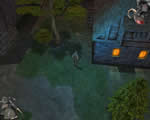 Graphics: The isometric view and crisp graphics give the town a pleasing “dollhouse” feel. Animated details, like large birds flying overhead and small rodents underfoot, add to the atmosphere, as do the effective real-time shadows. Perhaps the worst thing that can be said about he graphics is that there simply isn’t very much of them, considering the size of the gameworld. But that’s forgivable in a game with a modest budget. Gameplay: Mixed bag here. As stated earlier, you have to enjoy reading to make this game work. At first you might not believe the long-windedness of the characters. Even anonymous guards seem to have no “Off” switch to their chatterboxes. The saving grace of this wordiness is that the language isn’t boring. The reading fest continues in the interface. Your character has a diary that contains notes about all of the people you have encountered or heard about, what steps are required to complete objectives, and even instructions for the creation of potions. The player ignores any of this information at her peril. That having been said, it is satisfying to uncover that new conversation topic that nudges a character to give you that important new clue. Puzzles: Wish I had better news here. Aside from the fun of teasing-out new conversational topics from the townspeople, the puzzles aren’t particularly impressive. Much of any given “puzzle” you’ll be facing is wondering which person or place you need to go to next. You’ll end up doing a lot of running around the small gameworld trying to trip the next plot point. Worse, the solutions to several of the puzzles feels arbitrary and non-intuitive. Finally, the game doesn’t escape that old chestnut that has plagued adventure games since Maniac Mansion: The pixel hunt. There are several times when the game stops dead until you can find a needle in a graphical haystack. Good times! 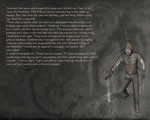 Combat: Ouch. No, that’s not a misprint. There is a bit of combat in the game. However, much of it is optional and once you understand the controls it’s quite easy. In fact, in all of Act I (of 5) there’s only one time you have to pull out your sword. Those players who dislike the combat may be further put off by the shaky support it gets from the game’s documentation. The game’s Option screen allows you to toggle something called “Simplified Combat,” but after comparing this condition being turned on and off in the same fight, I could discern no difference. Worse, the manual claims that when you use the spacebar to block, that you cannot be hit. This turns out to not be true, as some of the more powerful enemies in the game can occasionally strike through your defense. All that being said, while this gameplay element might not please the hardcore adventure game purists, it truly is a minor aspect of the game. Interface and Controls: The player controls the character and navigates the menus with the mouse. There are various keyboard commands to bring up the interface, diary, inventory, etc. The mouse can be used to zoom the view in and out, and the directional keys are used to rotate the camera angle. This method of camera movement isn’t as elegant or intuitive as the traditional right-mouse button method of camera movement in 3D environments, but it works serviceably well. Harshing the Mellow. It’s time to talk about the game’s two biggest problems. Two elements stand out as roadblocks between the player and a good time in Daemonica.  First, the loading screens. In this post-Dungeon Siege world, it’s just difficult to accept so many loading screens that take so long. I played this game on a very peppy computer, and the constant intrusion of loading screens consistently brought me out of the experience. And while I understand that the game is in 3D, it’s still hard to imagine that all of these small environments needed to be loaded separately. Second, flower-picking. You spend a great deal of time in this game searching for and picking herbs which you use to make special potions. These potions are used for various purposes in the game, from restoring your health after a fight or other misadventure to putting you in a trance that allows you to speak to the dead. And while flower-picking is not a particularly terrible idea, what is unfortunate is the paucity of these herbs on the landscape. As with the aforementioned pixel hunts, there are times when the game comes to a screeching halt while you comb the country side for one more sample of a particular herb. It beggars belief that anyone who made this game actually believed that this sort of desperate scavenger hunt would fall under the heading of “fun.” The developers have informed me that a patch is being prepared to address this problem. I have not seen or tested the patch, but if it successfully makes the population of herbs more generous, I would highly recommend players avail themselves of it. 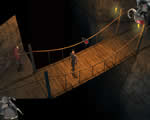 Verdict: I admire the literary (if not the technical) ambitions of Daemonica. There’s a good story to be told here, even if the package is a bit rough around the edges. And while the gameplay is somewhat static, you could really say the same thing about Myst. For those looking for perky puzzles and an array of dazzling environments, look elsewhere. But for the player with the patience to explore a rich story and meet lots of shady characters, Daemonica can be a dark, creepy pleasure. Final Grade: C+ System Requirements:
This review is copyright Ray Ivey and Just Adventure and may not be republished elsewhere without the express written consent of the author. Republication of said review must also contain a link back to Just Adventure. |