Voyage Review
|
Review Voyage
Review by Shannon Hall |
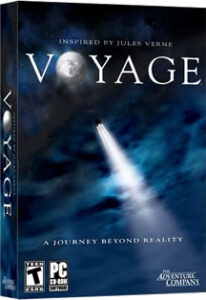 |
What do the 19th Century, the moon, drooling aliens, and a rooster have in common? They’re all part of Kheops Studio’s newest offering, Voyage: Inspired by Jules Verne. The creators of Return to Mysterious Island and The Egyptian Prophecy have created a quirky first-person point and click adventure with some surprising twists.
It all begins as the three of Verne’s heroes depart from his novel, From the Earth to the Moon, by actually landing on the moon instead of falling back to Earth. You’ll play as Michel Ardan, a French adventurer who must piece together the fate of his companions, Barbicane and Nicholl, as he explores Earth’s satellite.
Michel awakens to find himself in a space cannon, the interior of which is outfitted in true 19th century style. Rich, velvety fabrics line the walls the cushiony interior, antiquated brass fittings and pipes supply the naively simple needs of the occupants, and a well-stocked cabinet overflows with tin food cans and an indulgent cask of wine. One wonders what poor Jules would make of the stark, antiseptic reality of space travel, with its stainless steel and rations. However, I digress….
After an unoriginal but short-lived bout with amnesia, Michel discovers his companions, Barbicane and Nicholl, haven’t fared as well as he has. The only witness to the events is a rooster, and he’s not talking- or is he? Come on, you know you’re burning to how a rooster fits into things. Like I said, this game is quirky- and what’s more quirky than a rooster on the moon? Stranger things have happened, and they certainly will by the time you finish this game.
One thing I really enjoyed about Voyage is the unique puzzles. There are several that involve catching objects or using a meter to judge distance as you jump. It requires just enough hand/eye coordination to be interesting, but not enough to frustrate the dexterity-challenged (i.e., Yours Truly). There is also plenty of combining to do in this game. Fruits, plants, colors, sounds, and numbers all come together to achieve a plethora of results.
For anyone who was intrigued by the puzzles in Myst, but lacked the OCD characteristics needed to complete the game, this is for you. Yes, you’ll be working with alien numbering systems and languages. No, you won’t be required to fill an entire ream of paper with obscure symbols and notations, thus running the risk of having family members call the Men in White Coats upon discovery. Instead you’ll have a log that conveniently keeps track of key bits of information, current agendas, and combinations you’ve already created.
There is, in fact, so much in-game help I became very smug about not needing a walkthrough. Between the insect spy, utterances by the main character during key parts of the game, and hints included in the log, I thought there might be too much help. My arrogance was, however, short-lived. I paid the price with several days’ worth of slow or no progress, spurring a desperate flurry of internet searches and visits to gaming forums. If you find yourself stuck after feeling smug, don’t say you weren’t warned.
One contributing factor to the unexpected difficulty in the game is that there are often several different ways to achieve the same goals. This is a mixed blessing, offering more freedom and a dash of confusion. Combine this with the ability to earn intelligence points for many of the puzzles, and you have a game with definite replay value. This is a good thing, because I found the world of Voyage to be a very charming place worth revisiting.
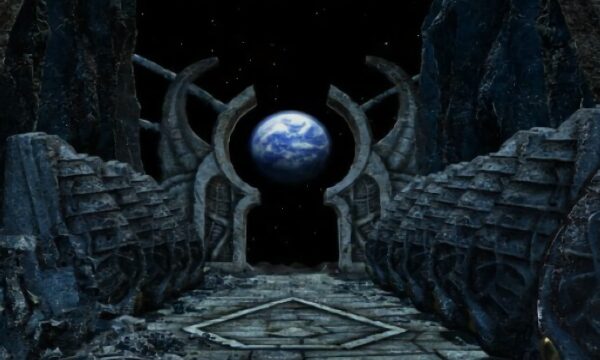
Much of that charm is due to the artwork, which remains true to the romantic ideals threaded through Jules Verne’s work. The colors are intense yet somber, and the mechanical devices are at once sophisticated and quaint. I wouldn’t say the graphics are earth-shattering (or moon-shattering, as the case may be), but they are lush and dreamy, bordering on psychedelic.
The vibrantly colored plants on the moon have characteristics you’ll come to know quite well, but you’ll also work with more sentient beings along the way: the Selenites. These are the lunar beings that inhabit this dreamy landscape, and they’re just as quirky as a rooster on the moon. While they have large heads and long limbs, they appear to have no bodies! Just try picturing that image without going mad, but I swear it’s true. They also lead very boring lives that consist largely of eating out of suspended tubes and waiting for you to ask questions. The Selenites speak in musical tones rather than words, so part of your challenge will be to find an instrument of communication.
Once you learn an ability, such as speaking Selenite, an icon will appear in your Inventory Menu. This inventory system has an unusual feature which I found to be more clunky than helpful: the transit area. This is an area where all collected items go before you can place them in your inventory. It takes just one click on the auto button to put them into place, but I found this to be an unnecessary extra step.
All in all, the game is very easy to understand and navigate, once you get your bearings. It has the usual cursor that changes to indicate actions and movement. To me, this cursor looks like a chicken foot, but I could be mistaken. Movement from one area to another is a smooth transition, and it’s easy to see exactly where you’re going.
So far we have pleasing graphics, an easy interface, and unique puzzles… but what about the down side? The only issue I had was that the game occasionally got tedious, but this could simply be a result of being stuck for so long. I wouldn’t really call this an exciting adventure, but more a relaxing and sedate journey. It’s a chill game. Still, I think it’s worth exploring, especially if you’re a Jules Verne fan, which is why I give it: B+
Final Grade: B+
(find out more about our grading system)
System Requirements:
- WINDOWS® 98/ME/2000/XP
- Pentium® III 800 MHz
- 64 MB RAM
- 64 MB DirectX® 9 Compatible Video Card
- DirectX® 9 Compatible Soundcard
- 16x CD-ROM Drive
- Keyboard, mouse, speakers