Electroplankton Review
|
Review Electroplankton
Review by Ben Bowen |
 |
Sometimes a game comes along and you just KNOW you have to have it. It exudes a special quality from the moment you lay eyes on the screenshots and read the articles, and every time it wends its way back into your attention your eyes light up. For me, Electroplankton is one of those games. Just a few days after I found out about it, a shiny new Nintendo DS was winging its way towards me replete with a copy of my latest craving from Japan – and I’m happy to report I don’t regret my investment one bit!
Actually, to call it a game would be doing it a disservice. Multi-media artist Toshio Iwai is famous in Japan for his interactive exhibits that use light and music to delight and entertain museum patrons of all ages, and has a keen interest in the development of console art pieces. Electroplankton is his first foray into this arena and will be of keen interest to adventure gamers – not as an adventure game, but because of its creative, soothing and non-violent nature.
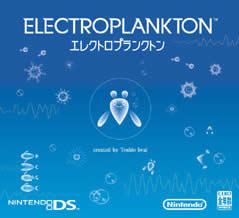
First things first – Electroplankton has fantastic packaging and presentation. Arriving in a shiny electric-blue card slip, it also includes a free pair of reasonable-quality (if a little uncomfortable) color-themed earbuds and has a fantastic hand-drawn manual of cartoons showcasing each Plankton game. It’s always great when a publisher tries to make a gamer feel special, as if the title they’ve bought is a gift to themselves, and on this front Nintendo have outdone themselves.
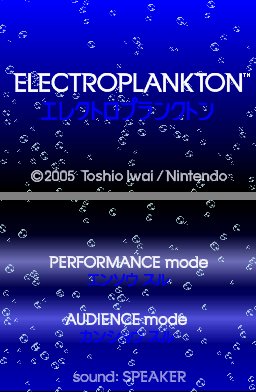
Booting up the DS, Electroplankton greets you with the sound of an orchestra warming up as the title fades in on a blue backdrop full of bubbles. As the music fades, it’s replaced by the sound of running water, a theme that continues all the way through each game. Electroplankton consists of ten seperate mini-games, of which none of them are scored or able to be completed. The point of the game is to relax, play and compose and nothing more… what you get out of it is the pleasure of creating and not having to worry about anything else. Naturally, this will only appeal to the kind of person that enjoys tinkering and sitting back and its lastability will depend on the type of gamer you are.
The main menu lets you either hear a performance by the DS or compose the music yourself. Typically each one has the same control, using the stylus to affect the plankton in different ways and with a close-up view of the action on the top of the screen, but other than that they’re all very different. The graphical presentation for each one is unique but clean, crisp and clear with vivid but effective colours and distinct Plankton designs, all very cute and easy on the eye. Even better, there’s hardly any Japanese and each one is easy to figure out on your own, making importing the game and playing it an easy prospect.
I’ll review each game in turn, as each is unique in how you play it and its content. Let the music begin!
1. Tracy
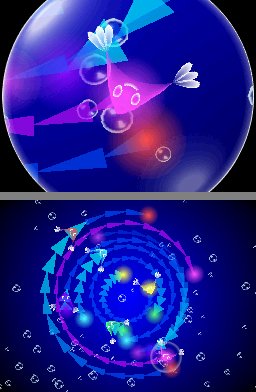
Tracy has the player compose music using six different coloured triangular Plankton. Using the Stylus, you touch one and drag a path around the screen, the speed at which you draw and the direction you’ve taken affecting the sound of the music that follows as the Plankton copies your movement precisely. It then repeats ad infinitum until you give it new instructions. Using each one you can create a symphony of sounds, every Plankton using a different sampled instrument from a xylophone to a piano. It’s highly enjoyable, but I’ve found it’s one of the games I’ve come back to the least… that said, you can compose some really beautiful stuff when you get the hang of it, and as with nearly all of them, it’s very relaxing.
2. Hanenbow
Now this one’s a toughy to describe. Hanenbow has tiny fish thrown into the air from a pond at the bottom of the screen, guided by a leaf towards a tree with six other leaves. When the fish hits a leaf, it bounces and produces a crystal-clear xylophone or string sound as it hits the line in the center. Moving a leaf around by its axis, attatched to the plant, produces different tones and deflects the fish according to its speed. The fish, being affected by gravity, will eventually run out of momentum and plop back into the water below.
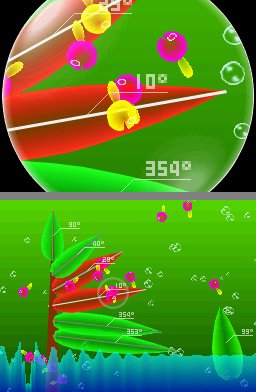
You can compose some pretty complex stuff, the more the fish hits a leaf changing its color and sound creating a moving soundscape. Turn all the green leaves red and a flower appears on the plant, giving you a goal should you feel you need something to aim for. Pressing select brings up three other tree variations, each more complicated than the first, allowing for the creation of more complex music when you get used to the basic idea. It personally love this one and have been playing it before bed to relax… fantastic stuff! Be warned though – pressing right throws more fish at a greater rate and can throw your sound off!
This game is incredibly relaxing and no doubt the one most will be returning to.
3. Luminaria
Luminaria has four different star-shaped Plankton starting on different corners of a grid of arrows… each arrow can be moved to point in four different directions, or held down on to cause them to spin. Touching a star causes it to move – each one at a different speed and emitting a different sound depending on which arrow it passes over and in which direction. The d-pad alters the arrow setup too, allowing for a continuously changing sound. Although simpler than Hanenbow, this one is also very addictive and allows the player to keep composing on the fly. Creating different tunes or even locking the stars into their own melodies is both creative and fun to watch!
4. Sun-Animalcule
The Sun-Animalcule plankton appear when you touch the screen with your stylus, and depending on if the background colour indicates night or day, appear as either a steel drum/piano/synth sun or an ambient moon. Each Sun-Animacule gains in age, their sound changing and each one getting bigger until they disappear. This game allows for more control than the others in the sound you attain and allows for a lot of creativity, as the pitch depends on where you place a Plankton on the screen. You can also adjust an individual Plankton’s position or delete them entirely if you make a mistake. Addictive and pretty, hours can go by and the sounds you can create are relaxing and sometimes incredibly beautiful.
5. Rec-Rec
As per its name, this game allows the player to record sounds using the DS’ inbuilt microphone. Touching one of four fish that passes across the screen allows the player to record a sound which can be then placed on a beat and the speed adjusted with the d-pad. As far as I can tell, its one of the least flexible and interesting of the games, but I’m sure kids will find recording sounds and creating different combinations endlessly amusing!
6. Nanocarp
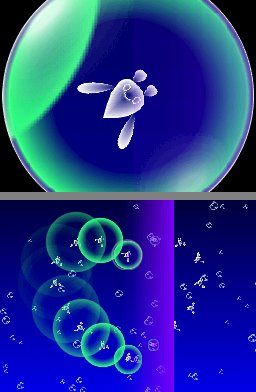
Although you don’t have the same degree of control over the Plankton as Sun-Animalcule in this game, it’s still an interesting concept and a ton of fun to fiddle with. The Nanocarp are tiny Plankton that swim in random directions until they hit the side of the screen, each one producing a tiny sound as they do so. Touching the screen produces a ripple that causes a melody as it hits each one, whilst using the d-pad makes a wave appear from the side of the screen causing them to chime as it rushes over them.
Interestingly, the Nanocarp respond to words and sounds with a little chirrup – but if they recognise what you say, the form a pattern. Unfortunately, being an import game, the words are all Japanese and for a Englishman like me, finding sounds which they respond to is trial and error. Say something too loud or they don’t understand, and they form an x. But amusingly blowing gently on the microphone causes them to form a heart.
Although due to the random nature of the Plankton making a coherent tune or melody is next to impossible, the chimes they create and the discovery inherent in using sounds to make them take a formation is addictive and always intriguing. Expect to pick this one up time and time again due to its peaceful nature and ambience.
7. Lumiloop
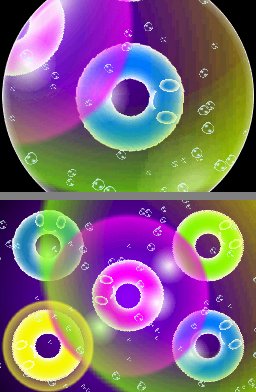
The ultimate chillout game. Presented with five donut-shaped Plankton, twirling the stylus over one in a clockwise/anticlockwise direction makes them emit different ambient chords that increase in tone the faster and further they’re rotated. And that’s all there is. Yet this is the one game I’ve played the most! You can sit there and draw circles for ages, mixing each sound to create different Vangelis-esque soundscapes and pressing select to cycle between the three different sets of Plankton on offer. I can’t place my finger on just WHY I’m so addicted to it… perhaps it’s just perfect in its simplicity. In fact, I’m going to play it after I’ve written this review!
8. Marine Snow
Marine Snow greets the player with a grid full of Plankton. Touching a Plankton produces a synthesized sound, pressing another does the same and swaps it with the one you last interacted with (or something to that effect). Hitting select gives you different patterns to play with. I’m of two minds about this game, as you can create some great sounds with it, but its lack of control is frustrating to me, as if playing an instrument where the strings sound different each time you play them. I’m sure others will delight in some of the patterns you can conjure up in it, however, and there’s no doubting its simplicity.
9. Beatnes
Beatnes has the player touching segments of five snake-like Plankton whilst a selection of tunes play to produce almost Kraftwerk style electronica! So I was bound to like it from the off. Although the tunes are limited due to the minor notes used in the game, you can spend ages trying out different combinations. Typically the heads and tails are special effects and digitized speech, but the central segments are notes which repeat between bars allowing for one of the more controllable games for composition. Each note fades after a while, so keeping a recognisable tune and rythym going between the snakes becomes a game in itself. Very addictive and the tunes (including a well-worn Mario stalwart) are fun to listen to!
10. Volvoice
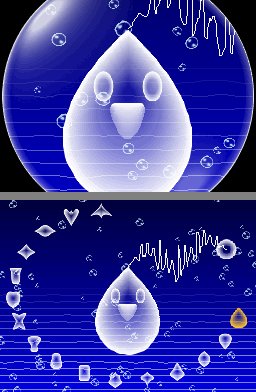
Volvoice is a very basic, but amusing, sampler. By touching the large central Plankton the player can sample their voice or a sound as it grows to absorb whatever it is you’re recording, which is then repeated ad infinitum. Smaller Plankton that circle it can be touched which alters the central Planktons shape and therefore the sound it contains – backwards, sped up or even warping it completely! Like Rec-Rec, it has limited appeal and could drive you mad in the hands of children, but its good for a laugh and at least allows the player to try to best themselves in producing the most bizarre sound possible!
So there you have it… possibly one of the oddest games I’ve ever played. Electroplankton is, in a sense, quite similar in style of a lot of the cleverer freeware flash games I’ve toyed with on the internet. However, due to the Nintendo’s stylus control affecting the little Plankton is both rewarding and immersive, making full use of the consoles unique nature. Many of the games are also extremely open ended and infinitely replayable, the question of longevity completely down to the type of player you are. The only other problem is the lack of any sort of record function, meaning any cool compositions you come up with are ultimately lost forever when you turn the game off, but you’ll soon forget any issues you might have whilst you’re poking your Nanocarp around for the hundreth time in a day. Well, I did, at any rate!
Electroplankton is the ultimate DS show-off title. It looks great, it sounds great, it has near-infinite appeal to gamers and non-gamers alike. As such, it’s a great reason to buy Nintendo’s finest handheld to date and if it ever gets a EU or US release will no doubt be the next craze after Nintendog fever takes hold. The only question you have to ask yourself is – do you really have enough time on your schedule to play it? Because anything you’ve got planned when it arrives at your door is going to go out of the window…
… now, excuse me… I’ve got some Lumiloop to twirl.