Future Boy! Review
|
Review Future Boy!
Review by Ricardo Marcos Pautassi |
 |
Once Upon a Time – Yep, history never repeats itself or so they say
What is the best way to travel in the world of A Mind Forever Voyaging (AMFV)? Where does the main character of Wishbringer work? Let me guess, if “subway” and “post office” popped up in your mind I can’t go off beam with the thought that you are a die-hard fan of the text adventure subgenre (also known as interactive fiction, IF), so you might as well safely skip to the next paragraph. On the other hand, you may be wondering what the hell AMFV and Wishbringer are in the first place. So, let this humble reviewer say a word or two about the latest multimedia trends in the IF world and how Future Boy! (further referred as FB!) fits in this scenario.
Sure, it was a matter of time. While by no means a new fashion (Legend Entertainment’s greatest games come to mind), the past years had seen more and more interactive fiction games coming out with multimedia content added here and there in order to add a new flavor to the usual typing-fest of the subgenre. Of course, this trend was spawned by the enhanced graphing capabilities shown by many text creation utilities, HTML Tads and Hugo being the best exemplars. And soon IF authors took advantage of it. Just have a look at Peter Nepstad’s 1893: A world’s Fair Mistery or Robb Sherwin’s Necrotic Drift and you will become aware of how music and a handful of pictures are able to enhance the general atmosphere of a game. All the same, these game were not radical in their aims; instead, they followed the widespread tradition of “evolution but not revolution” (any parallelism to the never-ending generation of real-time strategy games is just a fortuitous coincidence), adding new features to the long venerated pillars of the genre: story-driven gameplay more or less intertwined with puzzles, brainteasers and exploration. Interestingly, FB! producers have gone a step further by trying to create a truly multimedia experience, yet still in the realms of the genre. Let’s see how well they scored.
This babe really looks cute…
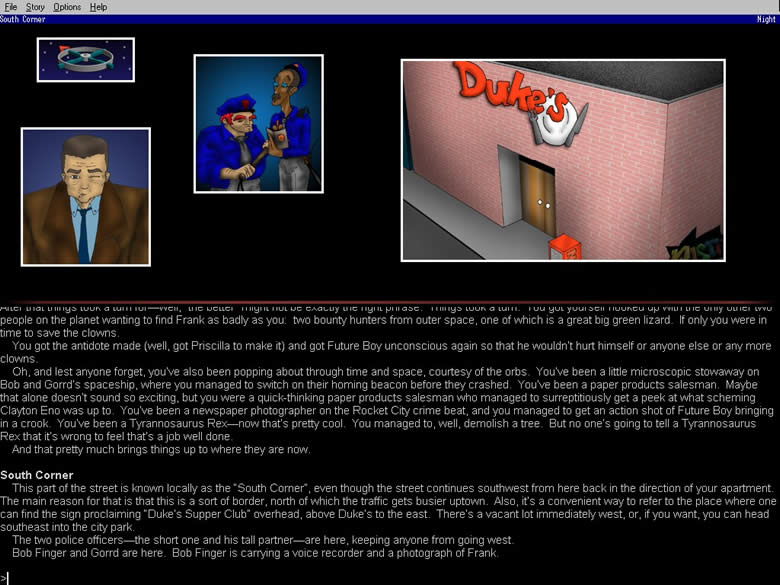
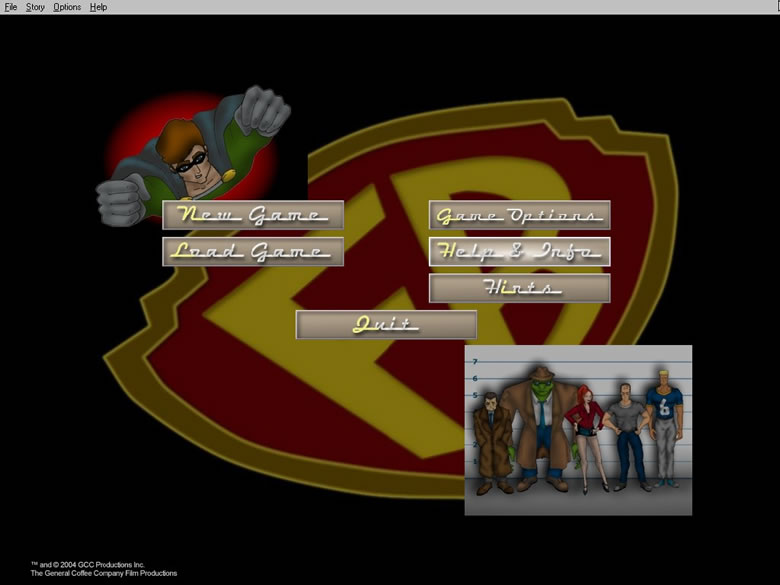
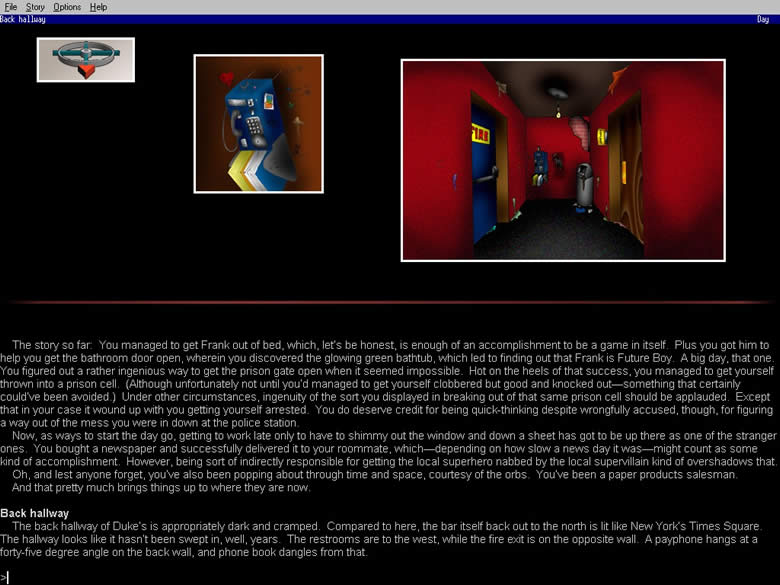
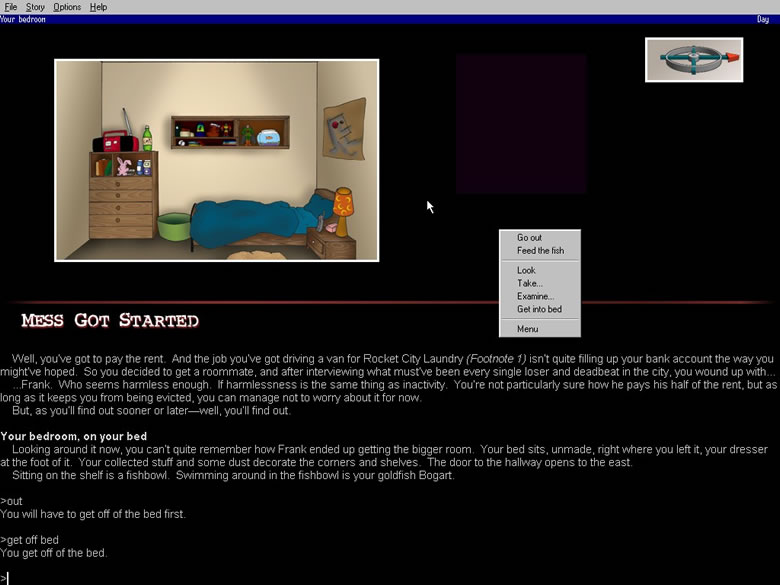
Yeah, I know, the above uninspired and dull heading is quite similar to the subject line of those damned junk mails you should receive more often than not; but still reflects what I thought when loading FB! for the first time. Believe me, it really makes a difference. How can you not be partial to an IF game that starts with and appealing and colorful animation (or cinematic as FB! authors call it) and ends up in a full screen menu, all this surrounded by a blasting epic song. There are almost twenty of these animations, which remain available in the main menu after seen the first time. In spite of being quite short (and when I say short I mean less than ten seconds), they serve both as pleasant rewards for the player and as chapter-dividers too. Once the animations are over, you will find that your screen will be split fifty-fifty (see the screenshot), the bottom halve reserved for the text while the remaining section including a compass rose showing the available exits (you can also insert the default clikable Hugo engine’s compass) and a drawing of the current room. Eventually, this section will also span two other small drawings that appear when examining the inventory or after noticing something relevant in the environment. An innovative feature, a right click opens a menu that suggests the more obvious action to follow, a characteristic quite handy for IF beginners. Hitting the escape button calls the main menu, from there you can load/save/quit, get info and hints as well as modify almost every aspect of the game you can imagine, from fonts/screen colors to the frequency of save reminders to whether or not voices are turned on, and a long list follows. Did I say voices? Yep, every dialog has its corresponding voice over. This was the first time I saw such a feature in an IF game and it should remain as an standard for future games. Most of the actors are highly competent, exception being made for the one featuring the main character (the superhero), whose plain and detached voice makes a poor case for living up the story. But, no one hits one hundred, right? So we can spare this point, even more when considering that FB! has plenty of those small little things that help enjoy the gaming experience. For example, every time you restore a game a paragraph pops up, summarizing your achievements so far and the current state of events. Moreover, the overall good voice acting goes along with well done ambient sounds (i.e traffic reverberation when in the streets, muffled voices and paperwork noises when entering an office, etc) and bits of music here and there. The pdf manual is quite neat and in case you get stuck, which most likely will occur sooner or later, there’s and in-game hint system that, while not giving away all the answers, makes its duty by providing from subtle suggestions to straightforward solutions (beware of red-earrings, though). So, to cut a long story short, FB shines when its comes to be considered as a multimedia experience and in this sense I find myself looking forward to future games following up its trail.
Would you please tell me a story, daddy?
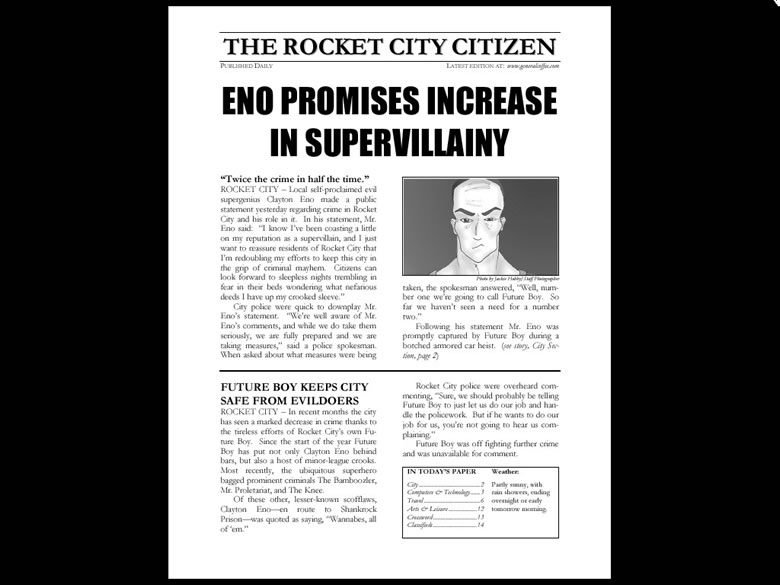
While neither a native English speaker nor a citizen of an English-speaking country, I would bet the preceding sentence fairly describes what little kids ask their parents at bedtime. They crave for stories, epic chronicles depicting appealing characters going against all odds to be back with their loved ones and/or fantasy accounts full of dragons and princesses; of course, even a simpler but emotionally loaded account of things is also able to do the job. Interestingly, this state of affairs also applies to IF gamers. Indeed, unfolding a fine story mixed with clever intertwined puzzles has been the distinguishing trait of the genre since its dawn. In fact, in the past years treasure-hunt and puzzle-fest games (other styles of IF games, not so interested in ambitious stories but also long-venerated denizens of this subgenre), have left room in favor of more and more narrative-centered installments. Thus, no matter how well FB! has scored in the graphic/sounds department, still has to show its credentials in terms of storytelling. Indeed, as time passes (in my own experience, an hour or so after loading the game the first time) the jaw-dropping effect caused by the graphs/sounds/voices combo fades away and the player’s focus of attention returns to its usual targets. As you already might suspect the game has chosen for its plot the well-known superhero theme. In short, a fictitious metropolis (Rocket City) is continually threatened by a brainless but persistent villain who always manages to give police officers the slip. Luckily, a flying mighty superhero suddenly appears from nowhere with the necessary means to stop this ever-present menace. Interestingly, the game unfolds with and original and interesting premise, namely, you do not take control of the superhero, which would have been the obvious path, but rather of his roommate, a laundry cleaner much more worried about paying the rent than playing the hero. But that’s the best the plot has to put forward; beyond that point the narration goes on in a very cheesy way, wrapping each and every one of the classic superheroes-stories clichés. For instance, (warning, story spoilers follow), the utterly villain manages to devise an ingenious plan to kidnap our superhero. After being taken as a hostage, he is injected with a home-made virus that causes him to engage in a villain-like agenda. This scheme will only come to a halt if you agree to reverse the effect of the virus and chase the bad apple back to his hideout with the help of a couple of colorful sidekicks (end of story spoilers). On top of that, common places continue throughout the game, with flying saucers, robots, brainless villain-minions and bulletproof oils making its appearance. These themes do a poor job in terms of drawing you in. Moreover, most of the characters seriously lack personality. To be honest, it should be said that there are indeed some efforts aimed towards this point. This is specially obvious towards the end of the game, when the loose ends are tied up and traces of the character’s underlying motivation finally show up. But all in all I definitely felt that FB! is one of those games that you can play cover to cover with just minor glances to the story, without any regret of having missed something important in the process.
So, after developing tolerance to FB!’s multimedia features and sort of disappointed with its storytelling skills, puzzles come obviously into sight. Throughout the first quarter of the game (total gameplay length is about fifteen hours) puzzle design is constrained by the layout of the rooms/environments. This phase is divided in small chunks with only a bunch of rooms to explore in each one and a clear and sometimes explicitly stated goal to achieve. The strategy works very well since puzzles are introduced not as obstacles but instead as logical steps in the follow-up of the story (i.e, you are not able to have a bath because a green glow leaks trough the bathroom door and when trying to cross-examine the putative culprit, your roommate, you find out him sleeping like a rock). Moreover, since exploration is constrained, the player is encouraged to carefully search the environments and experiment with the available objects. But from game’s second quarter onwards, gameplay changes abruptly. Specifically, simultaneous available locations increase, there’s a large quantity of objects to pick up and, most important, goals tend to become so diffuse that as a rule you’ll be browsing through the hint system with the sole purpose of knowing what to do next. These are not the only factors that converge in order to make puzzles less appealing. On the contrary, a handful of game designs decisions also help. For example, inventory capacity is limited, a thing that becomes an issue when considering that there are lots of red earrings throughout the game. The layout of Rocket City has its flaws, also. The town is small enough to be navigated without any transportation but your character’s feet; however, the designers inserted a subway and forced the player to use it all the time. Please have in mind that each trip has its own repetitive animation/description and you’ll understand what I mean. The last flaw in this line-up is a well known offender of adventure games: timed-puzzles. Fair enough, FB! ones let you start again every time you fail, but even considering this they should generate frustration in the average player. I found them definitely not fun. There is also a lot of backtracking, and most likely players will perceive it more than in other games. Two main reasons underlie this statement. As stated, the geography or layout of FB is far from being neat and, more important, the game is divided in chapters separated by video sequences, thus generating a salient flavor of “modularity” in the game. Let me clarify this with an example. One of the last chapters ends in a certain district of Rocket City, After the animation/description you appear not only out of the city but in a remote island. This logically generates the thought that in the previous chapter you have made all the tasks and collected the necessary items and that future puzzles will be self-confined within the boundaries of the island. Sadly, this is not the case, If you previously failed to collect an ordinary run-of-the-mill object that was somewhere on the city the game unrealistically requests you to a) realize that the solution to the puzzle is not in the surrounding area b) ask an additional non-playable character to fly back to the mainland with you c) roam through the city looking for hidden, lost, discarded objects that might have a connection with the puzzle d) Return to the island with your sidekick and e) Try out some potential solutions with the impending danger of having to go back to point “a” if the efforts are not successful.
There are some fresh ideas in the puzzle section, tough. At some point time-travel becomes a possibility and a necessity. The general scheme pretty much resembles the one that can be found in the first Discworld game. That is, you go to the past and your interactions there will facilitate puzzles in the present. My concern is that this feature is somehow spoiled because not only has similar drawbacks as those above depicted but also its underlying rationale in regards to the story is by no means well elucidated. That is, it feels like a good idea that has been thrown out in the middle of the game just for the sake of the endless variety of situations it tolerates. Later on there is a meta-puzzle that allows you to control the villain’s personal computer. To this end, the game’s interface changes and you are prompted to insert text commands as if operating a command-line based system, like MS-DOS. In terms of puzzles this is by far the best part of the game: many problems of varying difficulty that can be solved with the help of clues hidden in the prose.
Summarizing this section: don’t let this reviewer make you believe that the game is utterly boring or mind-numbing. On the contrary, it has numerous interesting situations, hilarious dialogues and good starting points for many puzzles, all of this packed with a polished presentation. It is just that the fun is somewhat hindered by the described flaws and the somewhat unoriginal clichéd story .
Concluding remarks
The bottom line of this review is that, when taking aside the multimedia section, FB! is an average game that suffers from more than a few inconsistencies when speaking in terms of game design. Also, its story is far from being composed by the substance dreams are made off. Nonetheless, it should be considered that FB! has raised the bar so high in terms of graphs, sounds and voices that this sole fact may be enough to keep you interested in the game for a considerable amount of time. Mainly recommended for newbies in the IF subgenre that might be willing to play games offering a smooth transition from the typical graphical adventure to the text-only based IF. FB! has received a C+ from this reviewer.
Final Grade: C+
(find out more about our grading system)
System Requirements:
- 350 MHz processor
- 64MB of RAM required for most operating systems (128MB or more recommended)
- CD-ROM drive required for installation
- 250MB HD space required for full installation (or play directly from the CD-ROM)
- 16MB video card with 800×600 resolution and 24-bit color
- 16-bit sound card or better recommended