Still Life Review
|
Review Still Life
Review by Shannon Hall |
 |
After playing the demo and writing a preview for Microids’ investigative thriller, Still Life, I was left panting for more. When I finally received the full length version of the game, I opened it reverently, stared at it a for moment, touched it lovingly… I was torn between popping it in right away and delaying the gratification until after working hours. Yeah, working from home does have its charms.
In the end I decided to let virtue rule and wait. But that nagging monkey called “responsibility” wasn’t the only thing that made me hold off. There was a little trepidation in there, too. Would Still Life live up to those sweet promises made by the demo? Or would this be yet another game that starts with a bang and ends with a snore? Let me state right off that my fears were completely unfounded. Still Life roared with excitement from start to finish, and definitely did not end with a snore. It may have ended with a little bit of a “huh?” but I’ll get to that part later.
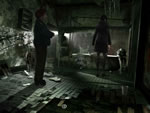
For now I’ll start with the beginning, which in this case means the graphics and game play. What can I say? If you’ve played the demo you already know the graphics are lifelike and flawless. Microids has taken the best of their slightly saccharine Syberia and added true grit. I must say they wear it well. Details are sharp, motion is smooth, all is heartbreakingly artistic in the world of Still Life.
Kudos to the actors, too, who truly brought Still Life to… well, life. In fact I found the use of sound in this game to be very effective overall. There was no unnecessary music (which I feel would have been seriously out of place in this game). For the most part the player is free to hear footsteps fall, a door opening, a piece of machinery running, all without distraction. These are things you would hear in the real world, exactly as you should hear them. A few times throughout my game, the dialog skipped. This wasn’t earth-shattering news to me; my sound card is a notorious underachiever.
For those of you who played Post Mortem, you’ll be happy to hear that major improvements were made in game play. In fact, Microids scrapped many things entirely, such as the notorious dialog tree. In Still Life, dialogue is very straightforward. Left click for plot-driven dialogue, right-click for details that are not crucial, but merely flesh out the story line. As for the rest, it’s standard point and click, third-person perspective. This is yet another departure from Post Mortem, which was a first-person perspective game.
As I mentioned before, Still Life is an investigative thriller, which means that it’s also been stripped bare of the supernatural undertones of its predecessor. Gus’ clairvoyant capabilities do make a few guest appearances, but beyond that, this is a straight case of man’s inhumanity to man (or woman, as the case may be). As both FBI Agent Victoria Macpherson and her grandfather Gus, you’ll be faced with the kind of investigation that is all to common to our mundane world: A serial killer on the loose, stalking women who’ve chosen the profession that is both the world’s oldest and most prone to misfortune.
You’ll alternate between characters and time frames, and you’ll have the opportunity to see how everything changes even as it stays the same. Two series’ of murders take place that share many of the same characteristics: all are gruesome, all show a progression of violence, all are toward women of questionable virtue. The problem is, these murders are a generation apart. Either our killer is an octogenarian with uncommon stamina, or a copycat is on the loose. Add to that the fact that the two people investigating the crimes just happen to be related, and it almost sounds strange to say that the game doesn’t have supernatural underpinnings.
There were many times that the game could have taken that direction, and yet it never did. The experienced gamer might be surprised by this. After all, we’ve been as conditioned to expect certain outcomes in our games as a prisoner is his daily ration of gruel. Instead, Microids chose the harder path, one in which misdeeds cannot be laid at the feet of the oft-maligned Knights Templar, the undead, or any of the other ubiquitous plot devices that comprise the industry standard. I’m not saying that secret society and conspiracy themes don’t rear their ugly heads, but they’re never presented as implausible or magical.
There is, of course, a parallel theme with the infamous Jack the Ripper case that is even mentioned within the game itself. I couldn’t help drawing some parallels of my own with Dreamcatcher’s Jack the Ripper. This was especially evident in the dingy streets of Prague, where Gus develops a relationship with a beautiful former-songstress named Ida. I also had a sense of déjà vu when Gus visited the local police precinct, populated by one condescending police chief and a helpful friend.
These similarities did not in any way take away from my enjoyment of the game. If anything, I felt these elements actually delivered a previously unfulfilled promise. There is, however, one more unfortunate parallel I would be remiss without mentioning: the ending. You won’t breathe that sigh of relief. You won’t jump up and say “I KNEW it!” You won’t even be able to say you didn’t see it coming.
Without giving away the farm, I will say that the ending leaves a wide berth for a sequel. Nothing would make this adventure gamer happier, but with the recent events surrounding the Microids crew, this future seems uncertain to me as the ending of Still Life.
Even knowing the ending of this magnificent game beforehand, I wouldn’t hesitate to play it, and I don’t hesitate to recommend it. Anyone who loves a mystery and has an investigative mind will get many hours of pleasure from Still Life. You may even find a few more of them after the game is finished, as you continue to turn the possibilities over in your own mind. The great thing about an ending that leaves a few openings is that it leaves you free to find your own answers. Of course, I’m sure I’m the only one who’s come up with the right ones.
Final Grade: A
(find out more about our grading system)
System Requirements:
- Windows® 98, ME, 2000 or XP
- Pentium® III 750 MHz (Pentium® III 1.2 GHz Recommended)
- 128 MB RAM
- 8x CD ROM Drive
- DirectX8.1
- 32 MB Graphics Card (64 MB or Equivalent Recommended)
- Keyboard /Mouse/Speakers