Adventures In Odyssey Review
|
Review Adventures In Odyssey
Review by Karla Munger |
  |
Introduction
Are you tired of finding blood, guts, gore, sex, crime, bad language, maladjusted behavior and anti-social attitudes in your computer games — or worse yet, in your kids’ computer games? Do you ever wonder if playing these kinds of games might be turning your children’s brains into mush? If so, do I ever have some good news for you.
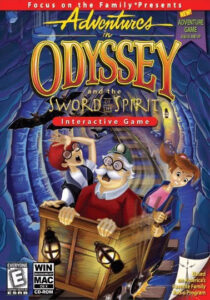
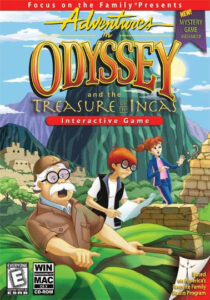
Here, I’ll be reviewing Adventures in Odyssey and the Sword of the Spirit, and Adventures in Odyssey and the Treasure of the Incas — two games from Digital Praise, a developer of Christian-based, family-oriented games that promote and reinforce values and virtues rather than encourage violence and mayhem. These games are the first in a six-product series, suitable for ages eight and above, based on a radio program produced by Focus on the Family called Adventures in Odyssey — Odyssey being the name of the fictional Midwestern town in which the program takes place.
The first part of this review will cover general information as well as features both games have in common. I’ll then get into specifics about each game, and I’ll wind things up with a few final comments.
There’s Much to Like Here!

Although I’d heard of Focus on the Family before playing these games, I knew nothing about the Adventures in Odyssey radio series. I subsequently discovered that the show has been on the air over 17 years and has a daily audience exceeding 1.2 million. Characters, places, and themes from the series have also been featured in 16 videos and 20 novels. How impressive is that?
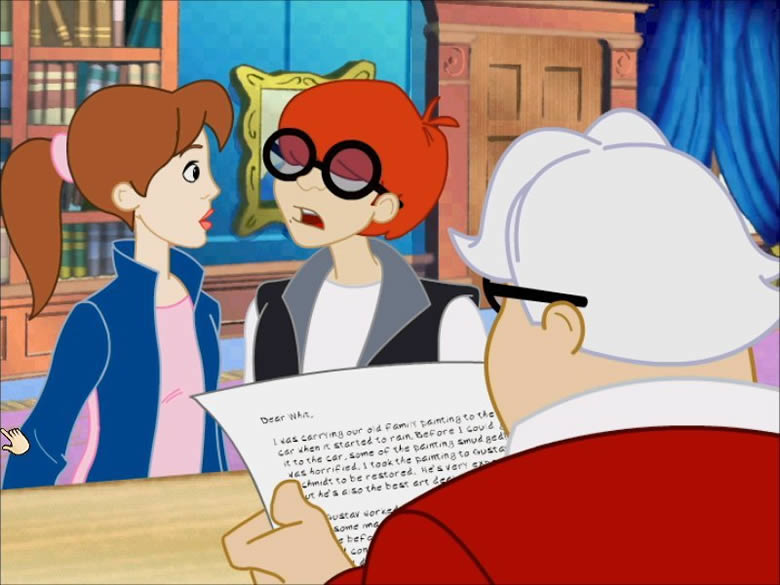
Fortunately, one need not be acquainted with the Odyssey series in order to enjoy these games. Players unfamiliar with the show will meet three of its characters in both Sword and Treasure: John Avery Whittaker (Whit), discovery emporium proprietor, inventor, and all-around nice guy; Eugene Meltsner, whiz-kid extraordinaire and intern to Whit; and Connie Kendall, who works for Whit and dreams of becoming a teacher, playwright, and director. You alternately take on the roles of all three characters as you progress though the games.
Whit, Eugene, and Connie are given voice by the same actors who portray them in the Odyssey radio program. Additionally, each game boasts a story penned by one of the show’s writers.
In both games our trio’s base of operations is an emporium owned by Whit, cleverly known as Whit’s End. Here, Eugene and Connie work diligently in the library and office locating information, while Whit labors at his workbench and in an area called Invention Corner, creating unique devices to aid our three characters in their quests.
Now, one might think that games suitable for eight-year-olds might seem a tad simplistic to adults. Well, not so with these games. Some of the activities are relatively straightforward, but others present enough of a challenge that my grown-up (and I use the term loosely) interest was held quite well. In fact, it’s possible that younger players may need assistance in completing some of the games’ more difficult tasks.
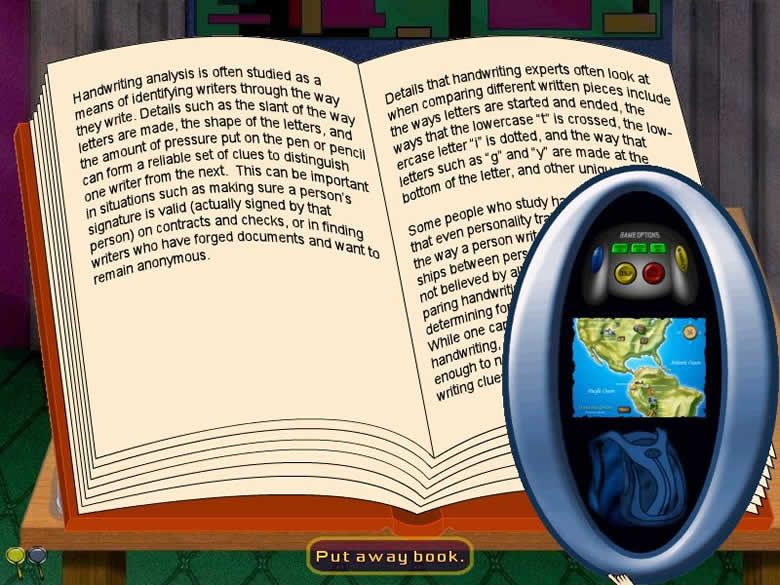
Or, on second thought…maybe not. Interestingly, as I was playing these games I found myself wondering if my cluttered adult brain might be unnecessarily complicating some of the activities. It’s entirely possible that younger players — who carry less mental baggage than we old codgers do — might have an easier time of it.
You may also be wondering — as I was, frankly — whether games having a basis in Christianity might preach at you, clobber you with the Bible, or be overzealous in some other way. I was really curious to see if this type of thing would occur in either of the Odyssey games. I was very pleasantly surprised.
At this point, let me be up front about something: I’m really not into religion. Nothing of the organized variety, anyway. But I’ll tell you what: I thoroughly enjoyed playing these games. Neither gets in your face with fire and brimstone or heavy-handed dogma (not that I think mainstream Christianity necessarily embraces such things, you understand). Quite the contrary, in fact. Both games have engaging stories done in a refreshingly gentle tone. And on top of that, they’re just plain entertaining.

Digital Praise has put together a team comprised of folks who have developed games for The Learning Company, Disney Interactive, and Activision. There’s a whole lot of talent here, and it shows.
One of the interesting features shared by the two games is that all activities can be played in two different modes: “Story” and “Practice.” In Story Mode, one is actually playing the game. However, anyone who is having trouble completing an activity can switch to Practice Mode, where skills can be improved through repetition, and where some activities can even be adjusted to easier levels to get a better feel for what’s required. Further, the Digital Praise proprietary FunWare game engine, which was used to create both games, features automatic adjustment of difficulty levels during gameplay.
Practice Mode also offers players the option of engaging in activities outside the framework of the games, just for fun. The only requirement is that the tasks must have already been accomplished at least once within the actual game. After that, they can be accessed as stand-alone activities. I think that’s pretty nifty.
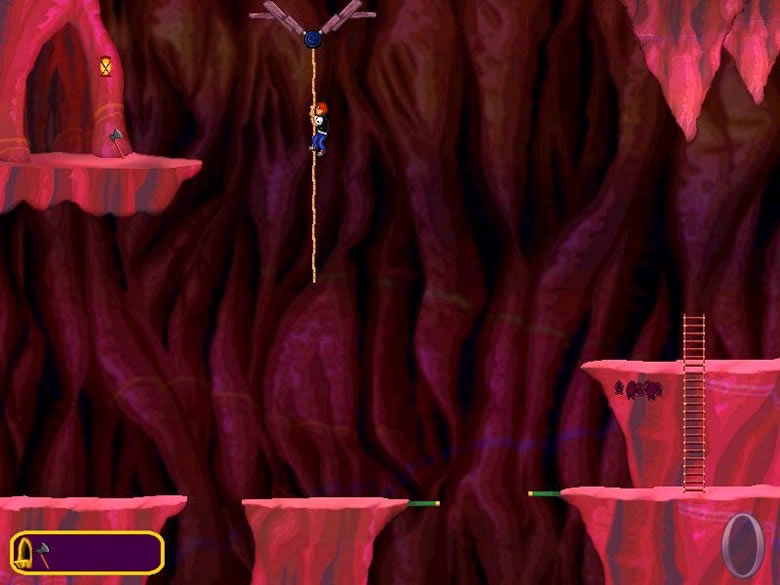
Many tasks in both games require the completion of multiple objectives; some also call for the acquisition and use of certain items. In most cases, the number of required actions/items is represented by rows of icons appearing at the lower left-hand side of the screen. As each action is accomplished, its icon changes color; the collection of an item causes its icon to vanish. Tasks not using icons illustrate multiple objectives in other conspicuous ways. In all cases, audible cues are provided to indicate success.
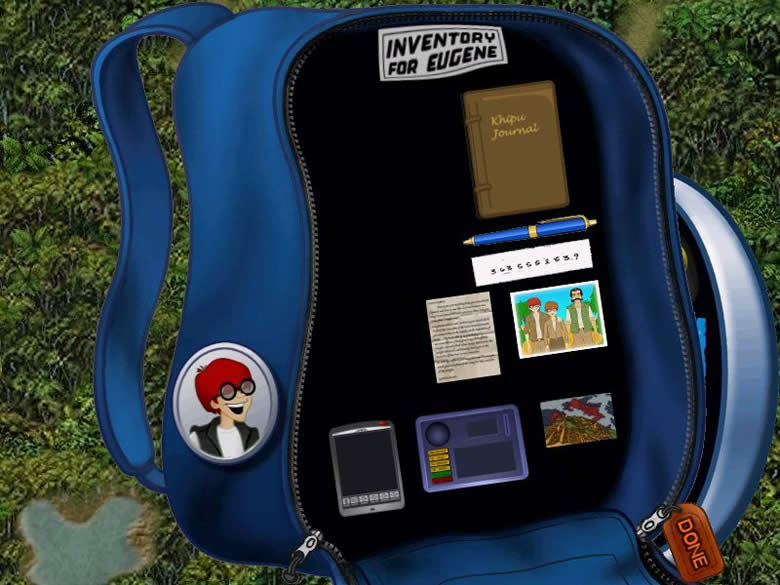
Inventory items are carried in characters’ backpacks, which are accessed by resting one’s pointer over an “0” that appears at the screen’s lower right. This also affords access to the games’ optional settings panels and navigational maps.
Using the maps, players can track their progress, identify where they’ve been, see where each character currently is, and access various activities. Each game also displays prompts at the bottom of the screen to indicate navigational options and available actions.
Our three characters get to use such high-tech items as scanners, Internet-capable computers, and specialized software. I always get a kick out of games that enable me to run programs and do searches on a virtual computer that’s inside my actual computer. I don’t think a person can ever have too many computers. (I’m not addicted to this stuff or anything. Oh no, not me…)
Each game offers cartoon-style graphics that are both colorful and crisp; animation is smooth and nicely rendered. The music in both games is pleasant and downright catchy. I had no problem with any of the voice acting, and some of the dialog is quite amusing.
Alas, I do have one minor issue related to music and dialog. This occurs more frequently in Sword than it does in Treasure.
While accomplishing various tasks, our characters make assorted comments, many of which are unrelated to the activity at hand. These comments are repeated over and over until the task is concluded. The activities’ background music, which tends to be rather short in duration, also repeats again and again. Neither of these things is much of a problem with tasks that can be completed relatively quickly, but with those that require more time and effort, they can become somewhat of a distraction.
To Digital Praise’s credit, both games do offer options of turning off music, dialog, and/or sound effects. But I found that doing so left me with one of those “something is missing” feelings. I would have preferred that music and commentary be more varied and repeated less often, particularly in Sword.
Each game’s CD-ROM includes a User’s Guide, which is accessible from the game’s opening splash screen menu and through the Options Panel during gameplay. If additional help is needed with either game, Digital Praise offers tips and tricks on its website.
Some nice extras are included on both games’ CD-ROMs as well. There are full episodes of the Odyssey radio program, a game called Jukebox Mixer in which one matches actual dialog from the show with corresponding background music, a preview of a new audio series called The Last Chance Detectives, and some game-based wallpaper for your desktop.
Both Sword and Treasure are relatively short in duration; I’d say they offer around 15 hours or less of gameplay, depending on the length of time it takes to complete each activity. I much prefer quality over quantity, however — and we definitely have two quality games here.
System requirements, identical for both games, are quite reasonable; even older computers should be able handle the games without any problems. And, perhaps best of all (from where I sit, anyway), neither game glitched up on me or had a single bug. I just love that.
Adventures in Odyssey and the Sword of the Spirit
This game highlights virtues such as patience, self-control, and cooperation. These concepts are presented subtly within the context of the story, and some of the game’s activities are so amusing that they had me laughing out loud.
The story, which is set in and around the town of Odyssey, revolves around the sword of the title — an ancient artifact discovered by Peter McAlister in the 1800s and engraved with nine Greek letters, each representing a virtue. After an introductory cut scene, our adventure begins as Whit, Eugene, and Connie become aware of the sword and start discovering clues concerning its whereabouts.
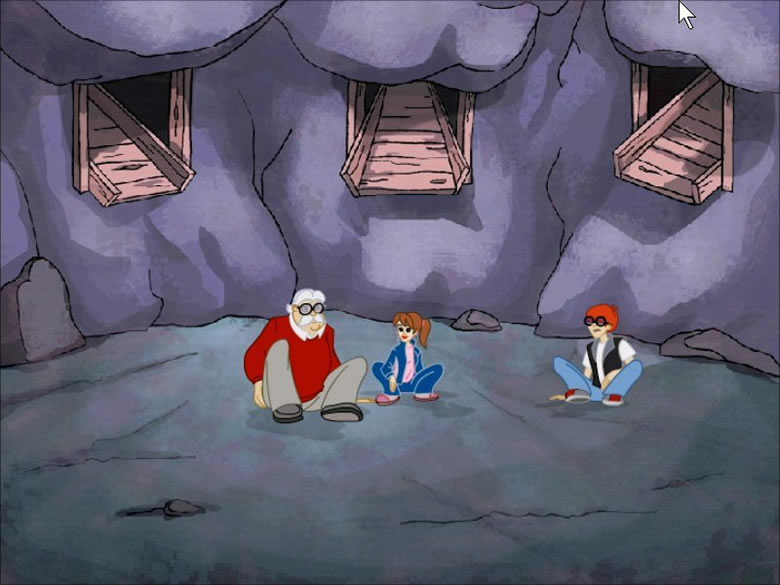
Unfortunately, greedy art dealer Gustav Schmidt knows about the artifact as well. He has kidnapped Marty McAlister, the great, great, great grandson of Peter, and is holding him hostage. Schmidt will release Marty only in exchange for the sword. He demands that our trio lead him to it.
The artifact is reached by way of a path called the Gauntlet of Virtues, devised by Peter McAlister to insure that whoever finds the sword will be of suitable character to possess such a treasure. The negotiation of this path takes up a major portion of the game.
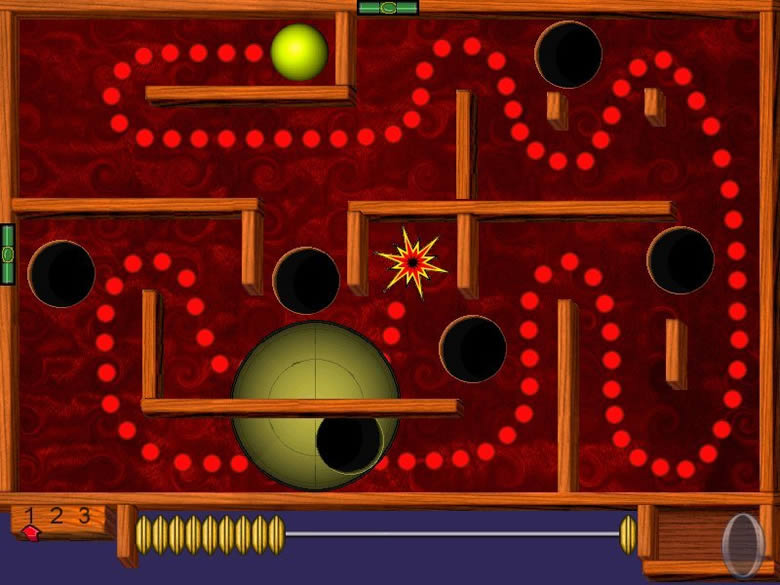
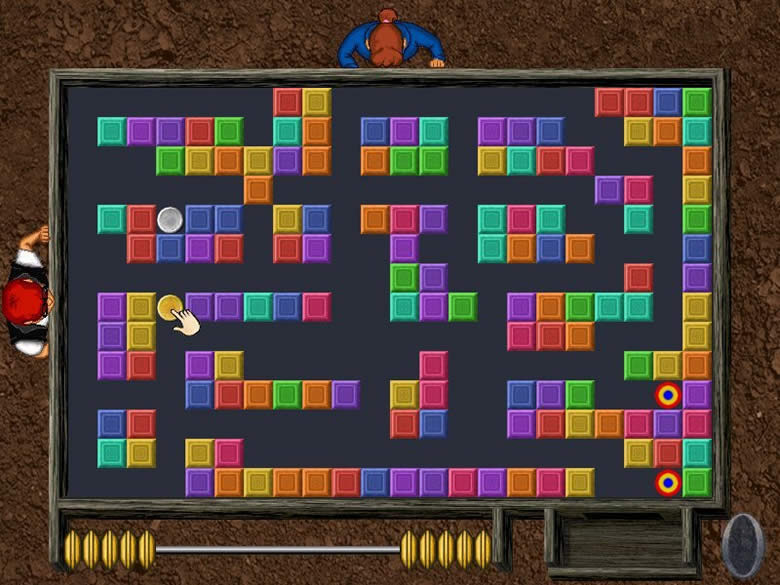
The Gauntlet consists of nine tests of character representing the virtues depicted on the sword. These are mastered by successfully completing puzzles and arcade-style games, and navigating through a series of mazes (which aren’t bad — honest!). Each activity has multiple parts based on a common underlying structure. All must be completed in order to advance the game.
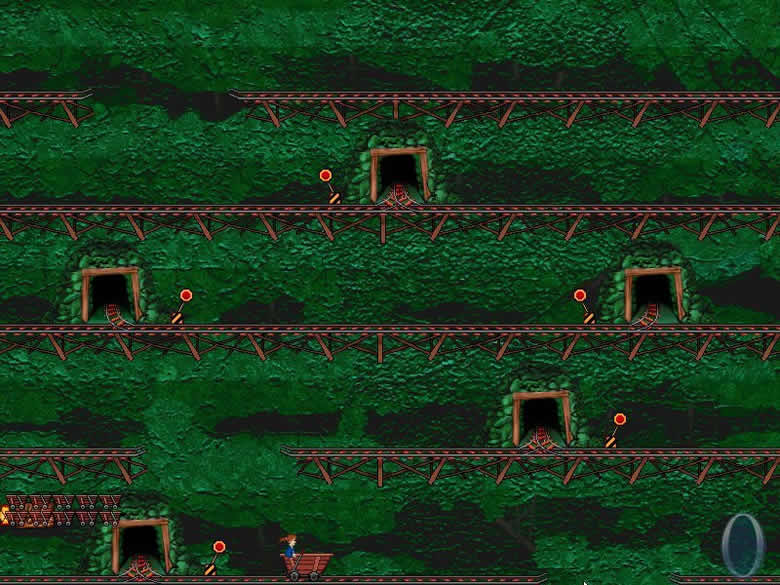
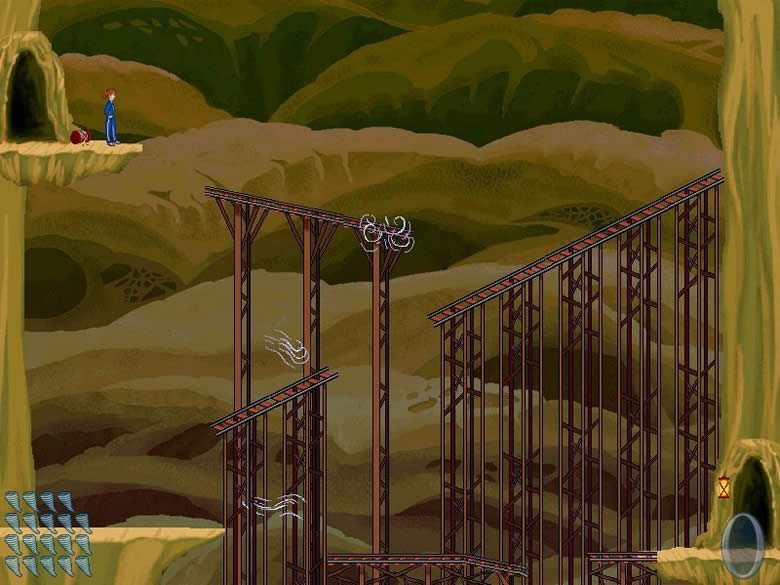
My favorite activity in Sword is an arcade game, tackled by Connie, called “Switch Way Out” (which represents self-control and alertness, both of which I can always use more of, thank you). In my opinion, this activity also contains one of the game’s most challenging sequences. One of the comments Connie makes during this sequence is, “I could do this all day!” Well, it took me so long to get through the thing that she (and I) nearly did do it all day. How embarrassing. Must be that cluttered brain of mine…

Anyway, “Switch” has Connie in a moving rail car that she can either speed up or slow down. Connie also has an abundance of rocks, which she throws at targets while negotiating multiple levels of tracks in order to switch the rails and successfully maneuver to the exit. The first few instances of the game are fairly easy. Then, Connie must negotiate more complex configurations, including tracks that have gaps. Unless she is going fast enough when approaching one of these gaps, Connie will fall through it and land on the track below with an enormous crash (don’t worry — she doesn’t get hurt and keeps going). The sound effects are just great, and I loved throwing those rocks. Fortunately, Connie’s rock supply is unlimited, which really comes in handy for out-of-control, distracted people like me.

Other activities have Connie floating on air currents; Eugene swimming underwater and tiptoeing through bat caves; Connie and Eugene teaming up to maneuver objects through a series of mazes; and Whit unscrambling letters to form words, rearranging puzzle pieces to form pictures, and guiding marbles over hazardous paths filled with holes. Each activity does a very good job of illustrating the virtue(s) it represents.
I do have one problem related to the number of tasks required in order to successfully complete the game’s activities. These activities can contain up to 30 different variations. Some can be a little tricky, necessitating a lot of repetition, even in Practice Mode. This seems a bit much to me, particularly for young children — especially considering that each part of an activity must be mastered in order to proceed with the game. It’s possible this was done deliberately by the game’s designers to reinforce such things as patience and perseverance, and I’m willing to give them the benefit of the doubt. But I would have preferred a more reasonable number of tasks in each activity.
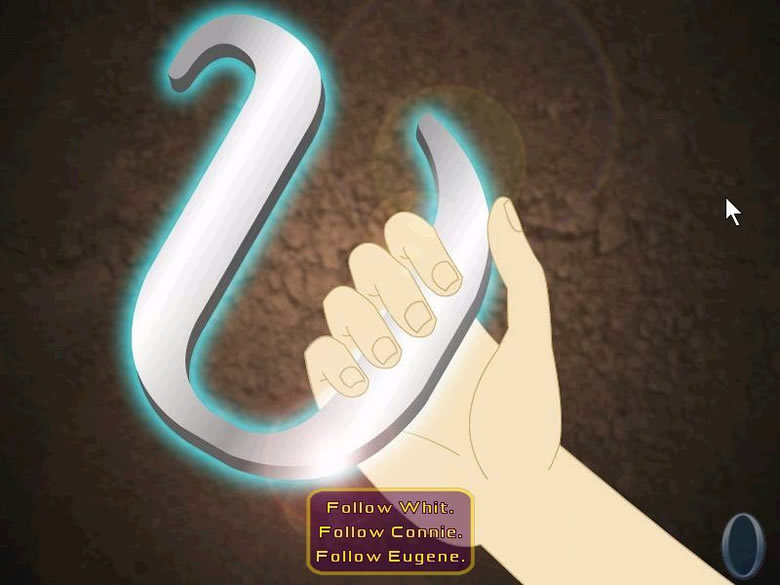
Overall, I found this game to be most enjoyable. By the time I finished playing it, I felt as though I’d even learned a thing or two about myself — and I’d actually had fun doing it. You just can’t beat a combination like that.
Final Grade: A-
(find out more about our grading system)
Adventures in Odyssey and the Treasure of the Incas

Here we have a game that addresses faith, determination, and redemption; it also emphasizes the skills of logic and reasoning, problem-solving, and critical thinking. It features more characters and locales than are present in Sword, and the story is a little more involved. The game is also a bit shorter than Sword.
In Treasure, a mystery has developed involving Eugene’s archeologist parents, who disappeared while on an expedition when Eugene was seven years old. Accusations are discovered that just before they vanished, Eugene’s parents abandoned the rest of their team and made off with an Incan treasure.
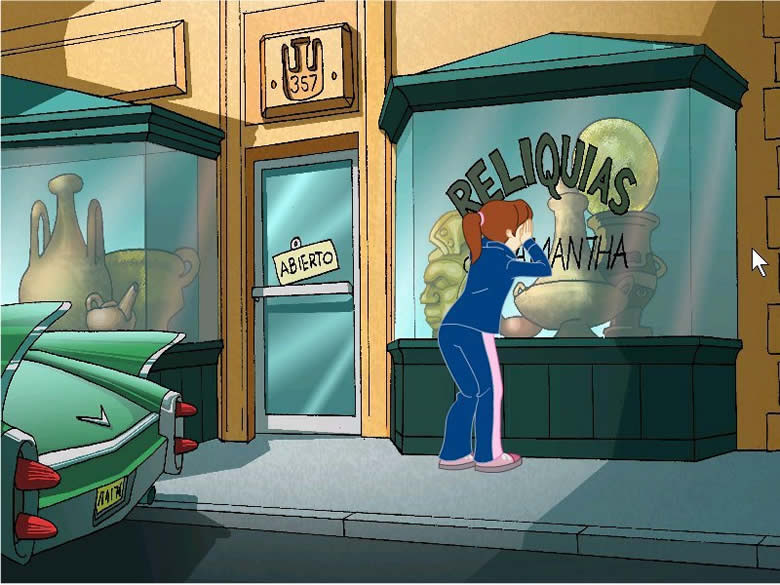
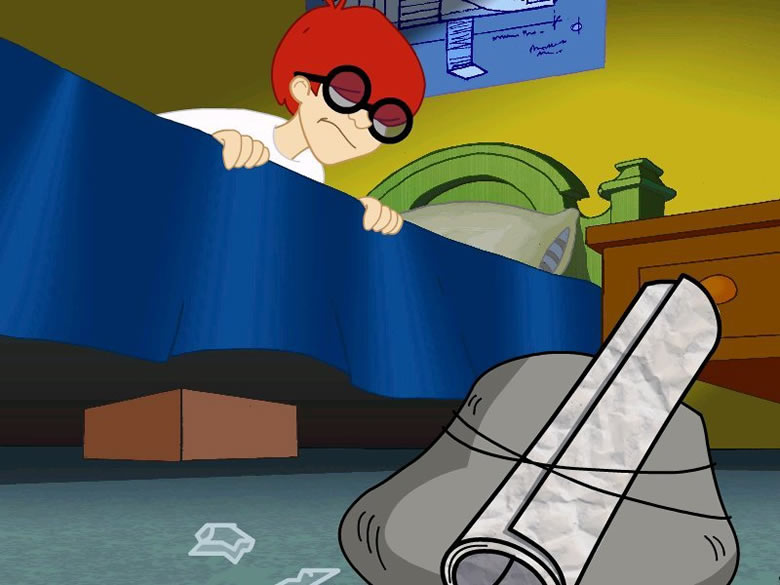
In the opening cut scene, a rock bearing a note is thrown through Eugene’s bedroom window. (Eugene is sleeping at the time, and mutters, “E=MC cubed? That’s utterly ridiculous, Albert.” I think that’s pretty funny!) The note demands the return of a stolen map, presumably to the Incan treasure. Eugene knows nothing about such a map.
Our adventure begins with Eugene telling Whit and Connie about the note. The balance of the game is devoted to solving the mystery surrounding the note, the map, and the treasure.
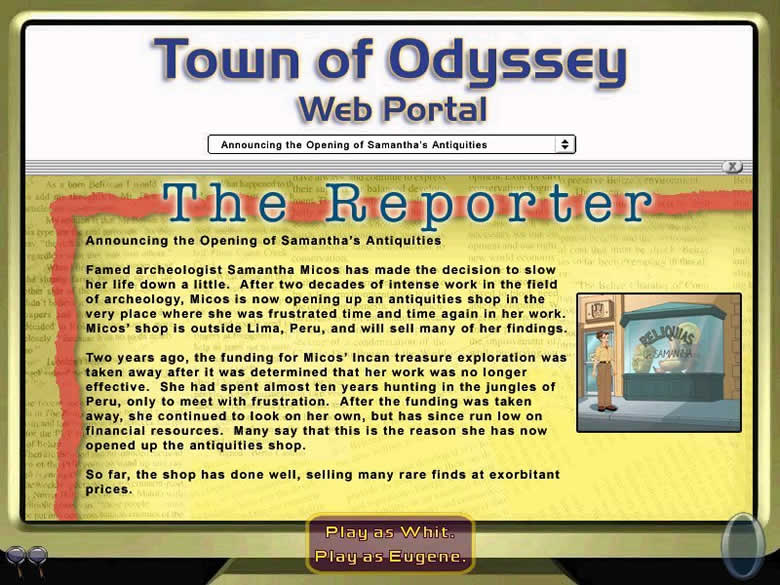
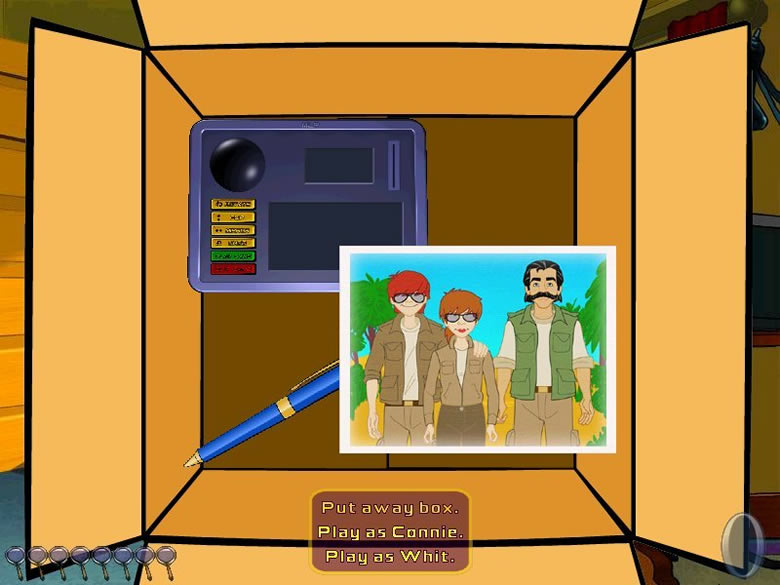
In addition to the usual accoutrements, each character carries a device called a DataCom. This is used to enter notes concerning clues that are discovered and organize them into categories. The DataCom also includes a phone that our trio can use to communicate with each other and call outside parties.
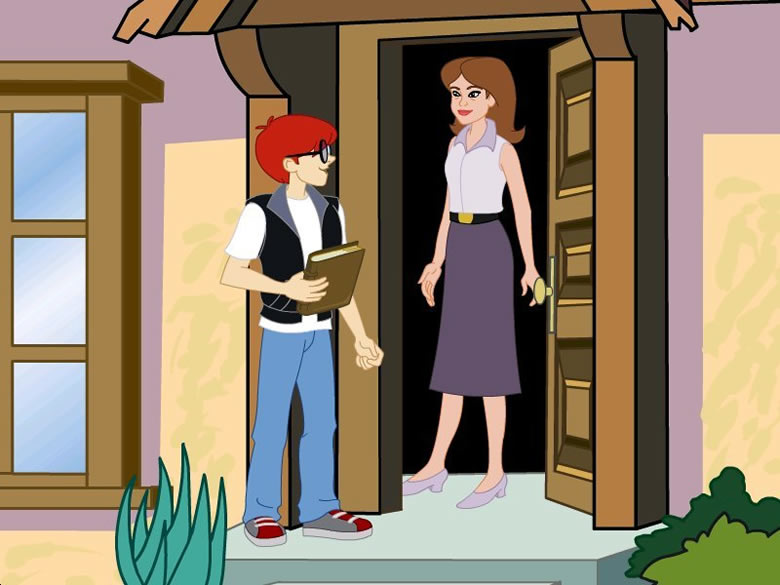
During their adventure, our trio meets Andrea Hiller, an old college roommate of Eugene’s mother, Thelma; Samantha Micos and Carlton Freedman, both archeologists; and mystery man Francisco Valdez, who appears to have some connection to the treasure.
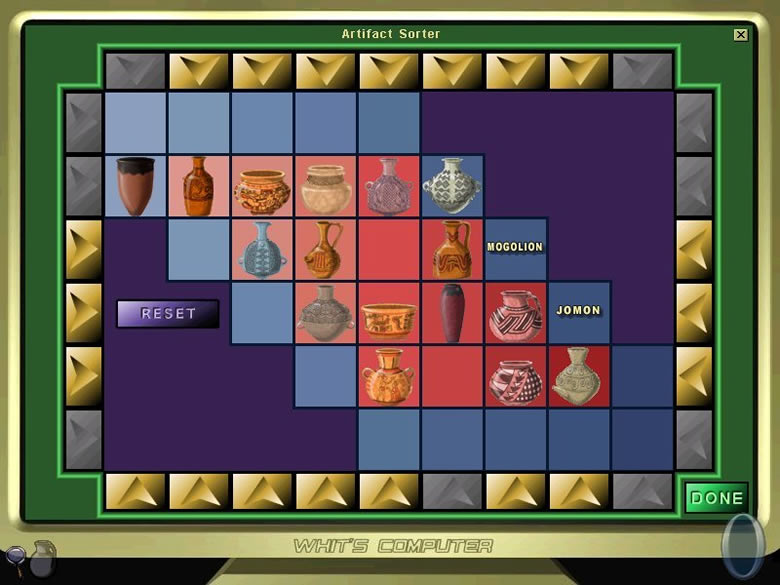
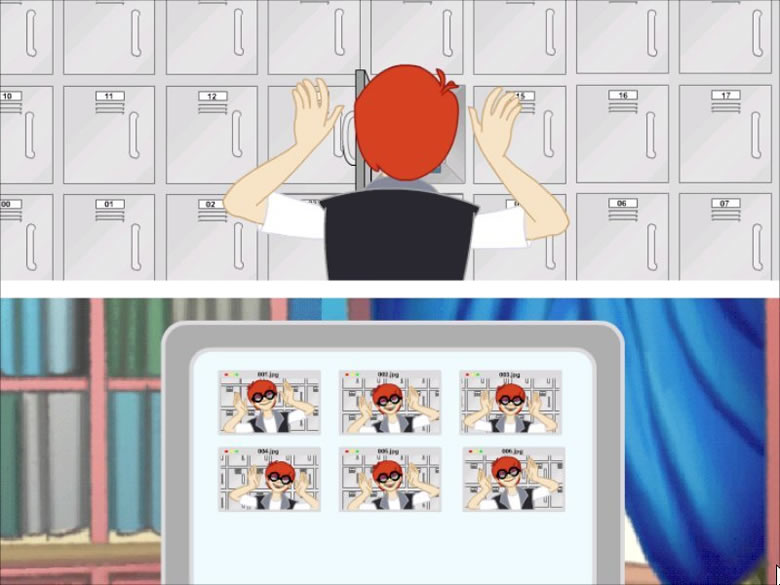
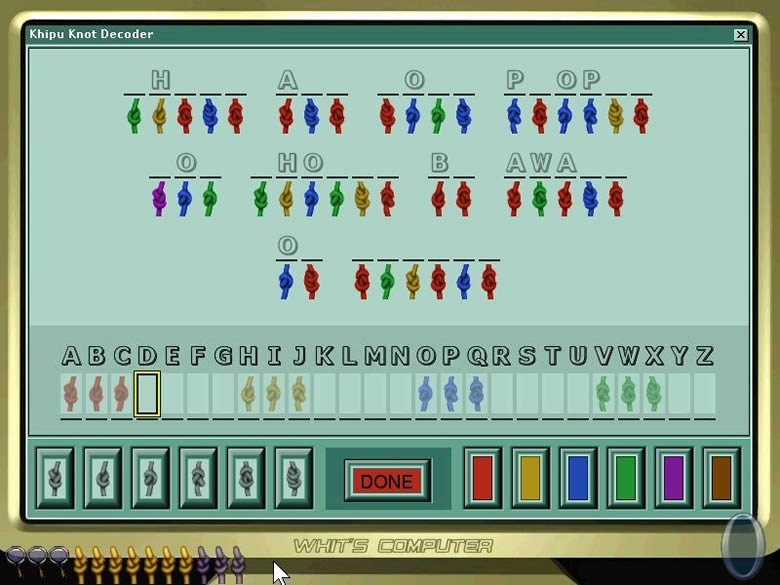
In the course of solving the mystery, Eugene, Connie and Whit sort artifacts, decipher a journal written in code, and build a self-activated camera that takes pictures automatically at set intervals and transmits them to Whit’s computer. They also fly to Peru, navigate through a jungle maze, unscramble maps, and solve a puzzle that uses prisms to redirect beams of light.
There’s one clue in Treasure that doesn’t come from an outside source, is stated verbally only once by one of the characters, and doesn’t show up in the DataCom. Unless a player makes note of it, a subsequent scene might not make complete sense. I’ll leave it at that in the interest of avoiding a spoiler.
I also won’t give away the game’s ending, except to say that after all is said and done, everyone goes out for ice cream. And now that I’ve mentioned it, I want ice cream, too…chocolate chip would be nice.
By the time I reached the end of Treasure I was curious about a certain aspect of the story, particularly considering the game’s Christian underpinnings. I feel it warrants mentioning here, as others who play the game may be curious as well.
I was left wondering who was taking care of Eugene while he was growing up and his parents were away on lengthy archeological digs, and whether Eugene’s parents had ever considered what kind of effect their absences might have on him. (Leave it to me to be picky, huh?)
I contacted Digital Praise with my questions. The reply I received said that in the radio show, Eugene lives with an extended family. There was some uncertainty about whether Eugene’s folks had been concerned about their absences, but I was advised that this wasn’t addressed in the game because it’s already been covered in the series. So there you have it.
I enjoyed Treasure a bit more than I did Sword. It has a bigger scope, offers more variety and less repetition, and some of the music has a Latin American flavor that’s less “cartoonish” than the music in Sword. Also, the activities aren’t as time-intensive — but that doesn’t mean they’re easy. A couple of them, in fact, can be fairly difficult.
All in all, Treasure offers an engaging mystery that’s served up in an absolutely charming package. I had a great deal of fun playing it!
Final Grade: A-
(find out more about our grading system)
In Conclusion…
I heartily recommend both of these games to anyone — young or old, Christian or not — who’s interested in wholesome entertainment. The games have broad appeal and offer something for everyone in the family.
Digital Praise’s stated objective is to produce “faith-based and mainstream titles for families looking to enjoy interactive entertainment software with principled themes and ‘just good clean fun’.” Well, folks, they’ve hit bull’s-eyes with these two games.
I’m definitely looking forward to the release of the other games in the Odyssey series. Kudos to Digital Praise for producing such entertaining titles!
System Requirements:
| Windows | Mac |
|
|