The Wonderful World of Hybrids – Article
Articles
|
by Ray Ivey |
The Wonderful World of Hybrids |
At the risk of besmirching any semblance I have of journalistic integrity, I will once again go on record as saying “I love hybrids!” Many of the best gaming experiences I have ever had were with games that didn’t fit comfortably into any specific genre.
The first two games that raised my “Hybrid Consciousness” were System Shock and Outcast.
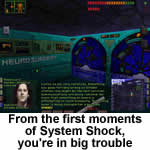 The now-legendary System Shock (Looking Glass, 1994) was Warren Spector’s follow-up to his highly-regarded Ultima Underground games. SS took place on a remote space station called The Citadel, in which the ships onboard master computer (creepily named Shodan) goes homicidally crazy. You play as a hacker grunt who desperately tries to neutralize Shodan. Though presented in first-person, the game wasn’t a shooter. And even though it sort of felt like an RPG, there were no actual stats or leveling. But Looking Glass’s willingness to borrow features from shooters, RPGs, and even adventure games created an unforgettable play experience.
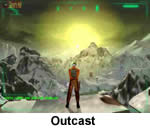 Appeal’s Outcast (1999) took the superficial features of an action/adventure but added the world-building complexity of the best RPG and the story richness of the best adventure games. Stranded on an alien world and caught up in its complex political and military struggles, your character had to find a way to fit in and survive a beautiful, but terrifying series of environments. The game’s designers even marched to a different beat with their game engine, using voxels instead of polygons. This is a game that I found myself thinking about for weeks after I completed it . . . as if the characters I had met during my journey had actually been real.
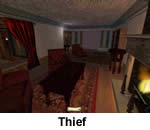 Perhaps not too surprisingly, the next three great hybrids I encountered all had either Looking Glass or Warren Spector involved: System Shock 2, the scariest game I’ve ever played, Thief: The Dark Project, which turned the mechanical conventions of the first-person action game upside down and created the PC stealth genre; and Deus Ex, a dazzling action/adventure/shooter/RPG hybrid that utterly defied any attempts to cubbyhole it into any genre.
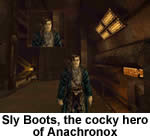
I also fell helplessly in love with the subversive Anachronox, a wild game from Ion Storm, which tried to use the conventions of Japanese console RPGs to create a game with a very Western feel.
 I’m passionate about hybrids because these are the games that actively embrace the idea that digital entertainment is a rapidly-evolving phenomenon. The designer of a hybrid is trying different and innovative combinations of gameplay styles in an attempt to come up with something new. This is a very valuable impulse in a gaming landscape choked with cookie cutter Real-Time Strategy games, Japanese console RPGs, and mindless shooters.
I believe the inherent complexity of hybrids can appeal to an older audience. And because the gaming public is aging, perhaps this will help the marketing of hybrids in the years to come.
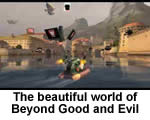 But for now, unfortunately, creating a hybrid game is a very risky business. My favorite hybrid of recent years (and one of my favorite games of any kind in recent memory) was UbiSoft’s spectacular, if lamely named, Beyond Good and Evil. This beautiful game combined adventure, action, stealth, Ico-esque environmental puzzle solving, Pokemon-reminiscent collecting, and wrapped it all up in a story worthy of a first-rate science fiction film or novel. This was one of those rare “played with a stupid grin on my face the entire time” games. The game was designed by Rayman creator Michel Ancel, and I was impressed that UbiSoft would put their resources behind a project so unusual, and even release it on all consoles.
 Alas, despite winning numerous awards, Beyond Good and Evil’s sales were quite disappointing. It’s always sad to see this happen to an innovative game, especially one published by a giant like UbiSoft, because it sends a deadly message to the bean counters: hybrids are bad business.
Charles Cecil, the gamegod behind Beneath a Steel Sky and the Broken Sword games, has also had recent heartbreak in the hybrid department. His last two games, In Cold Blood and Broken Sword: The Sleeping Dragon, could both be considered hybrids, in that he attempted to expand the definitions of what an adventure game could do. Both games had sales that were disappointing, to say the least.
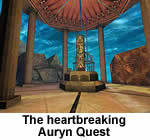 Perhaps the most heartbreaking example of grand hybrid goals coming to naught is the case of Attaction’s wildly ambitious game based on the popular German novel The Neverending Story. I first saw the game in development at E3 in 1999, and I was stunned at the designers intentions. They really wanted to make a game with the richness of a novel, with complex character interactions, branching storyline, and even something called a “Karma Meter.” Alas, the game collapsed under the weight of so many lovely ideas, and the game they finally released through DreamCatcher, Auryn Quest, was a sad shadow of the designer’s original intentions.
Perhaps the most important hybrid on the radar screens of adventure game lovers is FunCom’s Dreamfall, the follow-up (but not direct sequel to) their much-loved The Longest Journey.
FunCom’s designers have high ambitions for the game, every one of which I hope is realized. I do think they have their work cut out for them in the world game market, however, considering the poor track record of other recent adventure hybrids. I’ll be very curious to watch how they attempt to position, market and sell the game in a world that insists on neat, easily-described, well-defined game genres. My hope is that Dreamfall, if it’s as good as we all hope it will be, will break the negative trend these kinds of ambitious and creative games have been suffering under.