Welcome to Just Adventure + — Part 46
Just ASCII + A Column Covering Interactive Fiction and Other Nongraphical Adventure Games
Adventurer vs. Red Dragon
by Simon de Vet
(click to enlarge)
By Erik Reckase
Part Nine: ZZT
After this column, I’ll be diving into interactive fiction much more thoroughly, but there’s one more game that I’d like to cover that fits into the “Nongraphical Adventure Games” arena. This game is ZZT, an interesting modular adventure gaming engine with loads of add-on levels. ZZT was released as shareware in 1991 by Tim Sweeney (of Unreal fame) as the first Epic MegaGames title. (The name ZZT was chosen so that it would be the last game on freeware/shareware download lists.) Over 100,000 users registered ZZT–nothing to shake a stick at. Although the game’s “graphics” are nothing special, the great thing about ZZT is the built-in editor that gives even inexperienced beginners the ability to create new levels. Using the in-game programming language (ZZT-OOP), very advanced games can be created in many different styles, including side-scrollers, adventure games, RPGs, etc.
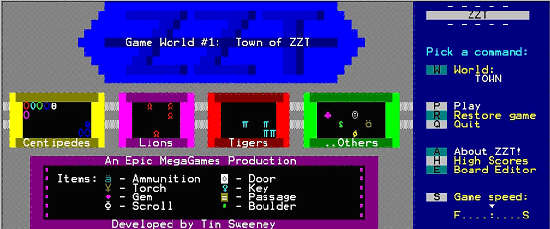
The introductory screen to one of the original four worlds: “The Town of ZZT”
Playing ZZT is extremely simple, as there are very few commands in your arsenal. You move your character with the keyboard arrow keys; shift-arrow fires ammunition in that direction. You can also light torches, which illuminate your immediate area for a number of turns. Although the goals change depending on the world that you are playing, there is usually a puzzle that requires your character to obtain a key, or succeed in a timed action sequence, in order to continue. Sounds simple? It is. In fact, this is a great game for kids, as the goals are reasonably straightforward and the controls are hardly complex. There can be quite a bit of frustration, though, as the puzzles can be downright difficult! ZZT comes with four preloaded modules: the Town of ZZT, the Caves of ZZT, the Dungeons of ZZT, and the Underground City of ZZT. These alone will keep you busy for hours …
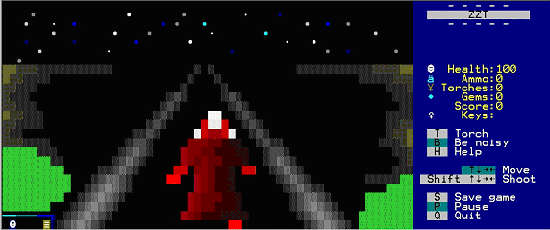
Some walking dwarf animation from “a dwarvish-mead dream” by “coolzx”
As I mentioned before, the graphics in ZZT–if you can call them graphics–are very basic. Even so, some of the programmers/writers of the newer modules spent a great deal of time on making the graphics as good as possible, much like the classic ASCII artists from fifteen years ago, creating complex images with the basic character set as their only palette. By varying the limited available colors, module creators can embed fairly complex images into their code, as can be seen in these screenshots.
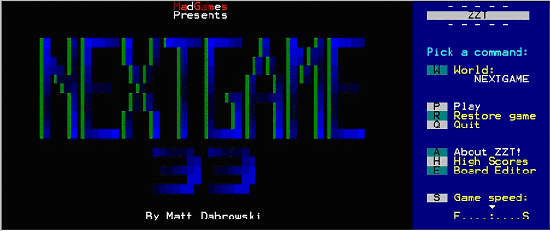
The “NextGame 33” splash screen, by Matt Dabrowski
Many of the web sites for ZZT files and information read more like hacker “warez” pages than information sources, but there are over 200 add-on modules to ZZT that can be found through careful scrutiny. Here’s a list of the best links that I’ve found for ZZT-related information.
The Official ZZT Home Page: This is the official home of ZZT at Epic MegaGames. ZZT and Super ZZT (a sequel to the original) are available for downloading at this site.
ZZT.org: Probably the most thorough source of ZZT modules, tools, and other nifty stuff on the ‘net. Although the site is a little rough around the edges, the download area is second to none. Check out the “reviews” link on the top menu bar.
KevEdit: This is a ZZT world editor that is much more powerful than the editor included in the game’s distribution. More colors, a better character picker, and an object editor are included in this excellent tool.
ZZT Encyclopedia Online: This collection of downloadable “engines” for ZZT is great for module developers.