Welcome to Just Adventure + — Part 40
Just ASCII + A Column Covering Interactive Fiction and Other Nongraphical Adventure Games
Adventurer vs. Red Dragon
by Simon de Vet
(click to enlarge)
By Erik Reckase
Part 3–NetHack
Let me begin by saying that NetHack is probably one of the best games of all time. The depth of gameplay in NetHack is nothing short of miraculous, a standing testament to what can be accomplished by a community of gamers working towards a common goal. Although the only graphics in the game are created using ASCII characters, this is one game that will cause you to lose sleep, skip homework, and otherwise completely ignore the world around you.
In order to fully understand the NetHack phenomenon, it is essential to get a little bit of historical background. NetHack, in its current incarnation (version 3.3.1 at the time this article was written), began way back in 1985, when Jay Fenlason, Kenny Woodland, Mike Thome, and Jon Payne wrote the original Hack, which was basically a clone of Rogue with a wider variety of monsters. (Rogue’s monsters were represented by capital letters, so there were only twenty-six different creatures that you could encounter in the dungeon.) Two years later, in 1987, a new version of Hack, with many new features, was released by Mike Stephenson. This iteration was called NetHack. (Many of these new features were suggested to the author via Usenet posts, hence the “Net” in NetHack.) This is where I think this game truly became legendary–hundreds of devoted gamers, working with each other to add humor, substance, and playability to an already addictive game.
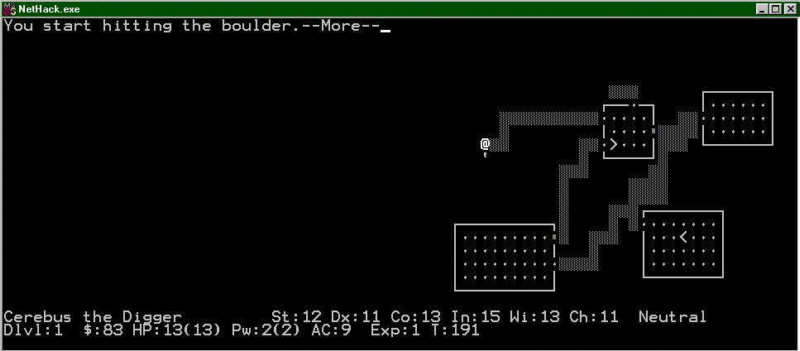 My level 1 human male archaeologist attempts to brute-force
a boulder into submission with a pick-axe. (Click image to enlarge.)
Following this release, NetHack has been maintained by a large number of people, collectively called the Dev Team. The Dev Team was organized by Izchak Miller, a University of Pennsylvania philosophy professor, in 1988. This is not to say that all developments have come from members of the team. Since NetHack is an open source game (anyone can look at the source code of game, modify it, and release the changes as an optional “patch”), there have been numerous user-contributed NetHack variants over the years. For example, the variant NetHack +, by Stephen White, addressed some combat issues, added some new character classes, and made things quite a bit harder–many parts of NetHack + were incorporated into NetHack version 3.2. There is no standard release schedule for NetHack–in fact, it’s a fairly mysterious process, as new versions are released with no notice whatsoever. Version 3.2 of NetHack was released in 1996, and after three years of silence, version 3.3.0 was released in December of 1999 without warning. Another update, version 3.3.1, was released in August of this year, fixing some minor bugs in the previous release–and who knows when the next version will be released.
The goal in NetHack is the same as the goal in Rogue–to find the fabled Amulet of Yendor. The method of gameplay is also very similar to Rogue; explore the mazes, obliterate monsters, and reach your goal. However, the authors have expanded the story a little bit, giving your character more background:
“Having exhausted your own meager financial resources, as well as those of your parents, you find that you must end your formal education. Your lack of experience and skills leaves you facing a pretty grim future. You could look for some sort of menial job and hope to perform well enough to be noticed and perhaps rise in responsibilities until you were earning enough money to be comfortable. Or you could set out into the world and make your livelihood by prospecting, stealing, crusading, or just plain killing, for your gold. Over the objections of your local guildmaster, you opt to follow the adventuring route. After all, when adventurers came back this way they usually seemed better off than when they passed through the first time. And who was to say that all of those who did not return had not just kept going?
“Asking around, you hear about a bauble, called the Amulet of Yendor by some, which, if you can find it, will bring you great wealth. One legend you were told even mentioned that the one who finds the amulet will be granted immortality by the gods. The amulet is rumored to be somewhere beyond the Valley of Gehennom, deep within the Mazes of Menace. You decide that even if the rumors of the amulet’s powers are untrue, and even if it won’t cure the common plague, you should at least be able to sell the tales of your adventures to the local minstrels for a tidy sum. You spend one last night fortifying yourself at the local inn, becoming more and more depressed as you watch the odds of your success being posted on the inn’s walls getting lower and lower. In the morning you awake, gather together your belongings, and set off on your adventure …”
From A Guide to the Mazes of Menace (Guidebook for NetHack 3.3) by Eric S. Raymond and Mike Threepoint
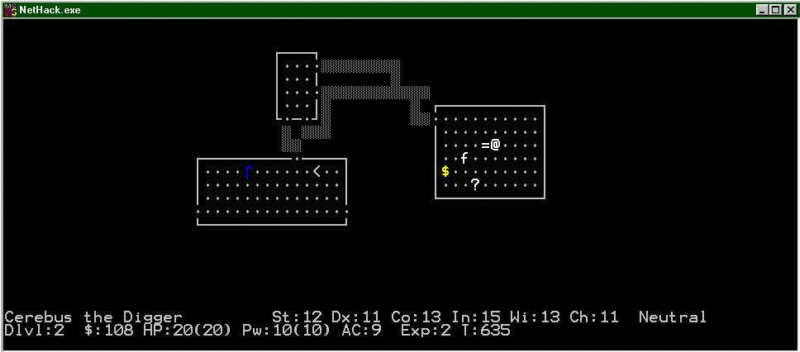
Sensing that the diamond ring (=) that I found might be cursed,
I try to convince my pet cat (f) to check it out. The cat refused,
but I put it on anyway. My cat was right–it was cursed.
(Click image to enlarge.)
This game’s features are far too numerous to describe in this column, but here’s a summary of what I think are the more interesting ones.
- Your character can be much more specialized than in Rogue–for example, there are thirteen different “roles” that your character can play, from Archaeologist to Wizard. There are also different options for your race (human, dwarf, gnome, etc.), your sex, and your alignment (Lawful, Neutral, or Chaotic), each choice determining your vital characteristics. There are now six characteristics (strength, dexterity, constitution, intelligence, wisdom, and charisma) as opposed to the one in Rogue.
- Each new dungeon level is random, so every descent into the Mazes is different. However, each level is saved to disk after you visit it, so anything dropped on a level stays there until you pick it up again. You can freely move up and down between levels, in contrast to Rogue’s “down until you get the Amulet, then up” gameplay.
- The levels now contain stores, which allow your character to use some of the treasure that he/she finds while exploring to improve their weapons and armor, as well as supplying potions, food, and other accessories.
- Your character happens to own a pet, either a cat or a dog. Your pet will follow you around through the dungeon, helping you dispatch the bad guys and warning you about cursed items (pets will avoid items that are cursed, and they will not pick up cursed items under any circumstances). They can also help you shoplift in stores!
- Amazingly, the game has a sense of the current time and date in the real world. For example, while playing the other day, I was greeted with the message “Be careful–new moon tonight.” Depending on the time of day and the phase of the moon, different things will happen while exploring!
- NetHack accepts a huge range of commands. Not only are all of the keys on the keyboard defined, but shift- and alt- modified versions of them as well. There is also a set of extended commands that allow you even greater flexibility in your approach to the game.
- You will encounter a number of subquests (given to you by other creatures that you encounter), as well as special levels that are explored a little differently than the rest. The first of these levels are the Gnomish Mines–you’ll know them when you see them.
- If you’ve played NetHack before, and died while exploring, you may encounter your ghost during one of your next games. Your ghost will be carrying everything you had when you died, except there’s a high probability that many of your old items are cursed.
- NetHack introduces the concept of qualifications. This is basically how well you perform certain tasks, or a skill level. The more you use a particular weapon or cast a certain spell, the better you get, and the more often you hit your target. Practice makes perfect!
- You have the option of playing NetHack in explore mode, which is a nonscoring discovery way of playing the game. This allows people to wander about a bit more before dying in some horribly stupid fashion (this is not a rare occurrence, believe me).
- This world of NetHack is rich and complex beyond your imagination. This is a rather difficult concept to visualize, so I’ll resort to an excellent example of the intricacies of the NetHack world, written by Dave Kosak:
“Eat a floating eye corpse and you’ll get ESP, which will allow you to see enemies anywhere on the map, but only while blinded. To take advantage of it, you may want to drink a potion of blindness, or preferably, find and wear a blindfold. Of course, while blindfolded, even with ESP you won’t be able to see inanimate objects on the floor–when you find piles of items, your character will have to “feel” for them. Oh, and you won’t be able to read scrolls. Whoops! In that pile of items you just felt is a cockatrice corpse–fortunately you were wearing gloves, otherwise you would’ve been turned to stone just by touching it. But now, blind and protected, you can pick up the cockatrice corpse and use it to attack monsters–now your enemies will turn to stone when you strike them! Unfortunately, their inventory turns to stone as well. Hey, no problem–you’ve got a pick-axe, so you can chisel open their statues to yield a pile of rocks and any of their old possessions. Sadly, thanks to the blindfold, you can’t see a nearby pit and tumble inside. Too bad you were holding the cockatrice corpse–it landed on top of you and turned you to stone. You die.”
I’ve only touched the surface here–there’s a reason that the NetHack Guidebook is twenty-five pages long and also for the countless help pages on the Internet to assist the novice adventurer. (If you’re obscenely curious, NetHack is about two megabytes in size–that amount of code, without graphics, can give you an idea of how detailed it is.) Since there’s a significant learning curve, expect to play many times before getting very far … NetHack is very hard and very complex, but it is also extremely rewarding and absolutely free. I’ve included some links to the best NetHack information I could find on the ‘net below. See you next time!
The Official NetHack Home Page: Maintained by Kenneth Lorber, this is the official distribution site for NetHack. You can find downloads for just about any platform, along with background information, bones file sources, and popular links to other NetHack sites. (Note–some platforms, like MS-DOS, now have colored characters, instead of that dreary monochrome of the older versions.)
Erebus/The NetHack Index: The most complete list of NetHack related links on the web. You can find informational sources, NetHack variants, patches, and all sorts of goodies on this page.
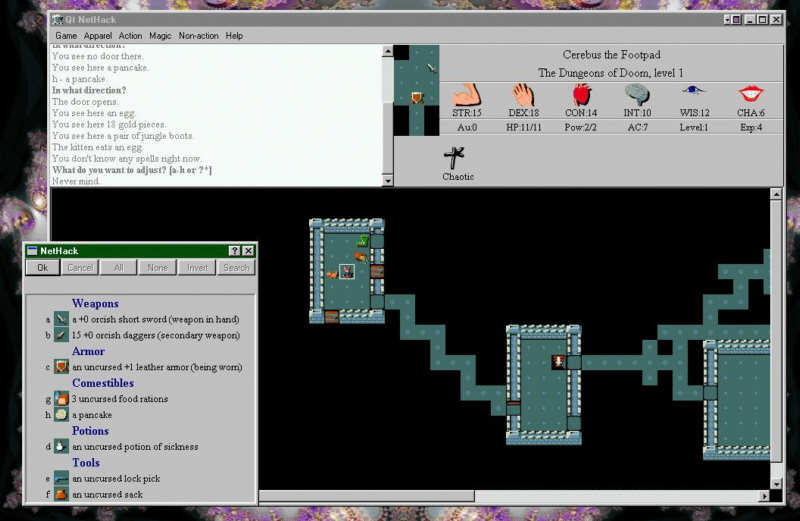
A sample of Qt NetHack’s gameplay interface. (Click image to enlarge.)
Qt NetHack: Written by Warwick Allison, this is a graphical front end to NetHack, with pull-down menus for many commands. If you really can’t stand the ASCII characters, this will make NetHack very eye-friendly.