Timelapse
|
Timelapse Publisher: Hammerhead Entertainment By Stuart Yoder and Randy Sluganski
     |
Stu: You should buy the game Timelapse. Why? So Barracuda can make a sequel. Is Timelapse good enough for a sequel? Absolutely. It is a great adventure game. How great? It’s one of my top ten, and if it’s in my top ten, it must be great.
Randy: Well, Timelapse is not in my top ten, but I do agree that it deserves a sequel. If more of the Myst-style adventures were of the same high quality as Timelapse, then I do not think the phrase Myst clone would have such a negative connotation.
Stu: We usually start reviews by describing the plot. To tell the truth, I don’t remember much about Timelapse’s plot. One of the reasons I like Timelapse is because it is not plot-driven: I don’t have to spend time talking to characters to advance a plot. At the beginning of the game, you land on Easter Island. You find a journal and a camera, and away you go on your adventure. You get to travel to four distinctly different locations. At each location, you will be challenged with a series of puzzles that once solved will allow you to move on to the next location. The focus is on the integration of the puzzles into the feel and mood of the specific location. Because of this focus, I give the plot an A.
Randy: The lack of plot was a major turn-off for me. While Timelapse is much more than a puzzle game with pictures, it is at its heart a game built around the puzzles. The journey to save your friend, Professor Nichols, from the time gate he is stuck in could have led to many interesting time/space conundrums. I hope the intended sequel evolves the plotline and theme into areas that were largely unexplored. I give the plot a C.
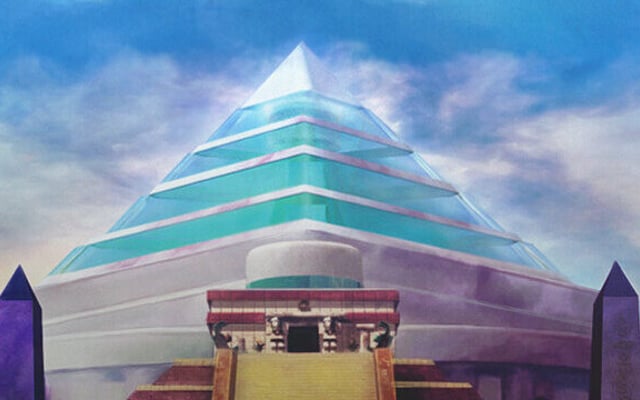
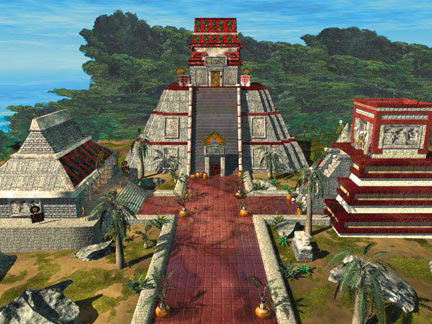
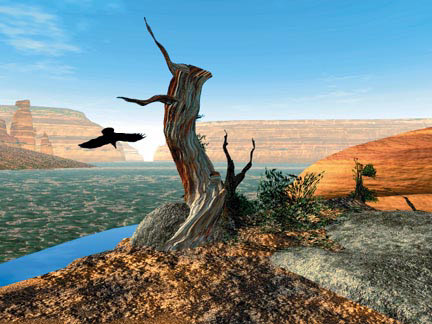
Stu: I thoroughly enjoyed the graphics in Timelapse. From the detail of the Easter Island campsite to the décor of the buildings at Atlantis, the game truly delivers a feast for the eyes. Some of my favorite moments in adventure gaming are from Timelapse. While I was deep in concentration, trying to solve a particular puzzle at Anasazi, my hand and mouse clicking me through exploration, I was stopped dead in my tracks at the image of a coyote standing on a distant rock, staring at me. At the conclusion of that puzzles, you are signaled that you have solved the puzzle as the shadow of a coyote moves slowly across the rockface, lifts his head and howls. Spine-tingling. I originally played the game two years ago, and these image are still fresh in my memory today. Timelapse has excellent graphics and a beautiful gaming environment. I give the graphics an A.
Randy: The photorealistic full-screen images in Timelapse are without a doubt stunning. The ray-traced graphics are even more impressive when you consider that this game is already two years old! The sunken city of Atlantis, the monoliths on Easter Island, ancient Egypt, the Mayan jungle and the American Southwest are all painstakingly and historically recreated. There are also some full-motion video sequences that are deftly incorporated into the game. I had not played this game when it was originally released, so I was totally unprepared for the graphical visual treat. I also give them an A.
Stu: Just as Timelapse gave me some of my favorite game-graphics memories, it also is responsible for some of the most memorable music in any game I have played. I found the music to be comforting, always sending the message, “Take your time, enjoy your stay, and have fun with the puzzles.” I never found the music intrusive or bothersome. I for one always appreciate this in a game. The sound effects are very important in this game as there are several puzzles that require the player to rely on sound recognition to solve. With four different worlds to explore and enjoy, there are many varied and effective sounds, and each one is extremely well done. Of the three parts to this category, voice acting is the weakest. There is some voice acting, all contained in “video” sequences that the player must watch. The acting in these sequences is quite poor. However, I’ll tell you how good Timelapse is: the poor voice acting doesn’t matter. The is not a game about acting. This is a game about adventuring, and Timelapse is a wonderful adventure despite the poor voice acting. I give the sound, music, and voice acting an A.
Randy: I agree with you about the voice acting. These are clearly not professional actors. The music really is soothing. It, along with the sound effects, reminded me of one of those nature CDs you can purchase in those environmental/wildlife mall stores. The ambient nature sound effects are extremely crisp and add a lot of atmosphere to the game. Overall grade in this category is an A.
Stu: Timelapse has a wonderful collection of puzzles: lots of variety and very unique. Most adventure gamers have developed a habit which should never have become a habit: if we encounter a puzzle we don’t understand, we will click on everything in our inventory. In Timelapse, you can carry only one item in your inventory. This translates to allowing the adventurer the joy of using his creativity and intelligence to solve the puzzle instead of resorting to wild guessing. The most important reason why the puzzles in Timelapse are some of the best is that the hints are built into the environment. It is always possible to solve every puzzle if you pay attention to your surroundings and watch for clues. If every adventure game took this approach to gaming, I would be the world’s happiest adventurer. There are a lot of adventure games that I believe were designed for the sole purpose of getting gamers to call 900 hint lines. But Timelapse is a game that allows the player to relish the exploration, knowing that he will be rewarded for his astute observation and keen perception. Well done. I give the puzzles an A+.
Randy: For my part, I found many of the puzzles to be difficult not in their presentation but in their execution due to the fact that I am better with inventory puzzles than I am with pattern and sound matching puzzles. In fact, you can never have more than one inventory item at a time, so their importance in the game is negligible. The puzzles are varied and interesting, though, as many of them arise from your perception of your surroundings. The nature of the puzzles do have a way of immersing you into the game. The two things that did annoy me the most about the puzzles were the amount of reading you have to do in the professor’s journal and the limited use of your camera. You must judiciously use your camera as you only have a 36-print roll of film (hey, Barracuda, have you thought about using Kodak as a product tie-in for the sequel?). I did not enjoy drawing pictures of items after my film had run out. As a deference to us gamers who can barely read their own writing much less recognize a picture we have drawn, how about an extra roll of film for the proposed follow-up? I give the puzzles in Timelapse a B for their lack of balance.
Stu: The producers, Barracuda, have rereleased Timelapse to see if it sells well enough to warrant a sequel. I hope that you will buy the game and support the effort of Timelapse 2. Don’t let any more time lapse before you go to your favorite game store and purchase this wonderful game. The final grade is a well-deserved A.
Randy: Stu, you should be ashamed to use such a horrible pun! Especially since I was going to use it. While Timelapse is not my “type” of game, I would heartily recommend it to anyone who enjoys games like Cydonia and Myst. It is easily the best of these type games I have ever played, and if Barracuda can deliver more plot and some character interaction in the sequel, Timelapse 2: Homeworld, then they will be grateful that they did not allow to much time to lapse before rereleasing this game (it is good to have the last word!). My final grade is a B.
Final Grades: A and B
System Requirements:
PC:
Microsoft Windows 3.1 or Windows 95 (Windows 95 strongly recommended)
Pentium 60 MHz processor or faster (Pentium 100 MHz processor strongly recommended)
16 MB RAM (32 MB RAM recommended for better performance)
Quad-speed CD-ROM drive or faster
Super VGA graphics card (local bus video card recommended) and color monitor
100% Windows-compatible sound card and external speakers
Mouse and keyboard
About 90 MB of hard disk drive space for full installationMacintosh:
MacOS 7.0 or later
Motorola 68040 processor or faster (PowerPC processor strongly recommended)
16 MB RAM (32 MB RAM recommended for better performance)
Quad-speed CD-ROM drive or faster
640×480 with 256 colors (8-bit) display and color monitor
Mouse and keyboard
About 90 MB of hard disk drive space for full installation