|
Interviews
High drama and suspense are what you strive to create in a good game. High drama and suspense are not what you want in the making of the game. For the past several years now a rather intriguing drama has been going on over at Cliff Johnson’s website.
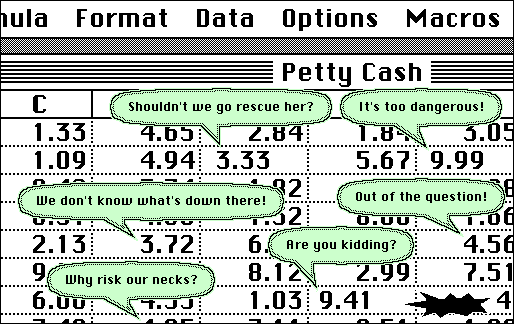
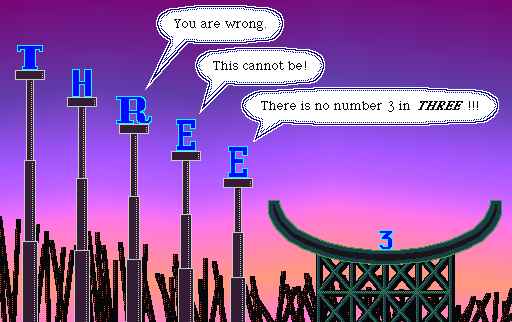
Cliff, as you may know, and if you’re a fan of computer gaming, should know, is the mad genius behind such groundbreaking computer games as The Fool’s Errand and 3 in Three. If you are truly a lover of good, challenging puzzles in a game, then you will be familiar with at least these two titles. With 3 in Three you have to be the type of person who can break down weeping with frustration and self-loathing several times during the course of the game, and then when you get to the end think, “Wow, what a great game!”
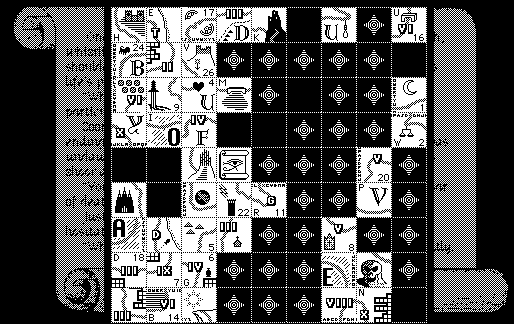
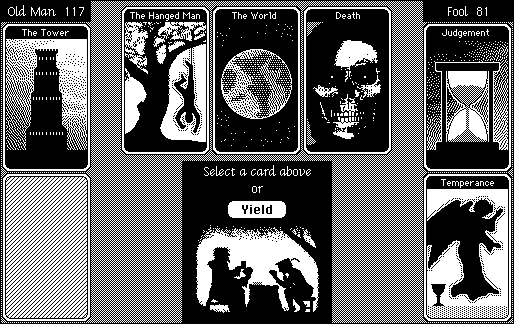
The Fool’s Errand is a little more forgiving, but not by much. It came out 20 years ago this month. Twenty years is an eon in computer gaming. The Mac had only debuted three years earlier. Fool was rightly praised as not only a great, entertaining game, but as something different, what came to be known as a “meta-puzzle.” A puzzle game where the individual challenges in the game all add up to the solution of the overall grand puzzle. I would argue that Fool’s Errand is really the granddaddy of what has come to be known as the adventure-puzzle game. Myst added the CD rom and some fluid navigation, but Fool predated it by six years. So along comes 2002 and Cliff thinks to himself, well maybe it’s time to produce that long-gestating sequel to Fool’s Errand – The Fool and His Money. After all, there was not only the internet to aid him now, but all these wonderful new commercial graphics and other applications. Should be a cinch. Well, five long years ensued. If you are one of Cliff’s “True Believers” you’ve probably been following along as each new digital stumbling block fell across Cliff’s path. Even today, as I write this, he’s wrestling with something that he has listed on his Fool and His Money webpage as “ . . . mending memory manager.” I’ve only been following this struggle for the past year or so, but even in my memory I can recall earlier announcements of: “Striving for December” and “Final Bouts of Glitch Fix.”
Well, the long drought is over. This month Cliff is going to ship, at long last, The Fool and His Money to his True Believers and all the others who over the years have pre-ordered the game. So let’s not dwell on the past. Let’s rejoice that Mr. Johnson is still producing games.
Okay, it’s true, in the middle of Cliff’s last lap getting the game out I did impose upon him the following long list of questions about the game and its rather dramatic birthing, which probably delayed the release of the game by a couple of weeks. But as compensation you get this informative and entertaining Q&A with the great Cliff Johnson.
“The Fool’s Errand” came out twenty years ago in 1987 (Happy Anniversary, btw). That was a time when writing games for the Macintosh actually made financial sense. What are the biggest differences between making a computer game then and making one now?
Yes, two decades ago. I say it best in the prologue of The Fool and his Money. It begins… “Twenty years ago… and just yesterday…”
Remarkably, creating a game hasn’t changed all that much from my perspective. The same elements dominate: story, puzzles, art, sound, and programming. My work could not exist without technology, yet advances in technology are not the force that drives me. My games are plainspoken and technology allows me to be an author with my own eccentric, eclectic style. I create old-fashioned games with cutting edge tools.
Because my audience skews 50% Windows and 50% Macintosh, my biggest development advantage is that I can develop for both at the same time, thanks to Macromedia Director and Flash.
Flash I credit with empowering tens of thousands of people to express their creative voice in storytelling and animation (and gaming); and the Internet provides a distribution venue for millions of viewers. These extraordinary works of avant-garde animation, once relegated to the BBC and the Canadian Film Board, now enjoy an unprecedented audience. It’s no coincidence that, for the last decade, there’s been a revolution from experimental animation to television commercials and finally to the cinema.
Technology tools have (finally) become more accessible to a wider variety of people.
In 1987 there was no internet, there was BMUG and all the other MUGs. Though commercial computer game production has since morphed into something resembling major motion pictures, the internet and the tools available for it must provide great advantages not available back then, certainly in terms of distribution and marketing.
In the 90’s, I had all but abandoned any hope of being able to make and market personal games like The Fool’s Errand or 3 in Three ever again. When I put up my website five years ago and offered the old games free of charge, I had my Field of Dreams moment, “If you build it, they will come.”
With the ability to develop for both platforms, now I had the ability to reach my audience. I no longer needed the middle man to market my wares. I couldn’t afford him and he couldn’t afford me.
The game industry has evolved into a multi-million dollar business — wait, what am I saying? Billions of dollars! — and with that mighty Hollywood-esque studio system comes the obligation that the products must make a lot of money.
I am burdened by no such obligation. >rim shot<
You’re someone also familiar with film production. I’d love to know your thoughts about the big computer and console (Xbox, Playstation) games of today. It’s getting closer and closer to running around inside a movie. Is that a good thing?
It seems to me that these products have achieved the verve of virtual reality without the goggles, the wired glove, or the omnidirectional treadmill of the Star Trek holodeck. Who’da guessed that staring into a rather modestly sized window could so readily transform into a magic portal to a living, breathing world. I daresay that this tiny window can command your attention more effectively than the best iMax movie.
I don’t think of these games as being inside a movie. I see them as being inside an amusement park with thrills and chills aplenty: shooting galleries, carny games, funhouses, and roller coasters. Moreover, they are theme parks where you can sail the seas with the Pirates of the Caribbean, tiptoe through a Haunted Mansion, or explore the Temple of the Forbidden Eye with Indiana Jones.
For a brief moment in time, computers were like books. They were text-based and you had to use your imagination. Now computers are visual with a vengeance and today’s games are the natural selection of that evolution.
How do thoughtful puzzle and adventure games compete with Halo 2? Or do they?
This question is not new. Would books survive as moving pictures thrived? Would cinema suffer as TVs filled every home? Will television fade away in the wake of the Internet?
A Chess tournament cannot compete with the Super Bowl. Classical music had its heyday centuries ago. Yet both Chess and classical music enjoy a dedicated following. Civilization managed to survive the spectacle and carnage of the Roman gladiators. I feel confident we can weather the season of the action game.
Perhaps the strategy for puzzle and adventure games is to honor the qualities that separate them from the crowd. Be proud of being a thoughtful and contemplative activity. If you stage a Eugene O’Neill play in the center of a demolition derby, not only is the play lost, but the demolition derby suffers as well. It’s lose/lose.
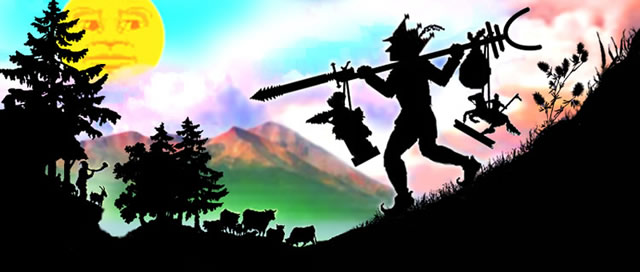
For my part, there will be no 3-D in The Fool and his Money. I will unabashedly continue my tradition of storybook tableaux and silhouettes. I am staging a treasure hunt, not a Mardi Gras. I want no distractions between you and the puzzles. I presume that’s why you’re playing my game in the first place.
Take us back to the halcyon days of 2003 (or was it earlier?) when you were first plotting out the production of “The Fool and His Money.” How long did you expect it would take to produce?
By the end of 2002, I had decided that I could do the game in one year. After all, I still had all of my old puzzle tools alive and well on the Macintosh, the same tools I had used at Philips to create data for the CD-i puzzle games (Merlin’s Apprentice and Labyrinth of Crete). It seemed reasonable at the time.
How did you go about writing “The Fool and His Money”? Tell us how you came up with the story elements, with the puzzles, and with the artwork (and the artist). Was the creative aspect similar to “The Fool’s Errand” or has that changed too?
The technology of yore had limitations and I turned that to my advantage. Instead of fretting over what I couldn’t do, I set about to discover what I could do. This gave each of my early games a particular style of its own, necessity being the mother of invention.
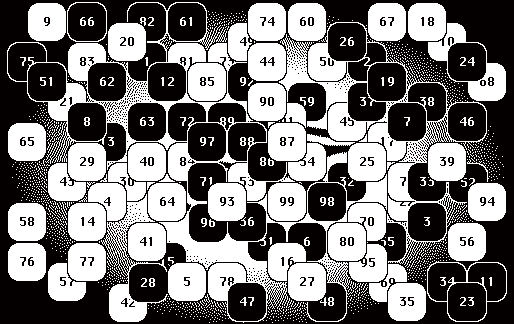
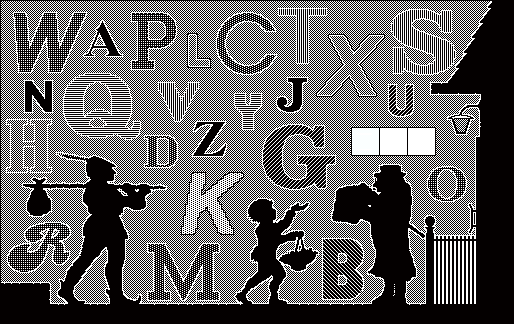
Today, I can pretty much do whatever I want and one of the challenges has been to realize that what I did back then is pretty much what I want to do now. The difference is that I have Photoshop to embellish the graphics and Sound Forge to create a bed of sound. Just because Flash can be flashy doesn’t make it an automatic mandate to do so. The task of an author/artist is to make the choices that are correct for each new work.
The story for the sequel begins the moment after the original ended. The Fool is carrying the fourteen treasures down the mountainside after having outwitted the High Priestess. He daydreams of the great rewards he will reap from a grateful populace. But by nightfall, he’s been bushwhacked by pirates and left for dead in the wooded swamps outside the Kingdom of the Swords.
This time, the Fool receives the counsel of the Moon who advises that, “The treachery, now, is mortal,” and the Fool is convinced that he must gather together a great ransom to reclaim the fourteen treasures from the pirates. Yet he is mistaken. All the characters of the Tarot deck have fallen under the spell of the High Priestess and a new bewitchment corrupts the Land.
In each of the four Kingdoms, the Fool discovers that merchants and shopkeepers alike share the delusion that words, not currency, represent the new economy and the demand is overwhelming. This affords him the opportunity to proffer his gift of wisdom, earned from his errand, to hoard piles of old currency in exchange for his services, extracting words and letters from the bewitched landscape.
Also, it affords me the opportunity to spin a tale with equal whimsy and invention as the original.
In designing the puzzles, I decided that I needed to (1) put new twists on the familiar, and (2), search for a method to introduce money and commerce puzzles. I spent a considerable amount of time going down the wrong path on the second. Having the Fool barter for fruits and vegetables or having him attend an auction for plots of land were alluring ideas, but I found that I was leaving puzzle territory and venturing into being a financial SIM. Ultimately, this is not at all what I wanted to accomplish.
I found myself going back to the original and studying it. I had abandoned the meta-puzzle without realizing it. Amassing money into a small or large fortune was a fine premise for another game. But in the meta-puzzle structure, you are collecting arcane clues that will only make sense when all are gathered together and compared to the Moon’s Map. Correcting this put the game back in balance and unfortunately took more time than I expected.
There are 8 auctions in the game, half are blind-bid auctions, and the others are bidding wars. There are 5 new Tarot Card games, 4 of which involve gambling. There are 3 inventory puzzles that draw on the logic of anti-magic squares. And there are a host of new twists and turns with jumbles, codes, patchworks, morphs, searches, concatenations, tracers, half-words, fill-ins, and the High Priestess surprises. Overall there are twice as many puzzles as the original and thrice as many on the Moon’s Map.
The set of 78 Tarot cards is based on a series of 1990 illustrations by artist and friend Brad Parker when there almost was a CD-ROM version of The Fool’s Errand.
 adapted from adapted from 
Here’s a link to those Tarot Cards, illustrating the story of the original.
Initially, I was going to mimic his style in creating the images for the sequel, like so.

Then Photoshop came along and, well, there was more time spent on artwork than I had anticipated.
I would really love to know how you go about creating a good puzzle. Is it a gift? Do they just come to you on the train? Or is there a specific method to their creation? And how do you know if it’s too tough or not tough enough? And how does one make a puzzle entertaining? That is, how do you avoid the challenging but tedious puzzle?
In creating a puzzle on the computer, I spend 25% of the time programming it, another 25% adding/subtracting features, and 50% debugging it. I figure, if I’m not sick of the thing by the end of that journey, then I’ve passed the first phase of the challenging but not tedious litmus test. Next I rely on my beta-testers to call me and shriek with agony or not. Then I feel I’m safe. The best outcome is when they say they hate me. This indicates that the blend of addiction is equal to the task.
A bigger challenge is not everyone likes the same kind of puzzles, yet I insist upon mixing and matching word puzzles with memory puzzles with logic puzzles. What I have learned is, if people like two-third’s of my puzzles, they’ll endure the other third.
But the biggest challenge, I find, is ensuring that anyone who gives the game their effort will indeed be able to solve and complete the game. For me, there is no glory in presenting a challenge that cannot be solved.
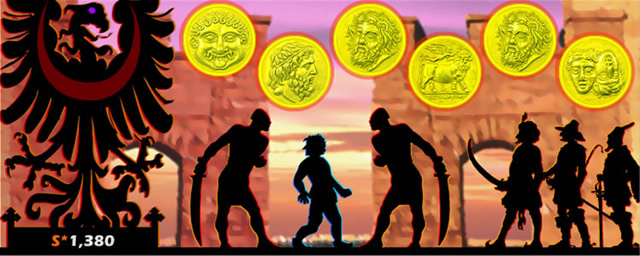
I consider “The Fool’s Errand” to be an adventure game. I even think of “3 in Three” as a sort of abstract adventure game. (It does have a protagonist, after all.) Do you consider your games to be adventure games?
My puzzle games represent the minimum requirement to be an adventure game. Solve something. Earn a new piece of the story.
Did you know that I wrote a text adventure, programmed by Allen Pinero, published by Scott Adams, called Labyrinth of Crete? It was arguably the first text adventure that allowed you to control two characters acting as one unit or separately acting as two units in two different situations.
Ruminating over the VERB NOUN command as a puzzle device was the direct cause and effect for me to explore hands-on visual activities as puzzle devices on 1984’s Macintosh.
How about a few thoughts about how puzzles and exploration interact in the adventure game. Why is it that the sense of adventure enhances puzzle-solving? Why not just have a series of puzzles like Sokoban?
A collection of puzzles is one thing. A collection of puzzles based on a theme adds a sense of mythology. A collection of puzzles connected together by a story provides a sense of purpose.
For me, no matter how great the adventure, when you stop to solve a puzzle, you’re in puzzle time, not adventure time. When you leave the puzzle and move on, then the adventure can continue.
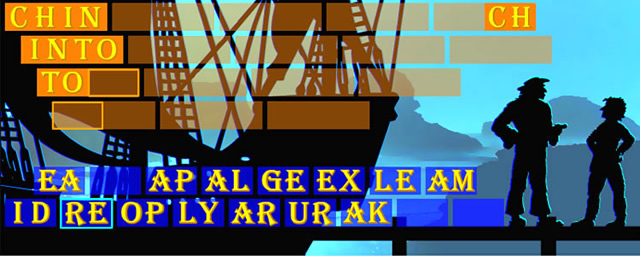
There was no Flash (or even QuickTime) in 1987. What program was “The Fool’s Errand” written in?
At the (further) risk of sounding like a paleontologist discussing the Triassic Age, the original was written as a series of files in interpretative MS Basic and then translated into ZBasic, a compiled language that allowed me to create a viable standalone product. Fate was kind to me in that regard.
At the Carnival and 3 in Three were written in Pascal where I developed my own graphics language to be able to accommodate all the art and animation and sounds onto a single 800K floppy disk. That was an important consideration to the early mammals of the Triassic.
Let’s see, since 2003, the Mac OS has changed several times, and even Windows XP is about to change to Vista. I can’t remember if Adobe bought Macromedia within that time, but the digital landscape must keep changing under you when a game takes more than a year or so to make. Has this been a problem, or is it less severe than ten or twenty years ago?
This is better. Far better. Yes, Adode bought Macromedia in the middle of my production and fortunately they have been rigorously keeping Flash very current and up-to-date. The fate of Director is not yet known, but I only rely on Director as a traffic cop and file manager for the dozens of Flash files. I made the decision from the beginning to limit the use of Director and that has proven to be a sound one.
Apparently, some of your fans have been sending you technical advice. Has that helped? It must at least be comforting.
The True Believers, as I call them, have been great. I dedicate four long pages on my website to their notes of good will.
My favorite remains, “Take your time, but hurry up.”
I have read where you financed “The Fool’s Errand” via your Visa card. What’s the cost of making a game like “The Fool and His Money” today?
Yes, I financed the original on plastic and once was enough. The cost of making the sequel has been the cost of my keep and the hardware and the software and the upgrades. I think the title of the sequel best describes the budget.
Is distribution to be strictly by download, or will there be a physical game package?
No downloads for the time being. There will be a physical package mailed to your home, autographed by me to you. If you have pre-ordered the game, your name will also appear in the Compendium of True Believers inside the game itself. There is, ahem, still time to pre-order.
How did you arrive at the price for the game? Was that a tricky calculation, or not?
I figured $39.95 for an average of forty hours of play which was the average on the original.
Are you still planning to make “The Fool’s Paradise,” the third part of the trilogy?
Definitely. Also 3’s a Crowd and 3’s the Charm. Now that I’ve taken the time to create all these new programming tools, I’d be a fool not to take advantage of them.
If so, how is that one coming along? Have you written anything yet?
As to the third installment, there are many elements and ideas set aside, ready and waiting, but second thing’s first.
Oh, yes. So when is “The Fool and His Money” going to ship?
I plan to be the April Fool. April is when the original shipped. April shall be when the sequel ships. Fate leans toward symmetry.
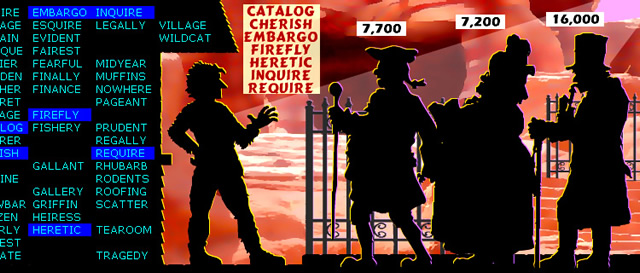
|