Temujin
|
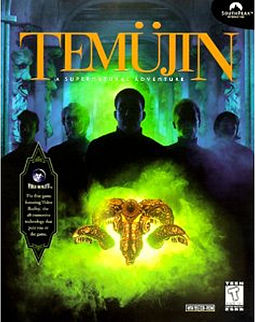
Temujin Developer: Southpeak By Craig White 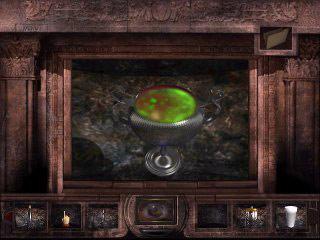 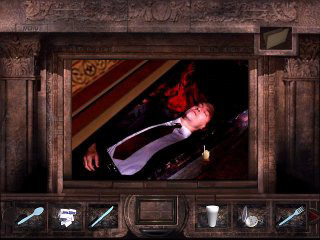 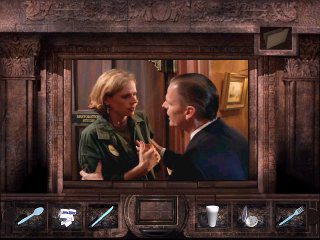 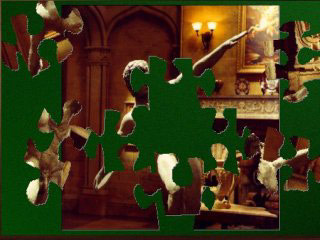 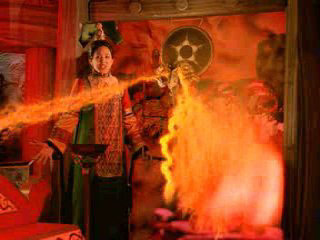 |
After spending two weeks in the deep halls of the Stevenson Museum, the building in which the entire game of Temujin is played, I’ve come to a conclusion: this game sucks.
When I first saw this game, I thought it would be cool. The graphics looked awesome and the name was unique, but once you actually get your hands on it, it’s not a pleasant experience. To start off, the interface in which you interact with the game environment is poorly designed and there are parts of the game that are nearly impossible to complete because of the slow, tedious interface (you will read more about this later).
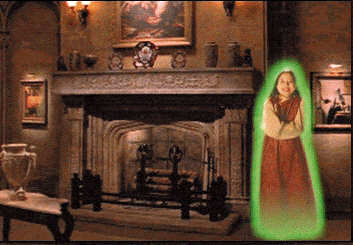
Character interaction is not controlled by you. You can’t choose what you say (because you don’t speak at all) or the topic of conversation. You do not know who you are until near the end of the game, therefore you don’t actually talk to the characters. If they are in a room you enter they will come up to you and talk, but you never reply to them and they almost always leave right after “conversation.” Often, they will poke fun at you because you do not speak.
Some of the characters designed into the game are very unbelievable. The entire museum staff seems to take control over the owner, and I have often wondered why he does not fire them! Crazy security guards and moody restoration artists … who needs to put up with them? If I ever have my chance in the seat of honor, I’d fire their butts!
Temujin is a game based mainly on being in the right place at the right time. The game won’t progress unless you’ve been to a certain location and run into a certain person first, with a few puzzles thrown in for bad measure. A few puzzles indeed. While there are not a lot of puzzles, the ones there are really difficult. The first puzzle you come upon on the first of the six-CD set requires you to measure an amount of water with various unmarked containers you’ve picked up along the way. You then must add a dash of this and a dash of that … and of course without a walkthrough or hint book you’d have no clue what’s going on!
Temujin’s inventory system is one of the poorest I’ve seen yet. None of the items are marked with a name, so you are left guessing what each is and what it does. Thankfully I had a hint book which had a complete listing of the inventory items with a picture beside them and the use and location where they were found. Without this, I would never have completed the first puzzle, and I’m sure many others may not have either (unless you count guessing, which is what I had to do even with the hint book).
Temujin has two good features: the jigsaw puzzles and the comic books. Now, I don’t much like putting together jigsaw puzzles, but in this case, they were fun. While not all of them are simple, they are fun and easy to put together. There is a big puzzle that needs to be put together to explain what’s going on. For this puzzle, pieces are scattered all over and appear in certain places at certain times. Other puzzles are found in the museum gift shop and in other areas. The gift shop puzzles are not required to be completed to win the game, but I thought they were fun, and they do give clues to other puzzles. The comic book sequences were very well done and put together. Multiple endings of the comic book allowed more playability and fun.
Another one of Temujin’s better features included the utilization of a memory system which begins after you’ve solved the Magic Book puzzle on the second disk. While searching the museum, you find memory objects for each character, four objects per character, which bind the story together. Once you’ve found all objects for everyone (this happens on the fifth CD) you actually begin to understand what’s going on in this crazy museum, and soon after, you realize who you are.
What really peeved me off was that I was unable to complete this game due to the poor interface (which I mentioned before). The end sequence is timed by a two-phrase chant by Xiao, the evil high priestess of Wah-Jin, in which you must put together two pieces of the broken Amulet and dunk it in blood to make it whole once more. By the time I turn around and pick up the two pieces of Jade and place them in the Amulet, she has already completed the chant and I am automatically cut into a scene in which she does some of her magic yadda yadda and I lose. I have tried this over and over more than 15 times, and each time I ended up with the same outcome. So, I hate to say, I have not successfully completed the game, and it’s all due to the stupid interface. Thanks a lot, Southpeak!
To sum it up, don’t buy this game! It is so poor and stressful that it is not worth a kick in the dirt. Maybe if the interface was buffed up and the plot was redone and the character interaction was improved and the inventory system was overhauled, this would be a better game, but I’d rather start from scratch on a new game and not bother. Better luck next time, Southpeak.
Final Grade: F