Review: Zork Nemesis
|
Zork Nemesis: The Forbidden Lands Developer/Publisher: Activision By Erik Reckase |
My first experience with the Zork universe was Zork I, when I was about ten years old. During my grade school and high school years, I probably played 90% of the text adventures that came out of Infocom, and I credit them for not only teaching me to type (some words, like “open” and “rezrov,” I can type faster than others–if you’ve ever played one of these games, you understand), but to reason as well. I’ve eagerly anticipated each new Zork release, and Zork Nemesis was no exception. I can say without a shadow of a doubt that Zork Nemesis is probably the best “pure” adventure game I’ve ever played, although some devoted Zork fans would strongly disagree with me, citing this episode’s dark atmosphere and (apparent) lack of humor. From the exquisite sound and graphics to the detailed materials supplied with the game, Zork Nemesis positively drips quality.
What’s Going on Here?
One of the great parts of ZN is the supplied materials. Included with the game is a small bound booklet, containing the journal and personal materials belonging to the deceased Karlok Bivotar, an agent for the Vice Regent Syovar the Strong. This archive details the efforts of Bivotar to locate four missing prominent citizens in the Forbidden Lands: Madame Sophia Hamilton, Bishop Francois Malveaux, Dr. Erasmus Sartorius, and General Thaddeus Kaine. All four of these individuals were last seen heading for the Temple of Agrippa, which is where you begin. The journal is a splendid backdrop for the game and not only provides an introduction to the main characters, but provides subtle clues that can help solve some of the more difficult puzzles in the game. By presenting the materials as a case file, it becomes easier to suspend disbelief and enjoy the story. In your explorations, you will visit the homes of each of the four missing persons in the search for clues regarding their disappearance. I won’t give away the plot details, as it twists and turns in a number of unexpected ways (even for experienced gamers like myself), but there are definitely some similarities between ZN and Myst that will be evident at the end of the game.
Overall Plot Grade: A+
How Did it Look?
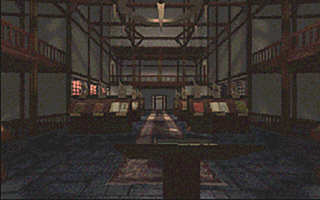
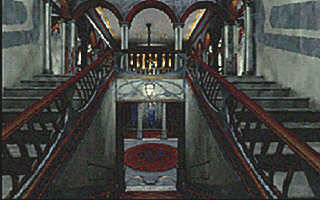
The graphics in ZN, although fairly advanced at the time of its release in 1996, are beginning to show their age. ZN uses the Z-Vision engine, allowing the player to experience the environment in a full 360-degree panorama. Although we take this for granted now, this was the first game I ever played with this sort of graphical presentation. While exploring, the graphics are ho-hum, with somewhat blocky details–but when examining an object or location closely, the graphics switch to a beautifully rendered, high-resolution scene, with the occasional high-quality animation.
There is also a significant amount of live-action video, inserted into the Zorkian world in a very believable fashion. As this sort of technology was reasonably new, these video sequences are highly compressed by eliminating every other line of the animated frames. There is some definite lack of detail, but since most of these video segments are flashbacks of a sort, it seems to fit the purpose; the resolution of our memories also fades with time. Overall, the graphics in ZN were exemplary four years ago and are still well above acceptable today.
Overall Graphics Grade: B+/A-
How Did it Sound?
ZN uses QSound extensively throughout the adventuring experience. For those of you unfamiliar with Qsound, it is a method of localizing sounds accurately between a pair of speakers to give the listener an added dimension of exploration. Numerous recording artists (Sting, for example) have used Qsound on their studio albums–and it makes a huge difference to semi-pro audiophiles like myself. In the game, when an object in front of you makes a noise, you feel as though you could reach out and touch it. I would recommend using headphones for this game, as some of the quieter ambient sounds and music might be hard to hear without them. Spectacularly creepy background noises, perfectly appropriate for each locale, accompany you on your journey.
The best part, however, of ZN’s sound is the voice acting. These are the most professional performances by actors/actresses in any adventure game, as far as I’m concerned. ZN is a perfect example of how proper voice acting can take a great game and push it into legendary status. These folks actually cared about this part of the game! (Pardon my excitement, but anyone who’s played adventure games for as long as I have knows how rotten acting positively ruins the suspension of disbelief.) This seems to be a trend in Zork games, as Zork: Grand Inquisitor is also superior in this area–but you’ll have to wait until I review that game to hear anything more …
Overall Sound Grade: A+
What About Them Puzzles?
From a purely logical perspective, the puzzles in ZN are not always very easy. In fact, some of them are downright difficult, as they involve clicking on things that you would not expect to be part of the solution; this is a consistent theme throughout the Zork series. The point is to experiment and see what happens. Sometimes nothing will happen, sometimes you’ll get the solution, and sometimes you’ll be treated to some of the funniest gameplay ever devised. There are all sorts of puzzles in ZN, from repeating a musical tone, to manipulating a corpse, to identifying and grouping alchemical symbols.
To those individuals who have played ZN and found it to be a significantly humorless departure from the historically comic series–I beg to differ. Playing it a second time, I found countless funny bits throughout the game, perhaps made even funnier by the fact that I’ve played all of the games in the Zork universe. (FYI–if you own the original text games, it’s a snap to install them on a Palm Pilot–if you need details, drop me a line.) Yes, I agree that the main plot’s subject matter is not a happy story, but there’s something funny just about everywhere you explore, and it’s that great subtle humor that seems to have been fading in popularity. For example, if you play an educational record about the makeup of a Zorkchestra backwards, you can hear someone saying “Paul is dead” and “redrum” over the static–what a classic. Take your time with this one, as it is definitely apparent that quality time was spent writing it.
Overall Gameplay/Puzzle Grade: A
‘Nuff said. Zork Nemesis is available as a three-CD set, and it can also be found bundled with the DVD release of Zork: Grand Inquisitor–if you haven’t played it, go buy it already! You owe it to yourself to play this classic.
(Note–this game actually played better on my old DX2-66 machine, as some of the animations are not scaled properly for processor speed. This may make a few of the puzzles fairly difficult. These problems may have been addresses in the DVD release, but I’m not making any promises. If you have difficulty, feel free to post questions on the JA+ bulletin board, and I’ll help you out as soon as I can.)
Final Grade: A
System Requirements:
PC:
100% IBM PC-compatible computer
486/DX2-66MHx processor
8 MB RAM
Double-speed CD-ROM drive
35 MD of uncompressed hard disk space
VESA local bus or PCI video card with 1 MB of RAM
16-bit high-color SVGA (640×480)–thousands of colors
100% Microsoft-compatible mouse and driver
100% Sound Blaster 16-compatible sound card (for digital and general MIDI audio)Macintosh:
Power PC
System 7.5.1
2X CD ROM drive
16 MB RAM (8 MB free)
35 MB free hard disk space
Thousands of colors
13″ monitor
Sound Manager 3.1