Review: Under a Killing Moon
|
Under a Killing Moon Developer/Publisher: Access Software By Ray Ivey 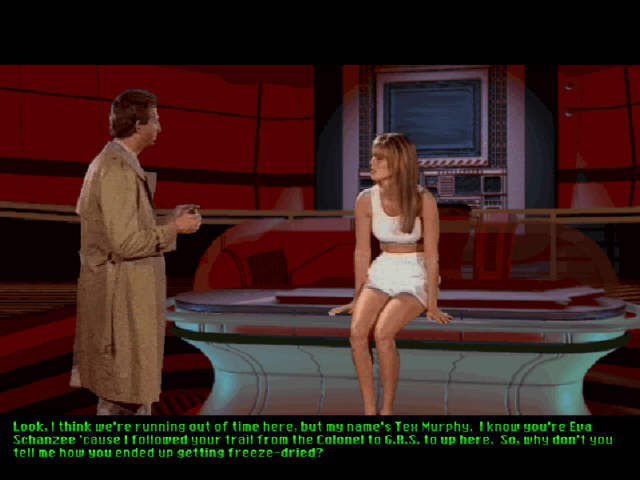 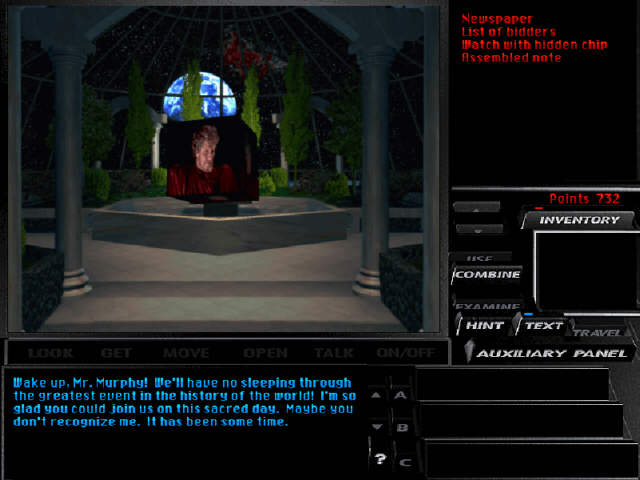 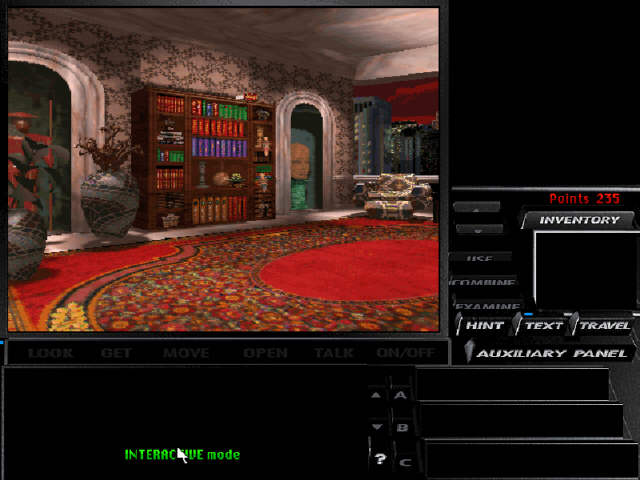 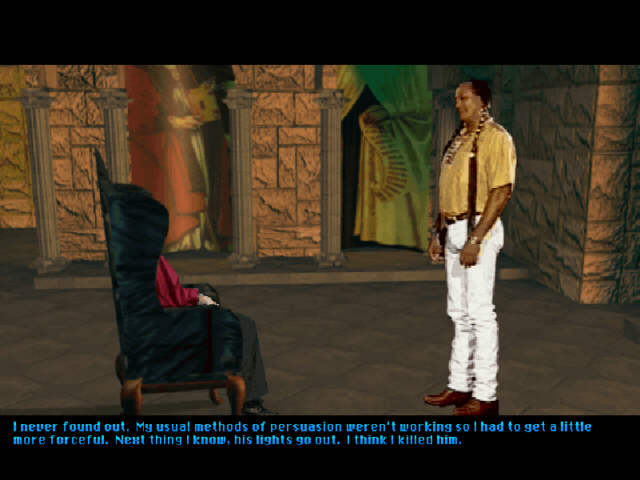 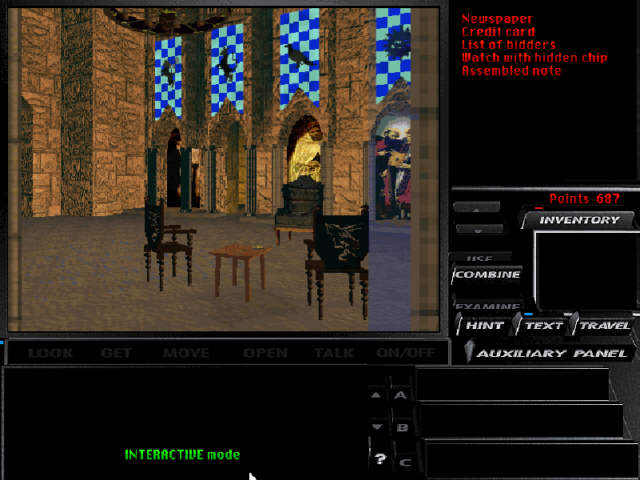 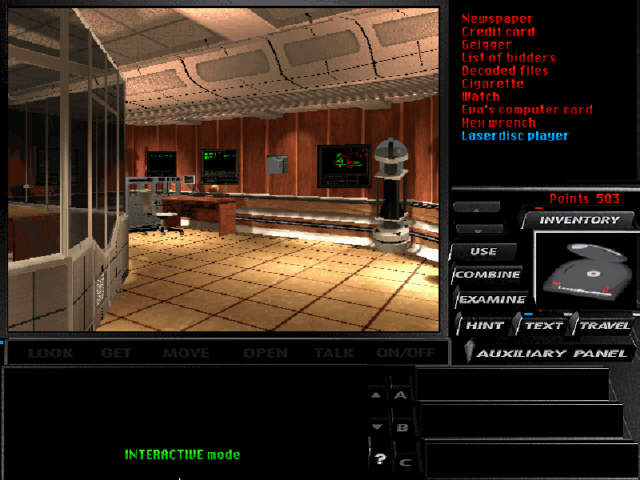 |
After playing almost 90 games, I finally decided I couldn’t ignore the Tex Murphy games any longer. Since I began playing adventure games, my friends have impressed upon me how much they enjoy this series. The series consists, so far, of five games. However, the last three are much more well-known than the first two and are similar enough in format to be thought of as a trilogy. So for the purposes of this review, I’m going to think of Under a Killing Moon as the “first” game, even though technically it’s the third.
I’ve been resisting UAKM for a couple of reasons. First of all, it’s DOS, and loading DOS games on my newfangled computer is a risky proposition at best. Second, it’s a multi-disk DOS game, which just seems weird to me. Finally, I was truly put off by the huge manual. It’s like an encyclopedia! I’m of the school that thinks an adventure game should be so intuitive that I should just be able to load and play.
Last week, however, I got a wild urge to give ol’ Tex a try. I screwed up my courage and tossed the first disk into my disk drive …
Love at First Sight
… and fell promptly, deliriously, totally in love.
First of all, the game installed beautifully. Not only that, but the game offered a wealth of setup options that were clear, comprehensive, and helpful. A pile of welcome choices on one big, easy screen–from screen size to subtitles to hints to sound. Included on this screen was a configuration option I can’t believe I’ve never seen on any other game: it actually let me take advantage of the fact that I have more than one CD drive! I assigned two disks to drive D: and the other two to drive E:, thereby cutting disk swapping chores in half. Why don’t all games offer this?!
Next we have to talk about the interface. Typical of many Myst babies, I generally prefer a simple point-and-click interface. I get quickly suspicious when things get more complicated. Considering that, you’d think I would have hated UAKM’s fairly busy, complex interface. Not so. Full of pop-up menus with choices dealing with conversation, inventory management, saving games, navigation, etc., the interface is very friendly and feels like a box full of helpful tools to solve the mystery, not an impediment to game enjoyment. The whole set-up gave me a wonderful roll-up-the-sleeves feeling.
The graphical format of the game is an odd hybrid of real-time 3D and full motion video. These two formats actually provide the two separate “modes” in which you play UAKM: “travel mode” and “interactive mode.” In travel mode, you have the ability to move around in a fully real-time rendered, 100-percent explorable environment. Whenever you want to interact with someone or something, you switch to interactive mode and work with elements on a static screen. Bouncing between the two modes is accomplished with ease and was second-nature minutes into gameplay. You can size the viewing screens to best work with your own equipment, and I very successfully used a full screen for travel mode.
A Marriage Made in Heaven
As I’ve said repeatedly, and will continue to say, the detective genre is one of two types of stories that are absolutely, perfectly, excruciatingly appropriate material for adventure games (the other, or course, is horror). The conventions of a whodunit and the mechanics of an adventure game mesh beautifully, and the glow of this happy synergy fills this entire game with a bright, happy light.
For those few of you who, like me, haven’t already played all of these games, let me just tell you that Tex Murphy is a down-on-his-luck private dick in a mid-21st century San Francisco that has been largely destroyed by WWIII. Humanity is now divided into two classes: people with natural immunity to radiation mutation (the minority) and people who have suffered severe genetic mutation and disfigurement.
Tex is one of the lucky ones, but many people that he meets have some nasty disfigurements.
The game is divided up into six chapters, or days (actually there is a seventh, but it’s a noninteractive finale). The first day is a warm-up, an entertaining catch-the-robber escapade that serves as a good training sequence for the mechanics of the game. The true case begins on day two, and you know what? I’m not going to give one single part of it away. Just trust me; it’s fun, imaginative, and fairly ambitious. The story was compelling enough that I never wanted to stop playing.
As in other detective games, the more you explore, the more environments are opened up to you. You wend your way through various San Francisco locations and eventually even to two “off-world” locations.
Welcome to the Happy Land of Good Game Construction
This game is full of elegant touches. I’ll talk about just two of them. As in many games, in UAKM you have to do a certain amount of inventory manipulation, including combining items and offering items to other characters. These tasks are handled with great visual flair and ease, which made playing with inventory a fun exercise rather than a laborious chore.
I also have to mention the chapter title screens. They are simply the best I’ve ever seen in a game. They’re better even than the chapter titles in GK1, which were my favorite until now. The pleasure and satisfaction of completing each chapter was even greater knowing I’d get to watch one of these cool chapter markers again.
Dialog in the game is excellent, and many times finding the correct conversational path is a puzzle in itself.
The puzzles in the game are adequate but not inspirational.
The Worst Game Acting Since Christopher Walken in Ripper
The game does have one very big downfall, I must admit. The acting is simply atrocious. I believe Access actually used employees as cast members, and it just stinks. Even the lead actor, Chris Jones (actually Access Software co-founder), is terrible. This blow would be softened if he was dreamy to look at, but he’s, uh, not. I’ve heard he gets better as the series progresses. We’ll see.
There are two famous actors thrown into the mess, Brian Keith and Margot Kidder, and they both acquit themselves professionally, thank God.
All this bad acting in a game that is so character-driven and full of dialog would sink a lesser game. It’s not enough to kill the sense of fun in UAKM, however, and I played the entire game with a stupid grin of pleasure on my face. It’s the kind of game that makes me feel sorry for all those misguided people who don’t play adventure games.
As superb as the other elements of this game were, the terrible acting brings the final grade down to a B.
If you liked Under a Killing Moon,
Watch: Trancers (1985)
Read: The Little Sister by Raymond Chandler
Play: Gabriel Knight: Sins of the Fathers
System Requirements: 386/25 MHz Processor or better
MS-DOS
4 MB RAM
SVGA display (VESA compliant)
Sound card (supports all major sound boards)
2X CD-ROM drive
8 MB available hard disk space
Keyboard/mouse/speakers